
Introduction
Cleaning large surfaces is rarely glamorous, yet it is an essential part of maintaining a healthy home or business. Driveways darken with oil stains, patios grow slick with algae, farm equipment and vehicles accumulate baked‑on mud, and outdoor furniture collects pollen and mildew. In the past, homeowners were limited to a garden hose or hired a professional with a gas‑powered pressure washer. Gas models offer great power but are loud, heavy and emit fumes. Battery‑powered units solve some issues but often compromise on performance and run time. The Greenworks 60 V hybrid 3000 PSI pressure washer promises to bridge that gap by blending two power sources in one machine. This hybrid design gives users corded reliability when an outlet is available, plus cordless freedom for off‑grid cleaning tasks.
This review explores the features, specifications, setup, operation, performance, maintenance and environmental impact of Greenworks’ 60 V hybrid pressure washer. We’ll analyse real‑world use cases and compare its capabilities to traditional electric and gas models using data from reputable sources. We’ll also answer frequently asked questions to help you determine whether this premium washer meets your needs. Throughout this article, you’ll find citations from industry publications, product manuals and independent tests to support the claims made.

Understanding pressure washer metrics: PSI, GPM and cleaning units
Before diving into the product itself, it helps to understand how pressure washers are evaluated. Three primary metrics determine cleaning performance: PSI (pounds per square inch), GPM (gallons per minute) and cleaning units. PSI measures how much force the water exerts when it leaves the nozzle; higher pressure can break bonds between dirt and the surface. GPM measures how much water flows through the system; a higher flow rate rinses away loosened debris faster. Cleaning units are calculated by multiplying PSI by GPM, giving a simple figure that compares the overall power of different machines. For example, a washer that delivers 3 000 PSI at 1.1 GPM has 3 300 cleaning unitspdf.lowes.com.
Typical pressure ranges and water use
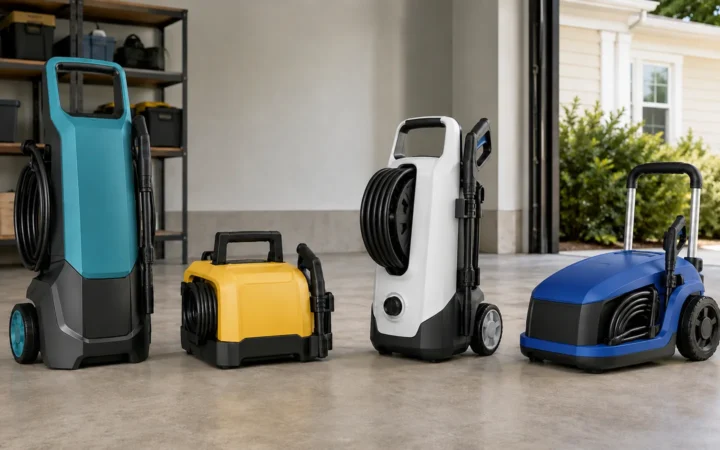
Pressure washers fall into broad categories based on output. Gas units typically produce between 2 500 and 4 000 PSI with 2.5–4 GPM of water flow. These machines are the choice for heavy‑duty work such as stripping paint or cleaning concrete. However, they are noisy (often up to 100 dB)medium.com, require fuel and oil, and emit exhaust fumes. Electric models usually deliver 1 500–3 000 PSI and 1.5–2.5 GPM. They are quieter (around 78–80 dB) advantageproservices.com, lighter and require little maintenance. Hybrids like the Greenworks 60 V use a brushless electric motor but can run on AC power or batteries, putting them at the top end of the electric category.
One misconception about pressure washers is that they waste water. In reality, they are far more efficient than garden hoses. According to HVAC Shop’s guide, pressure washers use 2–4 GPM while a standard garden hose outputs roughly 24 GPM, resulting in an 80 % reduction in water consumptionhvacshop.com.au. Using a washer not only cleans better but also conserves a significant amount of water—a crucial factor during droughts or in areas with water restrictions.
Electric vs gas: usability, cost and environmental considerations
Choosing between electric and gas pressure washers involves trade‑offs. Electric machines are easy to start—simply plug them in and pull the trigger—and they are lighter, quieter and emission‑free. Gas units deliver more power but require fuel, engine maintenance and produce more noise. Hybrids like the Greenworks 60 V aim to combine the convenience of electric washers with gas‑like performance.
Hybrid technology seeks to combine the strengths of both categories. With a brushless motor and high‑capacity lithium batteries, a hybrid washer can produce gas‑like power without fumes. It still plugs into an outlet for unlimited run time but also runs cordless for remote cleaning. This flexibility, combined with lower noise and easier maintenance, is the key selling point of the Greenworks 60 V hybrid reviewed here.
The 60 V hybrid advantage: features and specifications
Greenworks markets its 60 V hybrid 3000 PSI pressure washer (sometimes labelled PW3000HYB) as the most powerful electric pressure washer available. Its hybrid power system allows it to switch seamlessly between corded and cordless modes. Below, we analyse each feature in detail and explain how it impacts your cleaning experience.
Power and flow
At the heart of the machine is a brushless electric motor. When powered from the narrowest nozzle, the washer delivers 3 000 PSI at about 1.1 GPMprotoolreviews.com. Switching to the wide soap nozzle increases water flow to 2.0 GPM while dropping pressure, perfect for applying detergent and rinsing large areas. The Eco mode reduces output to 2 200 PSI and 1.0 GPM. Reducing both pressure and flow extends battery life while still providing enough force for light cleaning like washing cars or outdoor furniture.
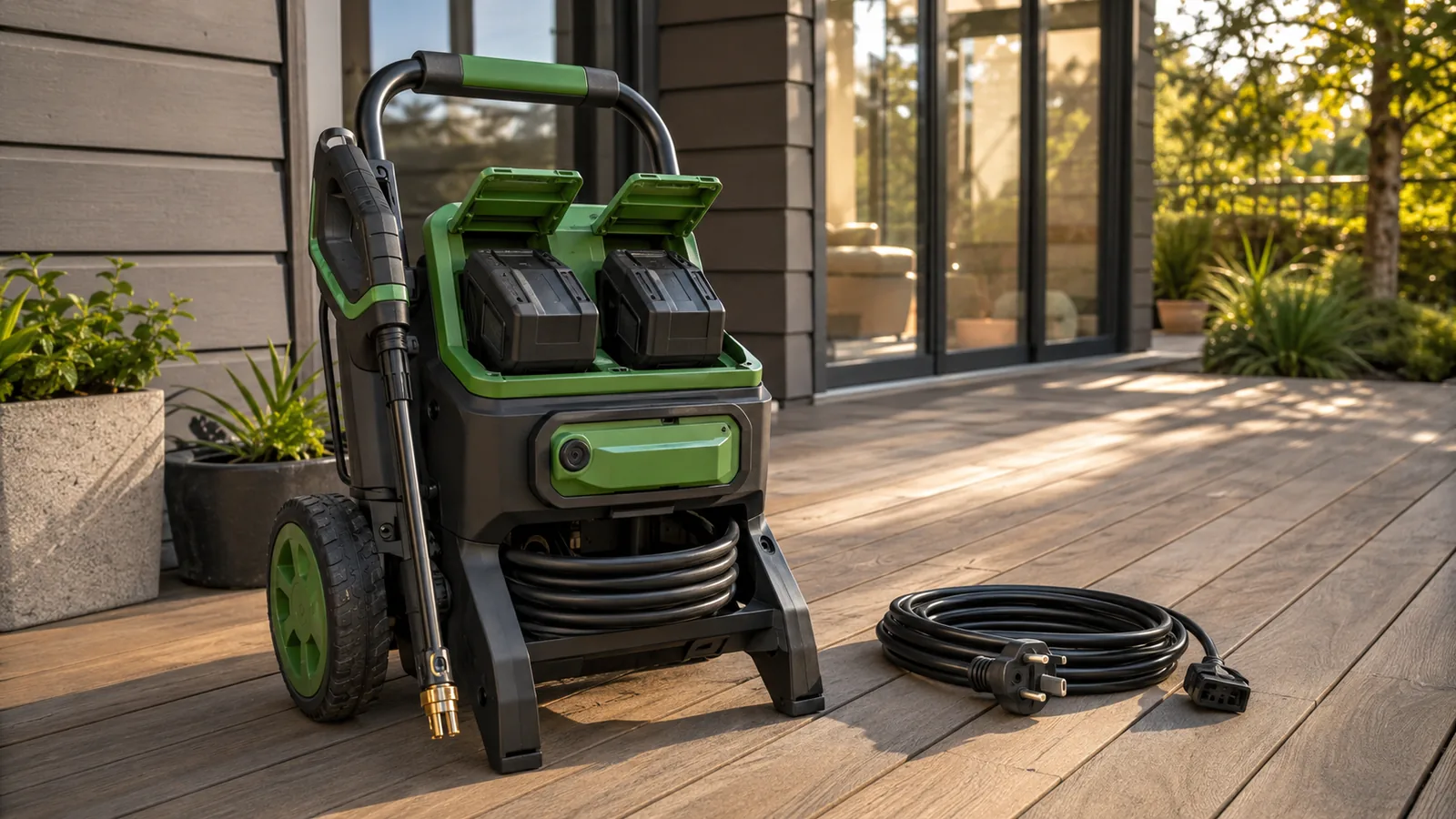
The hybrid machine runs on either two 60 V batteries or AC power. On battery power it offers roughly 18 minutes of full‑pressure cleaning and about 25 minutes in Eco mode. A self‑priming siphon hose lets you draw water from buckets or barrels when a tap isn’t available. Despite its high output, the washer operates at about 68 dB and rides on a steel frame with 10‑inch wheels, a 25‑foot kink‑resistant hose and on‑board storage for nozzles and the spray wandgreenindustrypros.com. Greenworks backs the tool with a four‑year warranty and ten‑year motor warranty; the machine weighs around 47 lb (21 kg), making it portable yet sturdy.
Specifications table
Feature | Specification |
Maximum pressure | 3 000 PSI |
Water flow | 1.1 GPM at narrow nozzle; 2.0 GPM with soap nozzle |
Eco mode output | 2 200 PSI, 1.0 GPM |
Power sources | AC 120 V corded or two 60 V batteries |
Noise level | ≈ 68 dB |
Hose length | 25 ft kink‑resistant |
Wheel size | 10 in never‑flat wheels |
Weight | ≈ 47 lb |
Cleaning units | 3 300 CU |
Warranty | 4 years tool, 10 years motor |
Run time | 18 minutes full power, ≈ 25 minutes Eco |
Unboxing, setup and basic operation
Greenworks includes everything necessary to begin cleaning immediately. In the box you’ll find the main unit, a detachable handle, a 25‑foot high‑pressure hose, two 60 V batteries with a dual‑port charger, a siphon hose, a detergent tank, five quick‑connect nozzles (15°, 25°, 40°, soap and turbo), a spray wand, mounting hardware and an owner’s manual. Assembly takes about 10–15 minutes: slide the handle into place, snap on the accessory holders, connect the hose and spray wand, insert the detergent tank, and plug in or install the batteries. Always inspect the inlet filter for debris and read the manual for safety information. The manual confirms the machine’s 3 000 PSI and 1.1 GPM technical datapdf.lowes.com
Operating the washer is equally straightforward. Clear your workspace, connect a garden hose or the included siphon hose to a clean water sourceprnewswire.com, and choose whether to run on AC power or battery. Prime the pump by squeezing the trigger until water flows, then select High (3 000 PSI) or Eco (2 200 PSI) on the control dial and attach a nozzle suited to your task. Keep the wand roughly a foot from the surface and adjust distance or nozzle size as needed. To apply detergent, attach the soap nozzle and draw from the built‑in tank; switch to a rinse nozzle afterwards. When finished, turn off power, squeeze the trigger to release pressure, disconnect hoses and allow water to drain. For winter storage, run pump protector or antifreeze through the machine and store the unit and batteries in a dry, temperature‑controlled space.
Performance: real‑world impressions
Laboratory specifications are useful, but how does the Greenworks hybrid perform on real jobs? Independent reviewers and homeowners have put it through its paces on driveways, decks, vehicles and even farm equipment. Several themes emerge:
- Concrete and brick cleaning: At full power with the 15° nozzle, the machine easily strips away built‑up dirt, oil stains and mildew from concrete driveways and brick patios. The turbo nozzle covers large areas quickly but leaves a visible spiral pattern; for uniform finish, follow up with the 25° nozzle. Because the washer produces up to 3 000 PSI, it tackles stubborn grime similar to gas units but with lower noiseprotoolreviews.com.
- Deck and fence washing: In Eco mode with the 25° or 40° nozzle, the washer lifts algae and dirt from wood decking without gouging the surface. Homeowners appreciate the ability to adjust pressure and protect softer materials. The 25‑foot hose and large wheels make it easy to navigate around the deck without moving the unit frequently.
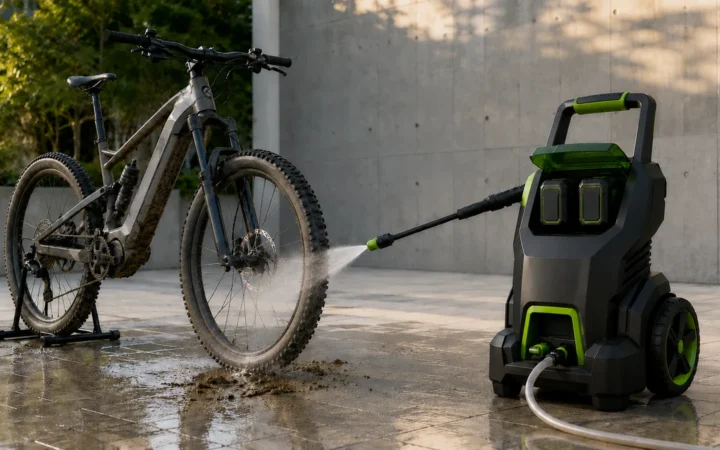
- Vehicle and equipment detailing: The included soap nozzle and detergent tank allow pre‑soaking cars, trucks, RVs or tractors. After letting the soap dwell, users switch to the 40° nozzle to rinse off road grime and bugs. Because the machine runs quieter than most competitors (~68 dB), it can be operated in residential areas without disturbing neighboursprnewswire.com.
- Remote locations: The hybrid design shines when cleaning remote structures like docks, cabins or farm gates. Using the self‑priming siphon hose, users draw water from a barrel and run the machine on battery power. Although the cordless runtime is limited to 18–25 minutes, this is plenty for spot cleaning or small projects.
While performance reviews are overwhelmingly positive, there are minor complaints. Some users note a slight delay—about one to two seconds—between pressing the trigger and the pump reaching full pressure. This phenomenon is common with electric and hybrid washers because the pump spins up after the trigger is engaged. Others mention that the battery run time may not cover a large driveway or house siding in one session, requiring either multiple battery sets or switching to corded mode.
Choosing nozzles and cleaning techniques
Selecting the right spray tip and technique maximises cleaning efficiency while protecting surfaces. Narrow‑angle tips like 15° concentrate pressure for stubborn grime on concrete or brick. Mid‑range 25° tips balance power and coverage, while 40° tips produce a gentle fan for rinsing siding, vehicles or outdoor furniture. A turbo nozzle rotates a pinpoint jet to cover large flat areas quickly but may leave a visible pattern. Use the soap tip to draw detergent from the tank. Maintain at least a foot of distance from the surface and test in an inconspicuous spot; you can move closer or change tips if more power is needed. On softer materials, select Eco mode and a wide nozzle to avoid damage. Apply detergent from the bottom up and rinse from the top down. Wear protective eyewear and closed shoes and keep children and pets away.
Maintenance, environmental impact and comparisons
Because the Greenworks hybrid has no engine oil, air filter or spark plug to serviceadvantageproservices.com, upkeep is straightforward. After each session, release pressure, disconnect and drain the hoses, and rinse the inlet filter and detergent tube to clear debris and soap. Periodically add pump‑protectant or RV antifreeze to safeguard the pump during winter storage, and store lithium‑ion batteries indoors at moderate temperatures. A quick inspection of hoses, O‑rings and screws before each use helps catch wear and prevent leaks or loose components.
The washer is environmentally friendly and cost‑efficient. It uses only 1–2 GPM of water versus around 24 GPM for a garden hose, saving hundreds of gallons over a typical project. Running on electricity or batteries produces zero exhaust emissions and keeps noise around 68 dB, much lower than gas models that can exceed 100 dB. Although the kit costs about US$650, its long warranty, shared‑battery system and low operating costs often make it cheaper to own over time than a comparably powerful gas washer.
In terms of performance, the hybrid’s 3 000 PSI and up to 2.0 GPM place it at the top of the electric class and overlap with light‑duty gas machines. Typical electric washers deliver 1 500–2 300 PSI and 1.5–2.0 GPM, while light‑duty gas models offer similar cleaning units but at the cost of noise, fumes and maintenance. Other Greenworks models, like the GPW3002 or Pro 3000 PSI corded units, deliver similar pressure but lack the hybrid’s battery‑powered portability and self‑priming siphon. Competing washers such as the Ryobi RY143011 match the 3 000 PSI rating but are corded only and cannot draw water from a bucket. These differences make the Greenworks hybrid unique in its category.
Pros and cons summarised
Pros
- High performance: 3 000 PSI and up to 2 GPM allow the hybrid washer to tackle tough jobs.
- Hybrid power: Switch between corded and battery use depending on the job and location.
- Quiet operation: At about 68 dB, it is quieter than most electric models and much quieter than gas.
- Self‑priming siphon: Draws water from any clean source, expanding where the washer can be used.
- Long warranties: Four‑year tool and ten‑year motor coverage provide peace of mind.
- Water savings: Uses significantly less water than a garden hose.
Cons
- Premium price: The kit costs around US$650, putting it at the high end of consumer washers.
- Limited cordless runtime: 18–25 minutes of battery operation may require spare batteries or switching to corded mode.
- Trigger delay: A brief delay before full pressure builds can feel unusual.
- Weight: At roughly 47 lb, it is heavier than entry‑level electric models.
Frequently asked questions
Why choose a hybrid pressure washer?
What is the battery runtime, and can it be extended?
Is 3 000 PSI safe for vehicles and wood?
What maintenance does it require?
How do PSI, GPM and cleaning units affect cleaning ability?
Will 3 000 PSI damage delicate surfaces?
How do I maximise battery life?
What maintenance does the hybrid require?
Can I use extension cords with the washer?
Is it possible to upgrade to higher GPM?
FrediTech Resources
To expand your knowledge on pressure washers, explore these FrediTech articles:
- Electric vs. Gas Pressure Washers: The Ultimate Guide for Homeowners – compares performance, maintenance and environmental impact.
- Ultimate Pressure Washer Maintenance Guide – details a comprehensive maintenance routine, including step‑by‑step instructionsfreditech.com.
- Best Pressure Washers for Home Use – to find the most reliable and efficient models.
- Ryobi Pressure Washer – discovers the ultimate guide to power, performance, and value
Conclusion
The Greenworks 60 V hybrid 3000 PSI pressure washer showcases how far electric tools have come. By combining corded and battery operation, it delivers cleaning power that rivals small gas washers without sacrificing convenience or sustainability. With 3 000 PSI, up to 2.0 GPM flow, a self‑priming siphon hose, quiet operation around 68 dB and long warranties, it addresses nearly every drawback of traditional electric models. The premium price and limited cordless run time are its main downsides, but for homeowners who need both power and portability, the hybrid offers significant value.
Properly assembled, used and maintained, this pressure washer will handle driveways, decks, vehicles and off‑grid projects for years to come. By conserving water and eliminating emissions, it’s a cleaner way to clean—proof that green technology can provide robust performance without compromise. This hybrid stands apart from typical electric models thanks to its dual‑power flexibility, high pressure and long warranties. It’s a compelling choice for homeowners seeking reliable cleaning performance.
About the Author
Wiredu Fred is a technology writer for FrediTech. He specialises in analysing home improvement tools and energy‑efficient equipment, bringing readers deep insights into how today’s gadgets improve everyday life.