

Introduction
Modern living often involves commuting in a car and working at a desk. Both spaces quickly accumulate dust, crumbs and pet hair, yet cleaning them with a full‑sized vacuum is inconvenient. Enter the handheld mini vacuum—a compact, cordless tool designed to deliver quick, targeted cleaning wherever you need it. Demand for portable vacuums has grown rapidly; research firm Mordor Intelligence notes that the handheld vacuum market is expected to register a CAGR of 8.54 % between 2025 and 2030mordorintelligence.com. Sales surged during the COVID‑19 pandemic as people spent more time at home and invested in cleaning devices. Another report on stick vacuums highlights similar trends: the global stick vacuum market was US $4.23 billion in 2025 and is projected to reach US $7.53 billion by 2034, driven by demand for lightweight, space‑saving appliances suited to small homesfortunebusinessinsights.com. Many consumers prefer cordless models because they are more energy‑efficient than corded vacuums (they draw power only during charging) and cater to busy households that value convenience and mobility.
In this guide you’ll learn how handheld mini vacuums work, what features matter most, which models stand out in independent testing and what pitfalls to avoid. We’ll also provide step‑by‑step cleaning tips for cars and desks, address frequently asked questions and link to related guides on FrediTech for deeper smart‑home insights.
Understanding Handheld Mini Vacuums
How do handheld mini vacuums work?
Mini vacuums are scaled‑down versions of full‑size vacuums. Most models are cordless and powered by rechargeable lithium‑ion batteries. They draw air through a small nozzle, use a motor to create suction and capture debris in a removable dustbin. Because there’s no bulky housing or long hose, they’re designed for one‑handed operation, making them ideal for tight spaces like car interiors, keyboards, craft tables and drawers. Many units include attachments—such as crevice tools, soft brush heads or motorized pet‑hair brushes—to handle different surfaces.
Key specifications and what they mean
When comparing handheld vacuums, look for the following specifications:
- Suction power (Pa or air watts): Higher suction means the motor can lift heavier debris. Premium handhelds may exceed 1,000 pascals (Pa), while entry‑level models often stay around 500 Pa.
- Runtime and battery type: Lithium‑ion batteries offer more consistent power and longer life than nickel‑cadmium cells. Runtime on a single charge ranges from about 13 to 30 minutes. Lab testing by TechGearLab found runtimes of 14.7 minutes for the Shark UltraCyclone Pet Pro Plus and 13.7 minutes for the budget Black + Decker HHVI315JO42, while the Black + Decker Furbuster AdvanceClean+ lasted 29.1 minutestechgearlab.com.
- Weight and ergonomics: A lighter vacuum reduces hand fatigue. Weights in lab tests ranged from 2.2 pounds for the HHVI315JO42 to 3.3 pounds for the Furbuster.
- Dustbin capacity: A larger bin means fewer trips to empty it. Capacities ranged from 0.43 litres for the Shark UltraCyclone to 0.68 litres for the Furbustertechgearlab.com.
- Filtration: Many handhelds use washable foam filters. If you have allergies, choose a model with a HEPA filter.
- Attachments: A slim crevice tool helps reach between car seats; a motorized brush lifts pet hair; a soft brush cleans keyboards.
Why go handheld?
- Portability: Lightweight, cordless units can be carried anywhere. They’re perfect for cars, where there’s often no power outlet, and they store neatly in a glovebox.
- Energy efficiency: Handheld cordless vacuums draw power only during charging and not when idle, making them more energy efficient than corded alternatives. They’re also ideal for small apartments and office desks where plugging in a full‑size vacuum is impractical.
- Rapid clean‑ups: It’s easier to pick up crumbs, pet hair and dust immediately rather than allowing debris to accumulate. Keeping small spaces clean reduces allergens and improves indoor air quality.
Market Trends: Why Portable Vacuums Are Booming
Global vacuum sales reflect a shift toward compact, cordless cleaning. The handheld vacuum market is projected to grow at 8.54 % CAGR from 2025–2030mordorintelligence.com. COVID‑19 lockdowns accelerated adoption as more people cleaned their homes and cars themselves. The stick vacuum segment, which shares technology with mini vacuums, generated US $4.23 billion in revenue in 2025 and is expected to expand to US $7.53 billion by 2034fortunebusinessinsights.com. Consumers value space‑saving designs that fit into small apartments, condos and dorm rooms. Cordless models comprised 79.72 % of the stick vacuum market in 2026, underlining the shift away from corded devices.
Rising urbanization and a growing working population mean people have less time to tidy up with bulky vacuums. Many households now prioritise energy‑efficient cleaning appliances, with surveys showing that 87 % of Americans in 2025 believe new home appliances should meet minimum efficiency standards. Manufacturers are responding by integrating smart sensors, app connectivity and convertible designs into portable vacuums.
How to Choose the Right Handheld Mini Vacuum
Before spending your money, evaluate your needs against these criteria.
1. Identify your primary use case
Do you need a vacuum mostly for car cleaning, for desk and keyboard cleaning or for both? Car vacuums typically require stronger suction and larger bins to pick up gravel, pet hair and heavier debris. Desk vacuums are smaller, focusing on fine dust, crumbs and keyboard crevices. If you plan to use a single unit for both, choose a model with adjustable suction and a variety of attachments.
2. Check suction power and motor design
A powerful motor is essential for lifting dirt embedded in car upholstery. Entry‑level mini vacuums may provide around 2,000–3,000 Pa of suction, while premium models can exceed 10,000 Pa (e.g., certain robot vacuums). Unfortunately, many manufacturers don’t list Pa ratings for handhelds. Instead, look for reviews that test performance: TechGearLab noted that the Shark UltraCyclone Pet Pro Plus removed most debris and pet hair during testing despite its modest runtime, while the budget Black + Decker HHVI315JO42 still delivered decent pickuptechgearlab.com.
3. Assess battery life and charging method
Battery life dictates how long you can clean before recharging. Short runtimes (≤15 minutes) suit quick spills, whereas cars with lots of pet hair may require 20–30 minutes. The Black + Decker Furbuster runs for 29.1 minutes, almost double the runtime of the Shark. Consider how the battery charges: some units use a detachable battery that can be swapped or charged separately; others charge via USB‑C or a wall cradle. A detachable battery ensures your vacuum isn’t out of commission while charging.
4. Consider weight and ergonomics
Mini vacuums should be comfortable to hold. Models under 3 pounds are easier to maneuver in tight spaces and less fatiguing for extended use. The Black + Decker HHVI315JO42, at 2.2 lbs, is lighter than the 3.3‑lb Furbuster. Balance also matters; vacuums with the motor near the handle often feel lighter even if the overall weight is higher.
5. Examine dustbin size and ease of emptying
Frequent emptying interrupts cleaning. A larger bin—around 0.6–0.7 litres—can hold enough debris for a full car cleaning. TechGearLab noted that the Shark UltraCyclone’s 0.43‑litre bin filled quickly, requiring multiple trips to the trash. Look for a one‑touch emptying mechanism that keeps your hands away from the dirttechgearlab.com.
6. Look for HEPA filtration and sealed systems
A HEPA filter traps fine particles like pollen and dust mites, which is crucial if you suffer from allergies. While some mini vacuums use washable foam filters, spending extra on HEPA filtration protects your indoor air quality. Check if the vacuum has a sealed system, ensuring that dusty air doesn’t leak out before reaching the filter.
7. Evaluate attachments and accessories
Versatile attachments make one vacuum suitable for many tasks:
- Crevice tool: A long, narrow nozzle for reaching between car seats or keyboard rows. TechGearLab praised the slim crevice tool on the Shark UltraCyclone because it fits tiny crackstechgearlab.com.
- Brush nozzle: A soft brush lifts crumbs and dust from dashboards, vents and keyboards without scratching.
- Motorized brush: Great for pulling pet hair from carpets and upholstery. The Furbuster’s rubber bristles effectively catch fur.
- Flexible hose: Useful for reaching under seats or behind monitors.
8. Check noise level
Most handheld vacuums are louder than you’d expect because small motors spin at high RPMs. Loud units may disturb coworkers or sleeping children. Reviews sometimes mention decibel levels; consider models that balance power and quiet operation.
9. Evaluate warranty and customer support
Portable vacuums endure rough handling—being dropped on the garage floor or tossed in a backpack. A good warranty (at least one year) and readily available replacement filters and batteries ensure longevity.
Best Picks: Lab‑Tested Handheld Vacuums
Independent lab testing helps cut through marketing claims. The following models were among the highest‑rated handheld vacuums in TechGearLab’s 2026 tests. Each offers a different balance of price, performance and features.
Shark UltraCyclone Pet Pro Plus – Best Overall for Cars and Pet Hair
- Performance: TechGearLab named this model its best overall handheld vacuum, highlighting its ability to remove pet hair and debris from carpets and upholstery. A motorized pet‑hair tool and crevice tool come standardtechgearlab.com.
- Specifications: It weighs 2.8 lbs and runs for about 14.7 minutes at full power. The dustbin holds 0.43 litres, so you’ll need to empty it frequently.
- Pros: Powerful suction for a handheld; great for pet hair; compact and balanced; slim crevice tool fits tight car cracks.
- Cons: Short runtime limits extended car cleaning; small dustbin; can be pricey compared to basic models.
- Ideal for: Car owners with pets, apartment dwellers who need a versatile handheld, and anyone seeking strong suction in a small package.
Black + Decker HHVI315JO42 – Budget Pick for Quick Clean‑ups
- Performance: This vacuum is praised as the best budget handheld because it cleans effectively without breaking the bank. It comes with a flip‑up brush and crevice tool.
- Specifications: Weight 2.2 lbs and runtime 13.7 minutes. Dustbin capacity 0.61 litres.
- Pros: Affordable price; good suction for crumbs and light debris; slim crevice tool; brush attachment helps pick up hair.
- Cons: Very noisy; struggles with pet hair and large debris; filter needs frequent tapping to remove hair; runtime is short.
- Ideal for: Students, budget‑conscious shoppers, or those who need a second vacuum for occasional use on desks, countertops or car seats.
Black + Decker Furbuster AdvanceClean+ – Best for Pet Hair & Long Runtime
Performance: TechGearLab crowned the Furbuster AdvanceClean+ the best for pet hair thanks to its powerful suction and rubber bristles that catch fur.
Specifications: It weighs 3.3 lbs and features an exceptional 29.1‑minute runtime. The dustbin capacity is 0.68 litres.
Pros: Extended runtime; excellent pet‑hair pickup; larger dustbin; two power levels.
Cons: Heavier and bulkier; crevice tool is large and awkward for narrow spaces; hair wraps around the filter, requiring frequent cleaning.
Ideal for: Pet owners who need longer cleaning sessions; users who value a generous dustbin; those who don’t mind a bit of extra weight.
Other Noteworthy Models
Although we don’t have lab‑test citations for every model, many reviewers and users praise the following vacuums for specific scenarios:
- Dyson Car+Boat: Known for powerful suction, HEPA filtration and a car accessory kit. It includes several attachments and runs on Dyson’s 12 volt car plug or wall charger. Its premium price reflects the Dyson brand’s innovation and warranty support.
- Worx 20 V Cube Vac (WX030L): A compact cube‑shaped vacuum with a handle, two power modes and a flexible hose. It is popular for its portability and easy one‑touch emptying. Battery life is around 10–15 minutes on high and 25 minutes on low.
- Ofuzzi H9 Pro: This sleek handheld vacuum offers strong suction and a run time of about 14–30 minutes, depending on power setting. Its accessories include a crevice tool and brush nozzle, and it charges via USB‑C. Reviewers appreciate its balance of power and price.
If you’re interested in broader floor‑cleaning solutions, FrediTech’s comparison of robot vacuums versus vacuum‑mop combos explains how autonomous cleaners are evolving. Our guide to cordless stick vacuums for small apartments examines lightweight uprights and offers additional product suggestions.
Mini Vacuums for Desks: Keeping Your Workspace Crumb‑Free
While car vacuums can handle desks, tiny desk‑specific vacuums offer unique advantages. These devices, sometimes shaped like ladybugs or mushrooms, are designed primarily for keyboards and office surfaces. They typically weigh under 1 lb and fit in the palm of your hand. Look for:
- Soft brush bristles that agitate crumbs without scratching your keyboard.
- Low‑power motors that protect delicate electronics while still lifting dust.
- USB‑C or AA battery power, making them easy to recharge from a laptop.
- Removable nozzles for cleaning interior components.
Desk vacuums won’t match the suction of larger handhelds, but they excel at quick clean‑ups after lunch at your desk or when you drop staples or eraser crumbs. Some models include miniature blower functions for cleaning camera lenses or other equipment.
What to Avoid When Buying a Mini Vacuum
Not every handheld vacuum is worth your money. Avoid these common pitfalls:
- Underpowered suction: Cheap units often provide weak suction, leaving gravel or pet hair behind. Avoid vacuums without published suction specs or with motors under 50 watts.
- Short battery life: Models that run for only 5–8 minutes won’t finish even a small car. Look for at least a 15‑minute runtime, or choose a swappable battery system.
- Tiny dustbins: Bins under 0.3 litres fill almost instantly, forcing frequent emptying. This is particularly inconvenient when cleaning cars or after vacuuming spilled plant soil.
- Lack of attachments: A crevice tool and brush nozzle are essential for cars and keyboards. Some budget vacuums only include a single nozzle.
- No HEPA filter: Without good filtration, dust can blow back into your face. This is especially problematic for asthma sufferers.
- Flimsy construction: Cheap plastics can crack or warp after a few uses. Prioritise well‑known brands that provide spare parts and service.
- False advertising: Some brands exaggerate suction numbers or claim unrealistic battery life. Read independent reviews to confirm performance.
Step‑by‑Step: Cleaning Your Car Like a Pro
Keeping a car spotless requires more than just running a vacuum over the seats. Follow this step‑by‑step process for a thorough clean:
- Prepare the space: Park in a well‑lit area and open all doors. Remove loose items, including floor mats, trash and child seats. Shake out mats to dislodge large debris.
- Choose the right attachment: Use a crevice tool for narrow spaces (between seats, around the gear shift) and a brush nozzle for dashboard surfaces. For pet hair, attach a motorized brush to agitate carpet fibres.
- Start from the top: Vacuum headliners, sun visors and seat backs first. Dust falls downward, so cleaning higher surfaces prevents re‑contamination.
- Move to the seats: Use the crevice tool to reach cracks and seams. Pull the seat forward to access the area underneath. Vacuum seat belts and cup holders.
- Clean the floor and mats: Vacuum the carpet thoroughly. If your vacuum struggles with gravel, stomp the area with your foot to bring debris to the surface. Clean floor mats outside, then replace them.
- Tackle the trunk: Don’t forget the trunk or cargo area. Remove any cargo and vacuum the floor and side compartments.
- Empty the dustbin and clean the filter: After finishing, empty the dustbin outdoors to avoid spreading dust in your home. Tap or wash the filter according to the manufacturer’s instructions. A clean filter maintains suction and lengthens the vacuum’s life.
For regular maintenance, try vacuuming your car once a week. If you’re dealing with heavy shedding pets or often transport construction materials, vacuum more frequently. You can pair your handheld vacuum with a plug‑in shop vac for deep cleaning, but the handheld is perfect for keeping things tidy between major cleanings.
Step‑by‑Step: Keeping Your Desk and Keyboard Pristine
Your workspace can harbour crumbs, hair and dust that damage electronics or trigger allergies. Here’s a systematic approach to desk cleaning:
- Unplug and power down: Disconnect your keyboard, mouse and any other peripherals. Turn off your computer to avoid electrical damage.
- Dislodge debris: Turn the keyboard upside down and gently tap to dislodge crumbs. Use a can of compressed air or a soft brush to loosen stubborn particles between keys.
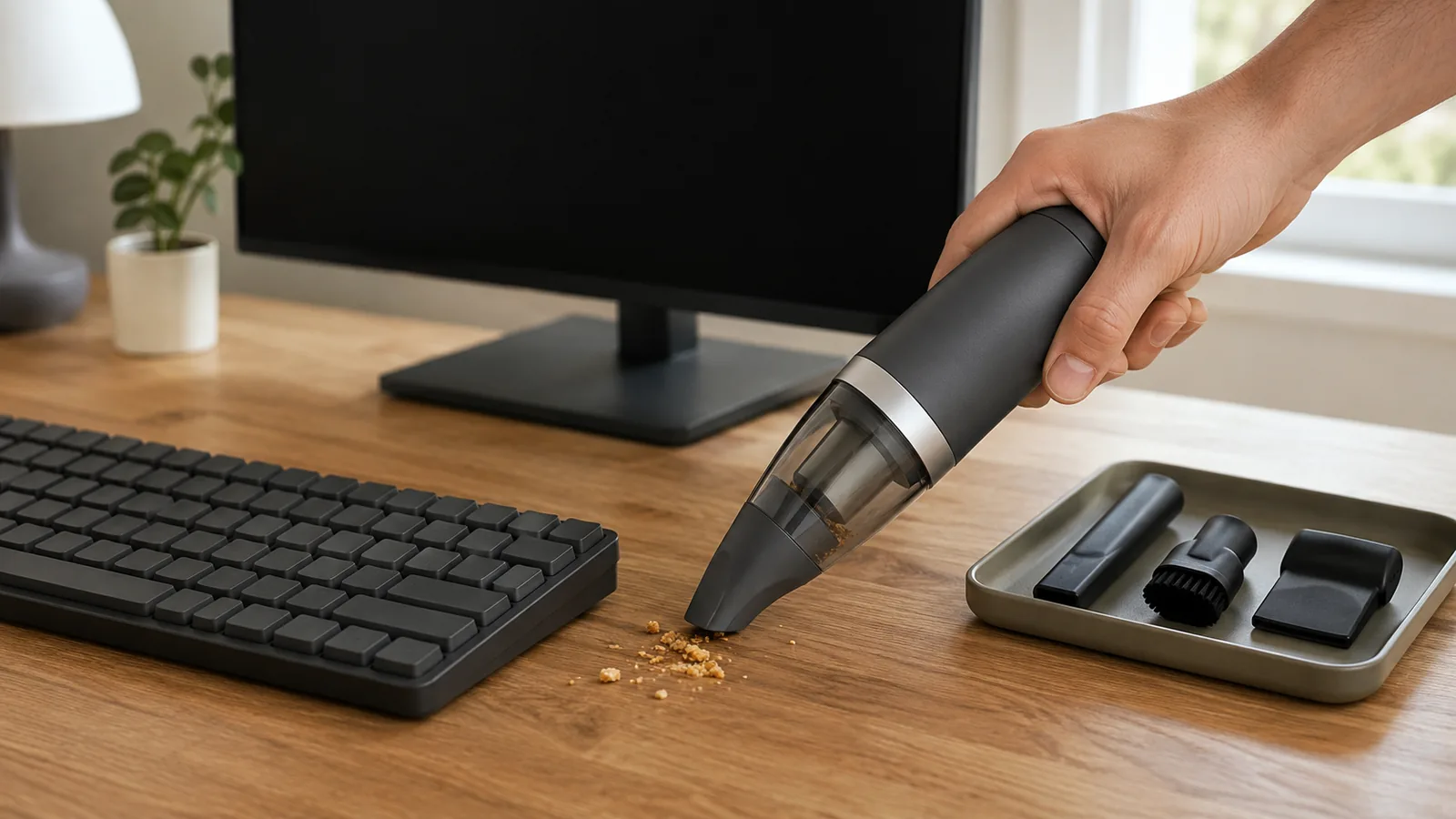
- Use a mini vacuum: Fit the vacuum with a small brush attachment and gently vacuum around keycaps, monitor bases and desk corners. For mechanical keyboards, remove keycaps for deeper cleaning.
- Vacuum the entire desk: Slide the vacuum under phone cords, monitor stands and desk organizers. Use the crevice tool for corners.
- Wipe surfaces: After vacuuming, wipe the desk with a microfiber cloth and a mild cleaning solution to remove oils and smudges. Allow surfaces to dry before reconnecting electronics.
- Clean your chair: Vacuum the seat and backrest, paying attention to seams where crumbs collect.
- Empty and maintain: Empty the vacuum’s dustbin and clean the filter. Store the vacuum in an easily accessible spot so you’re more likely to use it regularly.
Maintenance Tips for Long‑Lasting Performance
Proper care extends the life of your handheld mini vacuum:
- Charge wisely: Follow the manufacturer’s guidelines for charging. Avoid leaving lithium batteries at 0 % or 100 % for extended periods.
- Clean filters regularly: Wash or tap out filters after each use. Clogged filters reduce suction and strain the motor.
- Replace filters as needed: HEPA filters should be replaced every few months or according to the manual. Foam filters can usually be washed and reused.
- Check for blockages: If suction drops, inspect the nozzle and hose for obstructions like hair or large particles.
- Store safely: Keep the vacuum in a cool, dry place. Avoid leaving it in a hot car, which can degrade batteries.
- Use the right attachment: Don’t use a motorized brush on delicate surfaces like keyboards; switch to a soft brush or crevice tool.
Environmental Impact and Energy Efficiency
Handheld mini vacuums are generally more energy‑efficient than corded models because they draw power only while chargingmordorintelligence.com. Many are designed with brushless motors and lithium‑ion batteries, which are more efficient than older nickel‑cadmium batteries. However, battery manufacture and disposal carry environmental costs. To minimize impact:
- Choose vacuums with recyclable batteries and return spent batteries to designated recycling programs.
- Opt for modular designs that allow battery replacement rather than throwing away the entire unit. This is a growing trend, as manufacturers respond to consumers seeking durable, repairable products.
- Look for HEPA filters that can be washed and reused rather than disposable filters.
Related Links to Explore More
For a deeper dive into related home tech and cleaning topics, check out these FrediTech guides:
Smart Vacuum vs. Vacuum‑Mop Combo: Understand the pros and cons of robot vacuums that sweep and mop your floors.
Best Cordless Stick Vacuums for Small Apartments: Learn how lightweight stick vacuums compare and which models offer the best balance of power and portability.
Best Video Doorbells in 2026: Explore the latest wired and battery‑powered doorbells for home security.
Indoor Security Camera Buying Guide: Get tips on privacy, storage and night vision when choosing indoor cameras.
Frequently Asked Questions
How much suction power is good for a handheld mini vacuum?
Most manufacturers don’t quote suction in Pascals for handheld vacuums, but lab testing shows even budget models can provide adequate suction. Look for user reviews that confirm the vacuum picks up gravel, pet hair and fine dust. Premium handhelds often use motors rated around 100–150 watts and can deliver powerful suction comparable to some corded stick vacuums.
How long do handheld vacuum batteries last?
Battery life varies by model. In lab tests, runtimes ranged from 13.7 minutes on the Black + Decker HHVI315JO42 to 29.1 minutes on the Furbuster AdvanceClean+. Manufacturers may quote longer runtimes for eco-mode, but expect about 15–30 minutes for most quality units.
Are handheld vacuums effective for pet hair?
Yes—provided they include a motorized brush or rubberized bristles. The Shark UltraCyclone Pet Pro Plus and Black + Decker Furbuster were specifically praised for pet hair pickup. Budget models without motorized tools may struggle with embedded fur.
Do mini vacuums work on keyboards and laptops?
Small desk vacuums can safely clean keyboards, but use a soft brush attachment and low suction to avoid damaging key switches. Unplug your keyboard first and avoid liquids.
How often should I empty the dustbin?
Empty the dustbin after each cleaning session, especially if it holds under 0.5 litres. A full bin reduces suction and can cause dust to blow back into the air.
Are handheld vacuums worth it if I already own a stick vacuum?
Yes. Stick vacuums excel at floor cleaning but are often too large for cars or desks. A handheld mini vacuum complements a stick vacuum by tackling tight spaces, stairs and upholstery.
What’s the difference between a car vacuum and a wet/dry shop vac?
Handheld car vacuums are lightweight and designed for everyday spills. Wet/dry shop vacs are heavier, handle liquids and construction debris, and plug into mains power. Shop vacs are overkill for routine car cleaning but useful for heavy-duty tasks.
How can I recycle my old handheld vacuum?
Check your local waste-management program for electronics recycling. Remove the battery and bring it to a battery recycling facility. Some manufacturers offer take-back programs.
Conclusion
A handheld mini vacuum is a practical investment for anyone who commutes, shares a car with pets or eats at their desk. By understanding how these compact cleaners work, carefully comparing specifications and avoiding common pitfalls, you can select a model that fits your lifestyle. Independent tests show there are good options at every price point—from the compact Shark UltraCyclone for pet owners to budget‑friendly Black + Decker models and long‑lasting Furbuster AdvanceClean+. Meanwhile, market research suggests demand for portable vacuums will continue to rise as more people live in small spaces and value energy efficiency. Armed with the information in this guide, you’re ready to choose the best handheld mini vacuum for your car, desk or both—and keep your environment cleaner with minimal effort.
Written by Wiredu Fred, a home‑tech enthusiast and researcher focused on smart devices and efficient living. Fred’s writing combines evidence‑based insights with practical advice to help readers make informed decisions.