

Pressure washers deliver powerful water jets to clean driveways, decks, siding, vehicles and more. As cities focus on efficiency and conservation, these machines are gaining popularity. In fact, the global pressure washer market is projected to reach about $3 billion by 2034freditech.com. Unlike a garden hose, a pressure washer uses high-speed water to dislodge dirt quickly, using up to 80% less water than a regular hoseblog.hotsysystems.com. That makes them both water- and time-efficient for home and professional use. In this guide, we’ll explain how pressure washers work, compare electric and gas models, review PSI/GPM specs, and recommend top models by price tier. We’ll also cover safety tips, maintenance, and answer common buyer questions.
For related cleaning tools, see our Best Steam Cleaner for Homefreditech.com guide.
Why Invest in a Pressure Washer?
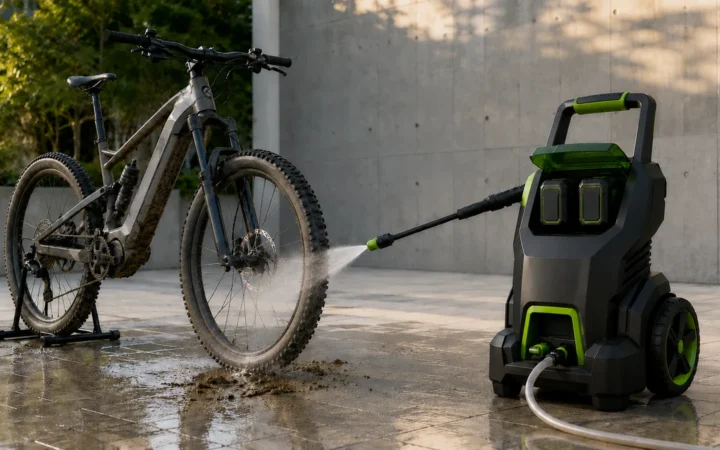
Pressure washers offer faster, deeper cleaning with less effort than manual scrubbing or hoses. They blast away mold, mildew, and grease on surfaces that a broom or hose can’t fully remove. You can use a pressure washer for decks, patios, house siding, roofs, driveways, fences, cars, and more. For example, a 2000–3000 PSI washer can remove algae from concrete or rinse a dirty car in minutesblog.hotsysystems.com. Compared to hand-washing, pressure washers save time and water. Manufacturers note that a pressure washer can use ~80% less water than a standard hose for the same cleaning taskblog.hotsysystems.com, thanks to concentrated spray and shorter run-time.
The market for pressure washers is growing. Global sales rose over 5% yearly recentlyfreditech.com, driven by consumer DIY trends and commercial demand (e.g. car washes, farms). More models mean more choices: you’ll find electric, gas, and battery models across a range of pressures. Lower-cost electric units may start around $100–200, while heavy-duty gas units run $400–$800 or more. (Premium commercial units cost even more.) Our goal is to help homeowners, professionals, and beginners pick the right washer without confusion.
Key benefit: Modern pressure washers give professional-level cleaning power to homeowners. They remove stains and grime that hoses and brushes leave behind, often with just one pass. For example, a surface cleaner attachment can scrub a patio in minutes (see image below). This powerful cleaning ability, combined with efficiency, makes a pressure washer a smart investment for maintaining a clean home exterior or equipment.

A surface-cleaning attachment (left) makes quick work of a dirty patio, illustrating how a pressure washer turns water into a powerful cleaning jet. The spinning pad evenly distributes the high-pressure spray across the concrete, speeding up cleaning.
Types of Pressure Washers: Electric vs. Gas vs. Battery
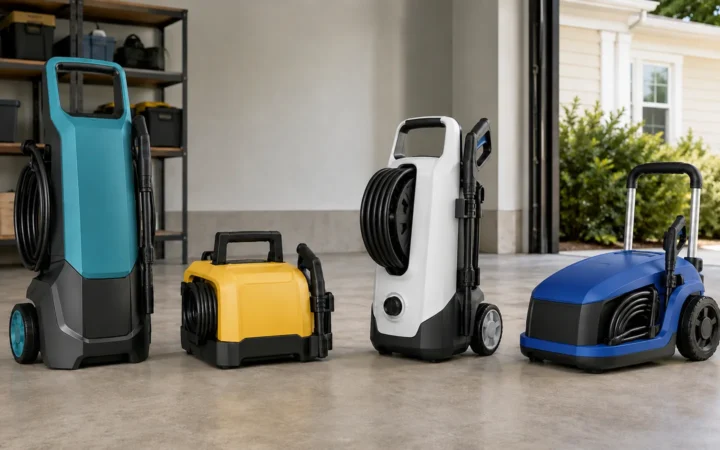
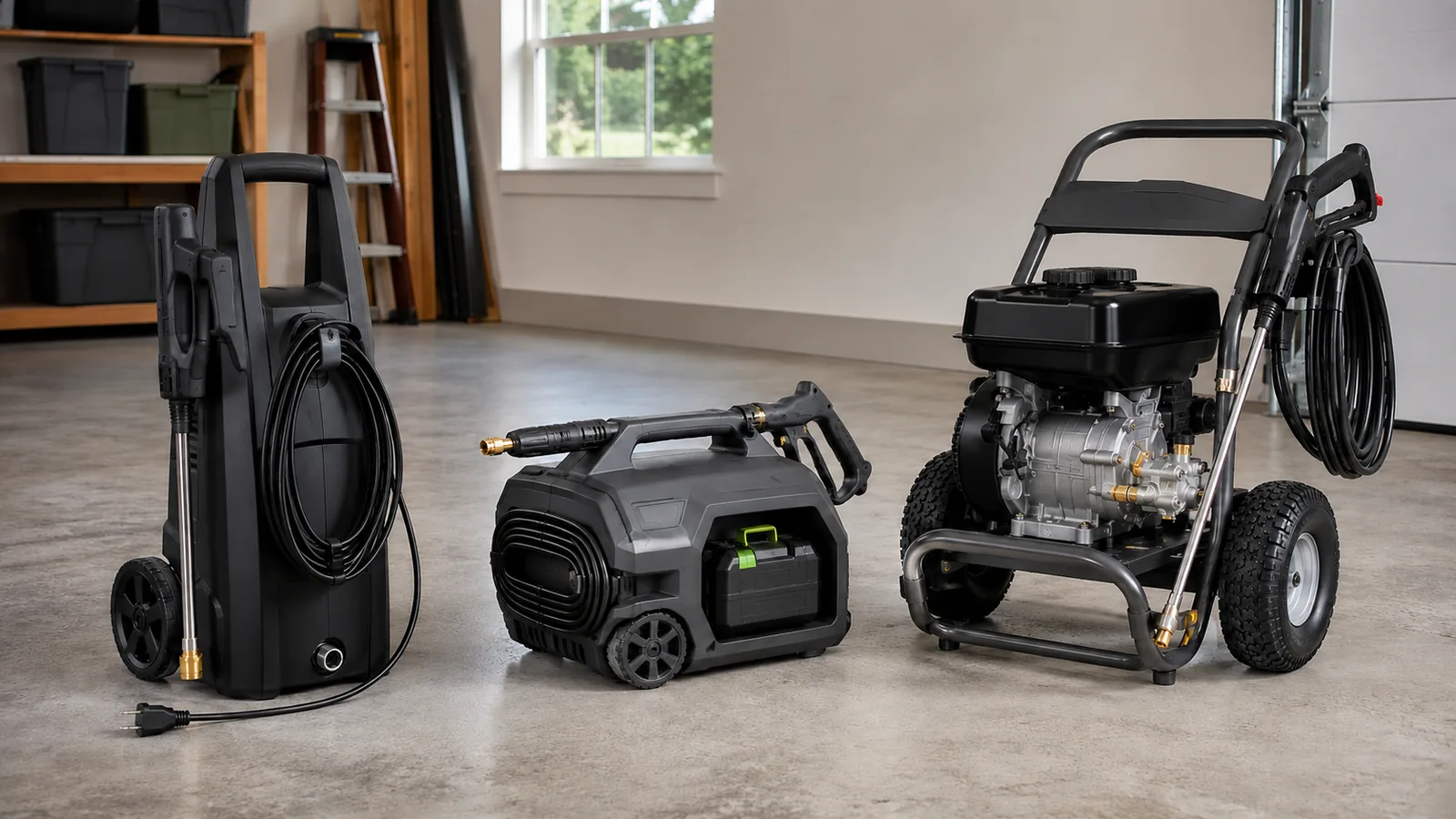
Pressure washers come in three main types: electric (corded or cordless), gas-powered, and increasingly battery-powered. Each has pros and cons for different users:
- Electric washers use an electric motor and are budget-friendly, lightweight, and low-maintenance. They start instantly (just plug in) and run quietly. Most corded electrics deliver 1300–2200 PSI, suitable for light to medium jobs (cleaning cars, small decks, patios). However, they require a nearby outlet or long extension cord, and generally produce lower PSI/GPM than gas models. They’re ideal for homeowners on a budget or those who clean occasionally. (For example, the Sun Joe SPX3000 is an electric model delivering ~2030 PSI at 1.2 GPM, good for washing decks or vehicles.)
- Gas washers run on gasoline engines and are more powerful and portable (no cord restrictions). They typically start around 2000 PSI and go up to 4000+ PSI, making them suitable for heavy-duty cleaning like driveways, siding, or farm equipment. Gas models often use triplex pumps (more durable) and can handle higher flow rates. Downsides: they cost more upfront (often $300+), are heavier, louder, produce exhaust fumes, and require maintenance (oil changes, spark plugs). Examples include the Westinghouse WPX3000 (3000 PSI, 2.3 GPM gas model) and the Simpson MSH3125 (3200 PSI, 2.5 GPM with a Honda engine)simpsoncleaning.com. These are designed for demanding jobs. Gas washers often include features like larger fuel tanks, more hose length, and multi-nozzle sets for versatility.
- Battery-powered washers are a newer category (powered by rechargeable batteries). They offer true portability (no cords, no gas) and very quiet operation. Output is usually in the range of 1700–3200 PSI (top-end cordless models). A notable example is the EGO 3200 PSI (cordless) series. Battery units are great for jobs far from power outlets, like cleaning boats or remote vehicles. Their drawbacks include limited run time (battery life) and higher cost per power rating. They’re best for users valuing convenience and mobility over maximum power.
Choosing a Pump Type: Axial vs. Triplex
Within each type, washers use either axial cam pumps or triplex piston pumps. In general, triplex pumps are higher-quality, can handle more pressure and run longer, but cost more. Axial cam pumps are common on less expensive units. For example, budget electric washers often use maintenance-free axial pumps. Many premium gas models (like the Simpson MSH3125) use triplex pumps with brass head for durabilitysimpsoncleaning.com. When shopping, consider that a triplex pump can last longer under heavy use.
Understanding PSI, GPM, and Cleaning Power
Two key specs define a pressure washer’s performance: PSI (pounds per square inch of pressure) and GPM (gallons per minute of water flow). In simple terms:
- PSI measures the force of the water jet. Higher PSI means the water stream hits harder, which helps break up tough dirt, grime, or mildew. For example, 2000 PSI can remove some tough stains, while 3000+ PSI can tackle extremely stubborn debris or degreasing.
- GPM measures how much water flows through the nozzle. Higher GPM means more water volume, which rinses away dirt faster. More flow generally speeds up cleaning time, especially on large areas.
Both matter: cleaning effectiveness is often calculated as Cleaning Units = PSI × GPM. (For instance, a 2500 PSI washer at 2.0 GPM has 5000 cleaning units.) A higher cleaning unit number means faster cleaning in most cases. However, too much PSI can damage delicate surfaces, so balance is key.
Typical ranges: Light-duty home washers run 1300–2000 PSI (at 1.2–2.0 GPM). Medium-duty units are 2000–3000 PSI (often 1.5–2.5 GPM) for larger jobs like decks or driveways. Heavy-duty and professional machines exceed 3000 PSI and may flow 2.5–4.0 GPMsimpsoncleaning.com. As a rule of thumb:
- Light-duty (1300–2000 PSI): Car washing, patio furniture, grills, small decks (flow ~1.2–1.5 GPM).
- Medium-duty (2000–2800 PSI): Home siding, fences, driveways, larger decks (flow ~1.5–2.5 GPM).
- Heavy-duty (2800+ PSI): Stripping paint, large-scale industrial cleaning, farm equipment (flow 2.5–4.0 GPM).
These ranges are approximate. Home Depot outlines typical tasks by pressure: e.g. 1800–2400 PSI for siding and decks, 2400–2900 PSI for tough stains on concrete, and 3000+ PSI for heavy-duty jobs. Always match your washer’s PSI/GPM to your cleaning task. If in doubt, starting too low (and increasing pressure gradually) is safer to avoid damage.
Must-Have Features & Accessories
When comparing models, consider these features and accessories:
- Nozzle tips: Most washers come with a set of interchangeable nozzles (e.g. 0°, 15°, 25°, 40°, soap). Narrower tips (0° or 15°) deliver extremely powerful, concentrated jets for very tough grime (use with caution!), while wider angles (25°, 40°) cover more area with less force. A soap nozzle sprays detergent. Some models offer a turbo nozzle (rotating jet for super-cleaning power) – very effective but use carefully on durable surfaces.
- Surface cleaner: A rotating brush attachment (like the one shown above) encloses a round spray bar and is excellent for flat surfaces (driveways, patios). It covers a circular path (often 12–20 inches wide) and cleans much faster and more evenly than a wand alone. If you need to clean large horizontal areas regularly, a surface cleaner is a great accessory to have.
- Built-in detergent tank: Many pressure washers include an onboard soap tank or a hose connection for detergent. This lets you apply cleaning solution without carrying a separate bucket. Tanks are handy for car wash or siding cleaning. High-end models may have dual tanks for multiple soaps.
- Wand length and gun quality: Look for a sturdy spray gun and wand – preferably steel or aluminum. Longer wands reach far surfaces and reduce the need to move the machine. Some premium wands telescope or have extra fittings for surfacers.
- Hose length and quality: Standard hoses are 20–25 ft. Longer hoses give mobility. High-end washers often have kink-resistant, kink-proof hoses. Make sure to buy OEM or quality hoses if replacing – a burst hose is dangerous.
- Pump quality: As mentioned, brass-head triplex pumps last longer. Check if the pump is aluminum or plastic (less durable). Some units feature maintenance-free pumps (sealed systems you can’t oil – convenient but require replacement if damaged). Others allow oiling (better for heavy use, as you can maintain them).
- Frame & wheels: For large machines, a sturdy steel frame and large wheels (often pneumatic) help moving over rough ground. Budget models may have plastic wheels – fine on smooth driveways, but consider tougher wheels if you’ll move it around the yard a lot.
- Switch/Stop features: Some washers have a “built-in” GFCI or auto-stop on trigger pull (electric) to save energy. Others offer adjustable pressure (on-the-fly) via wand controls or a pressure regulator.
By combining the right accessories (e.g. a foam cannon for car washing, a turbo tip for siding) with the right machine, you can cover nearly any cleaning scenario. Always follow the manufacturer’s guidance on attachments.
How to Choose the Right Pressure Washer (Step by Step)
- List Your Cleaning Tasks. Write down what you’ll clean most often (cars, deck, driveway, siding, heavy machinery, etc.). This helps determine power needs. Light tasks (cars, patio furniture) need less PSI; heavy tasks (concrete oil stains, paint stripping) need more.
- Check Required PSI/GPM. Use the task list to pick needed pressure. For example, car owners might need only 1500–2000 PSI and ~1.2–1.5 GPM, while deck cleaning might need 2000–2700 PSI. Consult charts (like Home Depot’s) for guidance. Remember cleaning units = PSI × GPM. Two machines with the same PSI could clean at different speeds if one has a higher GPM.
- Decide Electric vs. Gas. For mostly light to medium home use near power outlets, an electric washer may suffice and save money. It’s also easier for beginners (no engine to maintain). For heavy-duty jobs or remote locations without power, go gas. Gas models have more power (often >3000 PSI) and mobility but require more care (fuel, oil).
- Check Special Needs. If you need to use it far from outlets (e.g. farm, large yard), or for commercial/industrial use, gas is likely the right choice. If noise and emissions are a concern (or you’ll work indoors/outdoors with noise rules), electric (or battery) is better. (Note: battery washers are quiet but consider battery life vs job size.)
- Review Features. Consider attachments you want (surface cleaner, foam cannon) and buy a unit that either includes them or easily supports them. Check hose and wand lengths – a short hose can limit reach. For ongoing DIY use, features like onboard storage for nozzles and pumps with good warranties add value.
- Compare Budget. In each power category (light, medium, heavy duty), compare models. Look at build quality (metal frame vs plastic, brass pump vs aluminum). Read user reviews to see reliability. Remember that extremely cheap models may skimp on parts. Factor in warranty length too.
- Safety and Maintenance. Plan for wearing goggles, gloves and keeping others away during use (see Safety below). Also plan to buy pump-preserver fluid or antifreeze for winter storage, especially in cold climates.
By following these steps, you’ll narrow down to the models that fit your tasks and budget. Then you can compare specs and prices directly (our tables below show examples by price tier).
Recommended Models: Budget, Midrange, Premium
Here are some specific models to consider in each price tier. We’ve grouped them by budget (<$200), midrange ($200–$500), and premium ($500+). All are reputable brands, with enough power for typical tasks in their category.
Budget Pressure Washers (around $100–$200)
Model (Brand) | Type | PSI | GPM | Price ~ | Best For |
Sun Joe SPX3000 (Sun Joe) | Electric | 2030 | 1.2 | $169 | Light cleaning (cars, decks) |
Ryobi RY141900 (Ryobi) | Electric | 2000 | 1.2 | $179 | General home use (patios, siding) |
Karcher K3 (Karcher) | Electric | 1800 | 1.3 | ~$200 | Entry-level (small fence, driveway) |
These budget machines are usually corded electrics with axial pumps. They handle basic tasks like washing cars, outdoor furniture, small patios, and fences. Sun Joe and Ryobi are highly rated budget brands. For example, the Sun Joe SPX3000 delivers about 2030 PSI and 1.2 GPM and includes wheels and detergent tanks, making it a good starter model. (It’s CPA-certified at 2030 PSI.) The Ryobi RY141900 is similar (2000 PSI, 1.2 GPM) and often priced ~$179.
Note: Budget gas washers do exist (like small 2000–2500 PSI models), but their prices often approach midrange ($200+). If you find a sub-$200 gas model, expect trade-offs (smaller engine, plastic frame). In this class, electric models dominate because of their lower cost and simplicity.
Midrange Pressure Washers ($200–$500)
Model (Brand) | Type | PSI | GPM | Price ~ | Best For |
Westinghouse WPX3000 (WGT) | Gas | 3000 | 2.3 | $329 | Heavy patio/deck cleaning |
Greenworks PRO 3000 (Greenworks) | Electric | 3000 | 2.0 | $450 | Powerful electric for large areas |
Ryobi RY803001 (Ryobi) | Gas (Honda) | 3000 | 2.3 | $369 | Versatile home/farm use |
Midrange units step up the power. Gas models like the Westinghouse WPX3000 offer 3000 PSI at 2.3 GPM, driven by a 212cc Westinghouse engine. This model is rated for heavy-duty tasks like cleaning house siding, concrete, or larger vehicles. It comes with 4 nozzles and pneumatic wheels for mobility.
The Ryobi RY803001 (with a Honda GCV160 engine) delivers similar 3000 PSI, 2.3 GPM and is often priced around $369homedepot.com. Honda engines are known for reliability, so this is a solid pick for frequent outdoor cleaning.
In electric midrange, Greenworks PRO 3000 is notable: an 14-Amp motor giving 3000 PSI and ~2.0 GPMgreenworkstools.com. This plug-in model (often around $450) uses a brushless motor for longer life. It’s a top choice if you prefer quiet electric power but need above-average performance.
Midrange machines often feature a combination of durability and convenience: more metal (pump frames, wands) and extra inches of hose, while still being manageable in size. They target homeowners and small businesses who need a balance of power and value.
Premium Pressure Washers ($500 and up)
Model (Brand) | Type | PSI | GPM | Price ~ | Best For |
Westinghouse WPX3000 (WGT) | Gas | 3000 | 2.3 | $329 | Heavy patio/deck cleaning |
Greenworks PRO 3000 (Greenworks) | Electric | 3000 | 2.0 | $450 | Powerful electric for large areas |
Ryobi RY803001 (Ryobi) | Gas (Honda) | 3000 | 2.3 | $369 | Versatile home/farm use |
Premium machines deliver top cleaning power and features. The Simpson MSH3125 is a classic premium washer: a 3200 PSI machine with a Honda GC190 enginesimpsoncleaning.com. It flows 2.5 GPM, uses a triplex aluminum pump, and includes 5 nozzles. This unit excels at large projects (e.g. cleaning miles of fence, big equipment) and is built for longevity.
The Generac SpeedWash 3200 also offers 3200 PSI at an impressive 2.7 GPM. Its 196cc Generac OHV engine and integrated hose reel set it up for heavy tasks. Generac markets it for entire-home cleaning and professional use. At around $529, it’s a powerhouse for driveways, restaurants, and fleets.
For maximum output, the DEWALT DXPW3400PRNB-S hits 3400 PSI and 3.5 GPM (Powered by a 208cc DEWALT engine). This high flow (3.5 GPM) is exceptional – it rinses faster than most. This unit (around $675) has a steel frame, PressuReady pump, and is meant for commercial or intensive residential work (driveways, parking lots, farms).
Other premium options include hot water washers and trailer-mounted units, but those exceed our home/pro range. In general, premium models use heavy-duty frames, long warranties, larger fuel tanks, and extra accessories. They often support professional attachments like high-capacity foamers and wand extensions.
Safety and Best Practices
Pressure washers are powerful tools. Follow these safety guidelines to avoid injury or damage:
- Wear protective gear. Always wear safety glasses or a face shield, long pants, sturdy closed-toe shoes (e.g. steel-toe boots), and gloves. High-pressure spray can send debris flying. The Raken safety guide warns that injuries from pressure washers often start small but can worsen without treatment. A high-pressure jet can cut skin or cause eye damage instantly.
- Keep others clear. Make sure bystanders, children and pets stay out of the spraying zone. Never point the wand at people, animals, or yourself. Even a momentary spray to the skin can injure or inject detergent into tissue. Raken notes that wounds from washers “often appear benign at first, but can result in serious complications” if untreated.
- Use the right nozzle. Start with a wide-angle nozzle (25° or 40°) on a new surface. Only use concentrated or rotary nozzles (0° or 15°) on tough stains, and always test on a small area first. Never use a zero-degree (red) nozzle on surfaces like wood or vehicle paint – it can gouge or strip surfaces. Raken cautions never to use zero-tip unless absolutely necessary.
- Stable footing and secure placement. Place the washer on a firm surface. Wear non-slip footwear. Uncoil hoses fully to avoid kinks or trip hazards. Avoid standing on ladders or unstable surfaces while spraying. Never spray downwards from a ladder – it can kick you off.
- Electrical safety (electric models). Use only properly grounded outlets. Attach the washer’s GFCI plug directly to the outlet (if provided) – do not bypass safety devices. Do not use damaged power cords. Keep the power cable clear of water spray. Unplug before leaving the machine or doing any cleaning of the unit.
- Fuel safety (gas models). Refuel only with the engine off and cooled down. Refuel outdoors. Store fuel in approved containers. Keep sparks and flames far from the washer’s fuel tank. Ensure proper ventilation to avoid carbon monoxide buildup when running a gas engine.
- Follow the manufacturer’s instructions. Read the user manual for your model. It will cover safe operation, assembly, and maintenance steps. (For example, Home Depot advises immediately running pump protector fluid or antifreeze through the pump after use to prevent damage.) Pay attention to warnings about water temperature limits (most consumer washers are cold-water only), and use only approved detergents.
Pressure washers are safe when handled properly and respectfully. By taking these precautions, you can enjoy the cleaning power without mishap.
Maintenance and Storage
Proper upkeep extends the life of your washer:
- Pump care. After each use, run clear water through the system to flush out soap. At winter or long-term storage, use a pump protector/antifreeze solution (available from the washer’s brand or third parties). This prevents residual water from freezing or corroding the pump. Home Depot specifically recommends this as a final step.
- Engine service (gas models). Check engine oil regularly and change per the engine manufacturer’s schedule. Maintain fuel quality (use fresh gas with stabilizer if sitting, or drain before storage). Inspect/clean air filters monthly during use. Replace spark plugs annually or as needed. Gas models have small engines similar to lawn mowers, so follow basic small-engine care.
- Inspect hoses and nozzles. Check high-pressure hoses, fittings, and spray tips for wear or cracks. Replace damaged components immediately to prevent leaks or blowouts. Clean or replace nozzle tips if jets become uneven. A clogged nozzle can cause overpressure.
- Detergent tank and filter. If your washer has an onboard soap tank, rinse it after use to avoid clogging. Some models have inlet filters on the hose – clean these regularly to prevent debris entering the pump.
- General cleaning. Wipe off dirt and moisture from the washer’s frame and motor/engine after use. Drain any water from the pump by pointing the wand into a bucket (engine off) and pulling the trigger. This avoids standing water in the pump or hose.
- Winterize. If you live where temperatures drop below freezing, it’s critical to winterize by draining all water and using pump protector. Store the washer indoors or under cover if possible, to prevent cold damage.
Routine care not only prevents breakdowns but also keeps performance high. Inspect your washer before every season of heavy use (spring, summer), and address any leaks or odd noises promptly.
FAQ (Frequently Asked Questions)
Electric or gas – which pressure washer is right for me?
How much PSI and GPM do I need?
Can a pressure washer damage surfaces?
Is a surface cleaner worth it?
How much water does a pressure washer use?
What maintenance does my pressure washer need?
Can I use hot water or detergents?
How high of a pressure washer should I buy for cleaning a car?
For more on related cleaning tools, see FrediTech’s
- Best Steam Cleaner for Homefreditech.com. (Steam cleaners are an alternative for certain tasks like sanitizing indoor floors or upholstery.) Our
- Ultimate Pressure Washer Comparison Guidefreditech.com also covers the topic of electric vs. gas and explains PSI/GPM in more detail.
Conclusion
A pressure washer can transform tedious outdoor cleaning into a quick, even enjoyable task. By understanding your needs (PSI/GPM) and choosing the right type (electric vs gas vs battery), you can pick a model that delivers top performance within your budget. Budget electric models handle light tasks like cars and small decks, while midrange and premium units (especially gas) cover everything from house siding to heavy equipment. Look for reputable brands (Sun Joe, Ryobi, Karcher for electrics; Honda, Simpson, Generac, DeWalt for gas) and read specs carefully. Always prioritize safety: wear protective gear and use proper nozzles.
Finally, consider how often you’ll use it: an occasional user may be fine with a $200 electric cleaner, whereas a contractor or power user will justify a $500+ machine’s reliability and speed. With the right pressure washer, you’ll save hours of scrubbing and keep your property looking its best. Happy cleaning!