

The 2026 Toyota bZ4X (now renamed simply Toyota bZ) is a thorough update of Toyota’s compact electric SUV, addressing many of the original bZ4X’s shortcomings. For 2026, Toyota has added a larger battery (up to 74.7 kWh), significantly more power, and faster charging, along with styling and interior refinementspressroom.toyota.com. The result is a vehicle with up to 314 miles of EPA-rated range (on the FWD XLE Plus)caranddriver.com, 338 horsepower on the AWD model (vs 214 hp previously), and a new North American Charging Standard (NACS) port for Tesla Supercharger access. This review takes an in-depth look at what’s new, how it drives, and how it compares to rivals.
Toyota has confirmed the 2026 bZ is expected to arrive in the second half of 2025. It will start at about $34,900 MSRP for the base XLE FWD modelpressroom.toyota.com (approximately $40,000 out the door, including destination). With these updates, Toyota aims to make the bZ4X competitive with other compact electric SUVs – a segment where it previously lagged in range, charging speed and performancemotortrend.com. We explore each aspect below.
Key Updates for 2026
Toyota has “thrown everything at” the bZ4X for the 2026 refresh. Highlights include:
- Name change: Toyota has officially dropped the “4X” suffix. The 2026 model is branded simply Toyota bZ (“beyond Zero”). This follows Toyota moving away from its bZ numbering scheme (future EVs will use familiar names)caranddriver.com.
- Bigger battery: The new long-range battery is 74.7 kWh, up from ~72.8 kWh beforemotortrend.com. A smaller 57.7 kWh pack is now offered on base FWD models. Toyota projects up to 314 miles of range (on FWD Plus with 74.7 kWh) (European WLTP tests imply up to ~356 mi).
- Increased power: All-wheel-drive (AWD) models gain 338 hp combined (221 hp front + 117 hp rear), a leap over the old 214 hp AWD. Front-wheel-drive (FWD) versions have 168 hp (or 221 hp on Plus/Limited with bigger battery). According to Toyota engineers, the top AWD model now ranges up to 343 hp in some marketsinsideevs.com. This is up to 50% more power than the previous model.
- Faster charging: The on-board charger capacity doubles (now 11 kW AC), and every model gains a NACS charging port (Tesla-compatible) in addition to CCSpressroom.toyota.com. DC fast-charging remains capped at 150 kW, which is slower than many rivals, but improvements in charging calibration and battery preconditioning aim to make charging more efficientmotortrend.com.
- Enhanced interior: The bZ’s cabin has a major refresh. A standard 14-inch touchscreen now dominates the center stack, replacing the old awkward gauge panel on the dash. The center console is redesigned for better usability, and Toyota adds ambient lighting (64 colors), dual wireless phone chargers, a heated steering wheel with regen paddles, and a more conventional driver’s gauge pod. Car reviewers note the new interior feels “airier and more spacious”, though some oddities remain (the low-mounted steering wheel can still block the instrument view).
- New features: Every model now includes features like vehicle-to-load (V2L) power, hands-free power tailgate, heated steering wheel, and upgraded safety tech. The AWD version gains Toyota’s X-MODE off-road assist. Importantly, Toyota has finally added EV route planning to the navigation system, automatically recommending charging stopsinsideevs.com. Other new tech includes an 11-inch digital gauge cluster, ambient mood lighting, and subtle exterior tweaks (sleeker front end and new wheel designs).
These changes aim to address the bZ4X’s previous weaknesses in one swoop. As one Toyota executive put it, the 2026 bZ has “up to 50% more power [and] charging times up to twice as fast” than before. All told, Toyota says the upgraded 2026 bZ will arrive in late 2025 with a new starting price around $34,900pressroom.toyota.com.
Exterior Design
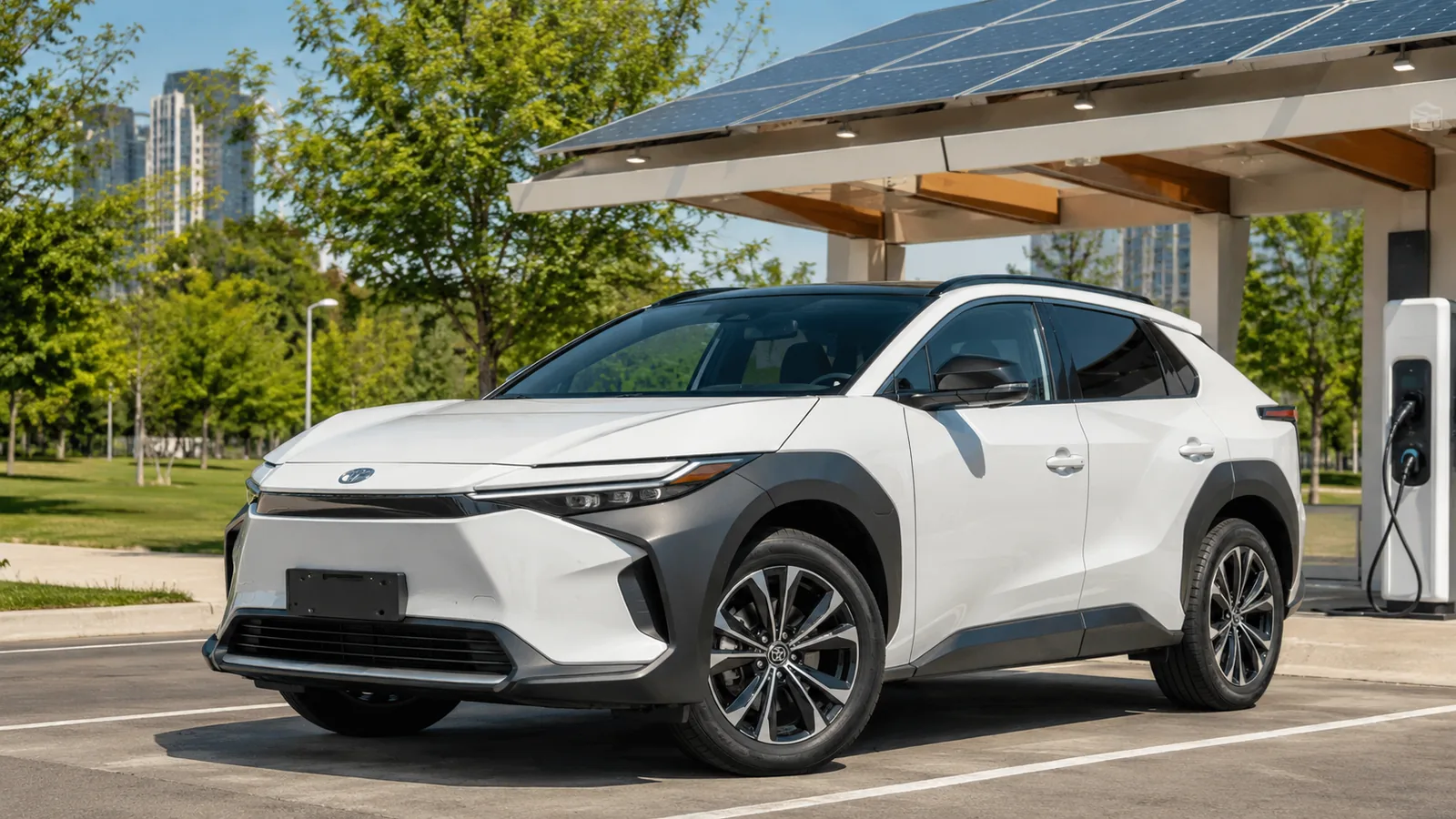
The 2026 bZ retains its compact crossover shape, but with refreshed styling details. The front fascia is sleeker and more elegant compared to the clunky original. Up front you’ll find new LED headlights and a partially closed grille (as with most EVs). Some trim-specific touches include black roof-painted panels and an available “Tech Bronze” color pack on higher grades.
The body dimensions are largely unchanged (it’s still a 5-passenger, 4-door wagon on a 112.2-inch wheelbase). Ground clearance is about 8.2 inches, typical for a small SUV. Cargo space is also similar: about 27.7 cubic feet behind the rear seatspressroom.toyota.com (expanding to ~60 cu ft with seats folded, per other sources). Overall, the exterior is sensible rather than radical – reviewers call it an “athletic SUV” look with sculpted lines.
Step-by-step exterior walkaround: The hood is slightly more sculpted, and the closed front grille bears a small Toyota badge. Available wheels now include 18- and 20-inch designs in silver or black finishes. A new panoramic sunroof (on Limited AWD) brightens the cabin. At the rear, a full-width LED light bar connects the tail lights. The charging port is relocated to the left front fender behind a flush door (now on the driver side). On Touring/RS trims, features like LED fog lamps and a power-operated hatch make loading easy (a hands-free liftgate is standard on AWD models)carsguide.com.
Internally, the build and fit are improved but still utilitarian. Most panels are durable plastic with cloth or synthetic-trimmed seats. Higher trims get faux-leather seats and a nicer flat-bottom steering wheel. The bZ’s design cues are clearly Toyota – functional and conservative – but it’s hard to fault the extra standard tech now on board (large screen, ambient lights, wireless chargers)carsguide.com.
Interior and Technology
Inside, the 2026 bZ4X’s cabin is much more modern than before. The dashboard is completely redesigned: a flat 14-inch infotainment touchscreen (Toyota Audio Multimedia) now sits atop the center stack, angled toward the driver. This screen replaces the old half-dashboard instrument panel of the bZ4X. There is also a new 11-inch digital gauge cluster (a “top-mount multi-info display”) right in the driver’s sightline. Toyota has simplified controls: much of the climate and audio is handled via the touchscreen and a few physical knobs, following the cleaner Lexus-style layoutmotortrend.com.
The center console is equipped with two wireless Qi chargers, plus plenty of USB-C ports. Toyota reports a standard heated SofTex steering wheel with regen paddle shifters on all trims. Ambient LED lighting now runs across the dash and doors (with 64 selectable colors), giving the cabin a more upscale feel. Front seats have ample bolstering and power adjustment (8-way for driver on XLE, 10-way on Limited). The rear seats fold 60/40 flat and offer passable legroom (about 35.3 inches)pressroom.toyota.com. Overall headroom and visibility are good thanks to the upright profile and available sunroof.
In terms of tech, the bZ comes loaded with connectivity and safety features. The Toyota Audio Multimedia system includes Bluetooth, dual USB-C ports, and smartphone integration. (Officially it supports wired Apple CarPlay/Android Auto via USB – unlike some Chevy rivals that dropped it.) The dash displays battery and efficiency info clearly. Crucially, Toyota has added native EV route planning, meaning the navigation will automatically suggest charging stops on long tripsinsideevs.com. Drivers can also set a destination to precondition (warm up) the battery ahead of charging. Voice recognition and infotainment controls are improved, though some testers note the new screen still has a “generic” interface feelmotortrend.com.
Safety and driver aids: The 2026 bZ comes standard with Toyota Safety Sense 3.0. This includes forward collision warning with pedestrian detection, lane departure alert with steering assist, adaptive cruise control (with stop-and-go), and lane tracing assist. Blind-spot monitoring and rear cross-traffic alert are available on Limited trims. A digital rearview mirror is optional. Toyota also retains a full suite of airbags and electronic stability controls. In crash tests (where available), the bZ4X was rated well, and we expect similar safety for the bZ given its unchanged structurecaranddriver.com.
Powertrain and Performance
Drivetrain: The 2026 bZ4X is built on Toyota’s e-TNGA platform, shared with the Subaru Solterra. Two drivetrain layouts are offered:
- Front-Wheel Drive (FWD): One electric motor on the front axle. Base XLE FWD produces about 168 horsepower (125 kW). The upgraded XLE Plus and Limited FWD get the larger battery and a more powerful front motor at 221 hp (up from 201 hp)caranddriver.com.
- All-Wheel Drive (AWD): Two motors (front and rear). Combined output is 338 hp (up from 214 hp). MotorTrend notes this totals about 323 lb-ft of torquemotortrend.com. This dual-motor system makes the bZ quite brisk.
Thanks to the power bump, acceleration is markedly quicker. MotorTrend tested the AWD Limited: 0-60 mph in 4.4 seconds (with stability control off)motortrend.com. Car & Driver reports a Toyota-claimed 0-60 in under 5 seconds for AWD (versus 6.3 s before)caranddriver.com. Even the entry-level FWD bZ is peppy off the line, though it is understandably slower. In normal driving, the instant torque delivers smooth, near-silent thrust. Passing power is ample in traffic; the electric powertrain keeps the response linear.
Handling and ride: Reviewers say the updated bZ rides and handles better than beforecaranddriver.com. Toyota has re-tuned the suspension: steering effort is noticeably lighter and the suspension is firmer. The result is a more composed feel in corners and at highway speeds. Indeed, Car & Driver reports better balance and reduced body roll. The electric platform’s low center of gravity aids stability. However, MotorTrend notes the steering can feel a bit “hyperactive” and numb on rough roads. Ride comfort is generally good – the bZ soaks up bumps well and feels quieter than the gas RAV4, though excessive road noise can intrude on coarse pavement. Regenerative braking is smooth and a conventional one-pedal mode (max regen) is available via paddles. Braking performance is adequate, with firm pedal feel but not class-leading stopping distances.
Overall, the driving experience is solidly competent. The AWD model in particular is entertaining – its acceleration rivals many sportier EVs (e.g. it beats Ioniq 5 AWD and matches most trims of the VW ID.4). Off-road, the X-MODE and Grip Control functions help on loose terrain, making it more capable than before. At the limit, some testers found the AWD bZ can feel “anodyne”, but most drivers will enjoy the confident ride and one-pedal driving on city streets.
Battery, Range, and Efficiency
The 2026 bZ’s new battery pack is the key to its longer range. Toyota offers two pack sizes: a 74.7 kWh high-capacity battery (gross) and a 57.7 kWh smaller battery (for base FWD models). Both are liquid-cooled lithium-ion packs. Toyota engineers used more cells (104 instead of 96 per pack) and improved energy density to fit the extra capacityinsideevs.com.
The range figures are a major improvement: Toyota claims up to 314 miles EPA for the new FWD XLE Plus with the big battery. AWD models with the 74.7 kWh pack are rated at 288–299 miles EPA depending on trim. (Toyota’s press release gives 299 miles for both Limited FWD and AWD on 74.7 kWh.) For context, the old AWD bZ4X had only ~252 miles max EPA range. The base XLE FWD with the 57.7 kWh battery is rated only about 236–235 miles due to its smaller packmotortrend.com.
In metric terms, CarsGuide notes the AWD model now reaches up to 517 km WLTP range (vs 411 km before)carsguide.com.au. InsideEVs expects the top WLTP range to be ~573 km (~356 miles). (EPA ratings are typically lower than WLTP, so a ~314-mi EPA is consistent.) In daily driving, the bZ4X should comfortably cover most commutes. Real-world consumption is around 16 kWh/100 km per WLTP (roughly 290 Wh/mi) for AWD. Owners can eke out more range by using Eco mode, gentle regen, and preconditioning the cabin/battery before driving. Toyota’s range estimates can vary with weather, speed, and driving style; 314 miles is the high end on highway tests.
Efficiency features include an improved heat pump (optional), front/rear heated seats and steering wheel, and available lower-body seat heaters to cut HVAC loads. The 2026 bZ also gains a battery thermal management system that speeds up pre-heating in cold weather. Toyota adds a battery preconditioning function: setting a DC fast-charging destination in the nav will automatically warm the battery to optimal temperature, allowing faster charging especially in winter. These EV-specific tweaks (plus tire low-rolling-resistance and aero tweaks) help the bZ close the efficiency gap on rivals.
Charging and Connectivity
Charging capability has been significantly enhanced. The 2026 bZ introduces a Tesla NACS charging inlet as standardcaranddriver.com. This means bZ owners can plug directly into the vast Tesla Supercharger network. It also retains the CCS charger, but Toyota says it will provide a dual-port charger cable for home (compatible with Level 1/2). Notably, the onboard AC charger is now rated 11.0 kW (Toyota says up from 6.6 kW), so Level 2 home charging is about twice as fast. InsideEVs reports that on higher trims the charger is actually 22 kW, surpassing even Hyundai’s Ioniq 5insideevs.com. In any case, expect about 4–8 hours for a full charge on Level 2, depending on outlet.
DC fast charging is capped at 150 kW for all models. This matches the previous AWD limit and is slower than many competitors (e.g. Chevy Blazer EV up to 195 kWfreditech.com, Ioniq 5 up to 220 kW). In testing, the new bZ AWD added about 115 miles in 15 minutes and 187 miles in 30 minutes at 150 kW. Toyota’s engineers have “flattened” the charging curve, so the bZ can sustain its peak rate longer into the session. Toyota targets ~10–80% charge in 30 minutes under ideal conditionsinsideevs.com, which is competitive with many mid-pack EVs.
Other charging and convenience tech: The bZ includes charge scheduling (via app or dash) and an EV charger grid locator. A new navigation feature will plan a long-trip route with optimized charging stops – a function sorely missed on the old bZ4X. Wireless phone charging and plenty of USB-C ports (front and rear) mean devices are easy to power. The dual-voltage portable charging cable (120/240V) is now standardpressroom.toyota.com. Overall, charging is much improved from the previous model, though still not best-in-class. Toyota has focused on user convenience (Tesla access, faster Level 2, battery heating) to make ownership easier.
Driving Impressions
On the road, the 2026 bZ4X is a pleasant everyday EV. Its smooth power delivery and instant torque make city driving effortless. On the highway, it feels stable and refined, aided by good high-speed aerodynamics. As noted, the AWD version is notably brisk – overtaking is quick, and the car can pin you back in your seat during wide-open throttle launches. Even in Normal mode, acceleration is lively. Sport mode sharpens throttle response but at a mild trade-off in range.
The steering, now lighter, is accurate on-center but can feel vague when the wheel is turned sharplymotortrend.com. The turning circle is tight for an SUV. The ride quality is a highlight: it’s comfortable and composed over bumps, better than many stiff-ride EVs in this class. Suspension softly absorbs road imperfections, though large potholes will thud into the cabin. Road noise from tires can intrude at highway speeds, but the overall quietness (especially with the weighty battery damping) is good.
On-road stability: The bZ tracks straight and feels sure-footed. On twisty roads, roll is controlled and grip is good. In AWD models, Toyota’s ABS and stability systems (including X-MODE grip) inspire confidence in low-traction situations. Braking is progressive with strong pedal feel. Thanks to regen, one-pedal driving is easy once accustomed to it.
Cargo and practicality: For such a compact exterior, the interior is quite roomy. Front seats have ample head- and legroom, and even tall adults sit comfortably in back. The flat floor (thanks to the underseat battery) leaves generous foot space. Cargo capacity is competitive: mid-20s cu ft behind rear seats, expanding to ~60 cu ft folded. The hatch opening is low, making loading groceries or gear straightforward. The rear seat backs can recline slightly or flip forward for larger items.
Pricing, Trims, and Availability
Toyota will offer the bZ in two main trim levels (XLE and Limited), each available in FWD or AWD. The XLE is the entry grade; in 2026 it comes in XLE, XLE Plus (larger battery FWD), or XLE AWD. The Limited is top-tier (74.7 kWh only). AWD adds about $6,000 to the price in our market research.
Pricing (US MSRP) starts at $34,900 for the XLE FWD (74.7 kWh, Destination not included)pressroom.toyota.com. The XLE AWD and Limited AWD climb higher (Limited AWD is expected around mid-$40k, depending on options). These prices make the bZ one of the more affordable EVs in its class – for example, it undercuts a comparable Tesla Model Y Long Range by roughly $1,000–2,000 (per Australian pricing comparisons). In fact, CarsGuide notes the 2026 bZ4X AWD is cheaper than a Solterra AWD and even beats the Model Y price in Australiacarsguide.com.au. (Exact US pricing will vary by trim.)
Toyota also offers incentives or financing deals on the bZ in many regions to move inventory faster. With price cuts of “up to $10,000” reported in Australia, the value proposition is strong. Given its improved specs and now high level of standard equipment (12-way driver seat, heated features, JBL sound on AWD, etc. as reported by CarsGuide), many reviewers say you’re getting a lot of kit for the moneycarsguide.com.au.
The bZ is slated to hit showrooms in late 2025. U.S. dealers are receiving allocations now. Early buyers should note that Toyota is requiring destination charges and letting dealers set final prices, so actual transaction prices may vary. The base price of ~$40k out-the-door is about $1,500 more than last year’s bZ4Xmotortrend.com. On the bright side, that increase buys all the new technology and performance.
Competition
In the small electric SUV segment, the 2026 Toyota bZ4X competes with a number of rivals:
- Subaru Solterra: Nearly identical underpinnings (shared assembly), the Solterra AWD Touring had similar specs. The new bZ now clearly outclasses the old Solterra in power and range. Both will still share the 150 kW charging cap, but the Toyota gains the NACS port. (Subaru version may lag on charging infrastructure.)
- Tesla Model Y Long Range: Tesla’s mid-size EV offers ~330 miles EPA and 0-60 in ~4.8s, plus 250 kW charging. The bZ4X is slower (0–60 in ~4.4–5.0scaranddriver.com) and has less range (314 mi vs 330 mi), but it’s priced lower and has more traditional controls. Tesla also lacks the all-wheel-off mode (X-MODE).
- Hyundai IONIQ 5 / Kia EV6: Both have similar range (~303 mi for 77 kWh AWD) and very fast charging (220 kW+). They feel more advanced inside (steeper tech focus) and have more rapid DC charging. The bZ offers similar everyday range (288–314 mi) and adds Toyota’s reliability reputation. Hyundai’s recent refresh added 11kW AC too, but Toyota’s 22kW (on some models) now matches or exceeds itinsideevs.com.
- Volkswagen ID.4: The ID.4 AWD gives up to ~275 mi range. It lacks the bZ’s power (201 hp) and climate features, but VW’s EV software is user-friendly. The Toyota’s higher utility (V2L, X-MODE, ambient lights) is a plus.
- Ford Mustang Mach-E: A sporty crossover with 270–314 mi range (LR RWD). Mach-E has more charging speed (150–250 kW) and a variety of trims. The bZ competes on comfort, price, and the latest tech rather than outright performance.
- Chevy Blazer EV: New from GM, with up to 324–334 mi range (RWD 102 kWh) and crazy 615 hp in SS trimfreditech.com. The Blazer EV even supports 195 kW chargingfreditech.com. The Toyota matches the Blazer in everyday specs (similar range, AWD system) but the Blazer’s interior is larger and more tech-rich. That said, the bZ’s reliability and Toyota network may appeal more to some buyers.
- Chinese EVs (BYD, Zeekr, etc.): Some new entrants like the BYD Sealion/Atto 3 or Zeekr models offer long range and lots of tech for the price. For example, the BYD Song L DM-i PHEV (plug-in hybrid) can exceed 1,000 miles total rangefreditech.com, but it’s a hybrid. A full EV competitor from BYD (e.g. Sealion) or Zeekr may offer more range and higher charging rates. Toyota’s advantage is its brand and dealer service network.
In summary, the 2026 bZ4X is now within striking distance of its segment leaders in range and power. It may not lead in any one metric, but its overall package (improved range, new tech, and lowered pricing) makes it a solid mainstream contender. As Car & Driver notes, the bZ is no longer far behind rivals in numbers and drive feelcaranddriver.com.
Conclusion
The 2026 Toyota bZ4X (bZ) represents a genuine turnaround for Toyota’s first EV crossover. By adding a bigger battery, more power, faster charging, and a host of modern features, Toyota has addressed the key criticisms of the original model. In practice, the new bZ offers much-improved acceleration, a much longer driving range, and a more user-friendly cabin. The experience is not flawless – charging speed is still modest (150 kW cap) and the interior layout remains unconventional – but it is now competitive in the compact EV SUV class.
Professional reviewers agree that the 2026 update brings the bZ4X closer to its rivals. Car & Driver observes that “these numerous changes… bring Toyota into competitive territory”caranddriver.com. On the other hand, MotorTrend cautions that more work could be done, especially in cabin ergonomics and charging pacemotortrend.com. In the end, the bZ offers a comfortable ride, Toyota’s famed build quality, and a rich feature set at a reasonable price point. It may not be the flashiest electric crossover, but it’s now a much more appealing and well-rounded option.
Overall, if you want a solid, well-equipped electric SUV and value Toyota’s reliability and dealer network, the 2026 Toyota bZ4X is worth considering. It may not match a Tesla or high-end EV in every spec, but it has closed the gap significantly while undercutting many on price. With its upgraded battery and tech, the bZ4X is arguably now the EV Toyota should have offered all along.
Author: Wiredu Fred – Automotive Analyst at FrediTech. Expert in electric vehicle technology and automotive reviews, Wiredu has contributed in-depth articles on EV trends and launches for FrediTech and other tech publications.