

The 2026 Chevrolet Blazer EV continues Chevy’s push into the electric SUV market. Riding on GM’s Ultium platform, it offers multiple powertrain configurations and up to 615 horsepower (in the SS trim)chevrolet.com. This in-depth review covers every feature of the 2026 Blazer EV – from exterior design to infotainment, and from battery range to charging – with facts and citations. We also compare it to the 2024 and 2025 models to highlight what’s new.
Early in its release, the Blazer EV has drawn attention for its spacious cabin, fast acceleration (SS does 0–60 mph in about 3.4 schevrolet.com), and a long driving range on certain models. However, it also has quirks: notably, no Apple CarPlay/Android Auto support and a recent history of software fixes. Below, we break down all aspects of the Blazer EV step by step, with real-world data, expert quotes, and useful examples.
What’s New for 2026
- Trim and powertrain changes: The 2026 Blazer EV drops the midlevel rear-wheel-drive RS trim, so the RS is now only offered in front-wheel-drive or all-wheel-drive. This streamlines the lineup. 2025 had introduced the powerful SS (615 hp) and a separate RWD RS; now the RWD RS is gone. As MotorTrend notes, “Rear-wheel drive RS trim discontinued” for 2026motortrend.com.
- Charging upgrades: Chevy now includes a standard dual-level charge cord (120 V/240 V) and offers an optional NACS (Tesla) Level 2 charging adapter. This makes home and public charging more convenient. The Blazer EV still has a CCS DC fast-charge port, but owners can buy a GM adapter to tap into the North American Charging Standard (NACS, i.e. Tesla Superchargers).
- Appearance tweaks: A new Tech Bronze appearance package adds bronze wheels and black trim. Exterior colors changed slightly: Polar White Tricoat replaces the Pearl Tricoat, and Iridescent Pearl is gone. All RS models now come with a black-painted roof by default.
- Interior and tech: Virtually all trim levels get the huge 17.7-inch touchscreen infotainment display (no smaller base screen), reflecting Chevy’s move toward Google’s Android Automotive OS. The tech suite is largely carried over from 2025. Super Cruise (hands-free driving) remains optional.
- Price: Pricing remains in the mid-$40K to low-$60K range. Kelley Blue Book cites a 2026 starting MSRP of ~$46,095 (LT) to $62,095 (SS)kbb.com. These are similar to 2025 prices ($46,495–$62,495). As always, actual transaction prices may be a few thousand less.
Exterior and Design
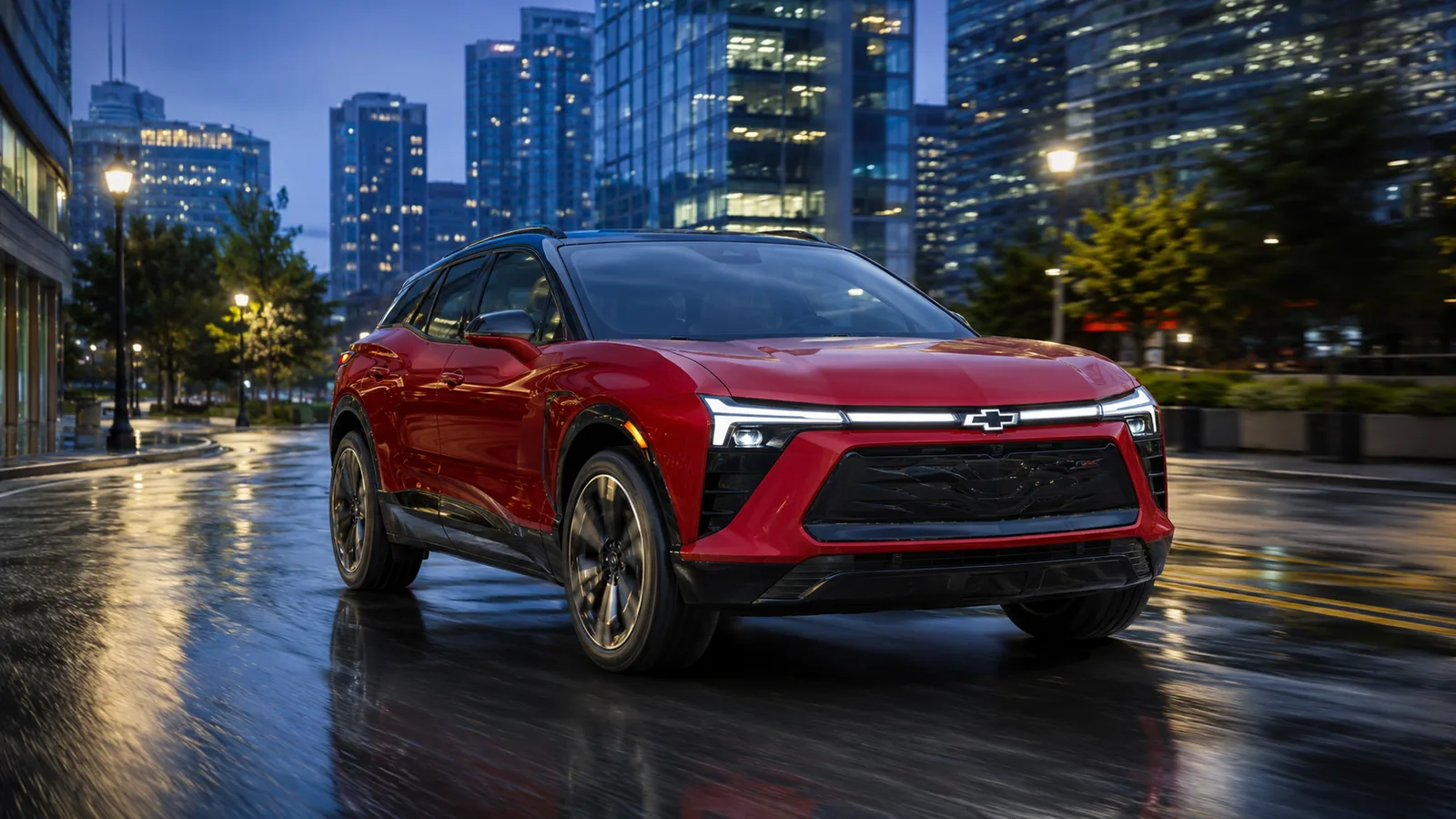
The 2026 Blazer EV’s exterior design carries over Chevy’s bold styling with a sculpted body and aggressive front fascia. It looks rugged yet sleek, reflecting an athletic SUV. Key features include LED headlights and a closed grille (since it’s electric) with a subtle LED “slash” across the nose. The ground clearance and body proportions are typical for a mid-size SUV. Available wheel sizes range up to 22 inches (with bronze finish in the Tech Bronze package). In person, reviewers say the Blazer EV “dazzles with upscale styling and a plush ride”motortrend.com.
- Dimensions: It’s a 4-door, 5-passenger crossover (no third row). Cargo capacity is solid: about 26 cubic feet behind the rear seats, expanding to 60 cubic feet with them foldedcaranddriver.com. That’s roomy for groceries or travel gear (Car & Driver calls it a “very large” 60-cu-ft flat load floor). The hatch opens wide for easy loading. The interior is well-finished with modern touches (available heated/ventilated seats, flat-bottom steering wheel in higher trims).
- Colors and trims: Beyond Tech Bronze, paint options include Radiant Red, Chase Gray, Dark Ash, and a new Iridescent Blue. Many trims (RS and SS) feature two-tone black/red interior accents; LT trims can be monotone. A hands-free power liftgate is standard on RS/SS and optional on LT, which adds convenience.
Step-by-step: Exterior inspection. Walk around the Blazer EV: note the enclosed grille with the Chevy badge up top, sculpted hood lines, and rear LED taillight bar. Check out 22-inch wheels (if on your trim) for a bold look. Inspect the charging port (located on the front fender) – it’s hidden behind a flush door for a clean side panel. Finally, test the liftgate: the RS’s hands-free opening is as easy as kicking your foot under the bumper (standard on RS/SS)caranddriver.com.
Interior, Comfort and Cargo
Inside, the Blazer EV is a two-row, five-seat SUV with a clean, driver-focused layout. The cabin feels modern and spacious: ample headroom and legroom for adults up front and in back. Materials are mostly cloth and soft plastics; higher trims get leatherette and heated/ventilated seats. Key interior highlights:
- Dashboard and tech: A massive 17.7-inch portrait touchscreen dominates the center stack, angled toward the driver. Below it are physical knobs for volume and climate controls – a nice ergonomic touch. An 11.0-inch digital gauge cluster sits in front of the driver, also providing navigation prompts and battery information. The infotainment runs Google’s built-in system, which has Google Maps, Assistant, Waze, Spotify etc., but Apple CarPlay/Android Auto are not supported. (This lack of smartphone mirroring is a frequent complaintkbb.com.) All Blazer EVs come with wireless charging and multiple USB-C ports.
- Seating and space: Both front and rear seats are comfortable and supportive. Car & Driver reports that “both the front and rear seats are spacious and comfortable for adults”. The rear seatback splits 60/40 and folds flat with a lever; folded, the flat load floor gives 60 cubic feet of cargo spacecaranddriver.com. Cargo length is sufficient for large items. Even with the hatch closed, a decent pass-through under the liftgate handles small items easily.
- Comfort features: Standard features on higher trims include heated front seats, a heated flat-bottom steering wheel, and a hands-free power liftgate. Ventilated (cooled) front seats are standard on RS and SS. The cabin has standard dual-zone automatic climate control. Headroom is good, though very tall people might find the sloped rear roofline (part of the EV styling) slightly restrictive.
A few downsides in the interior: the frunk (front trunk) is quite small – only about 2-3 cubic feet for charging gear (Chevy provides a basic charging cord). There is no jump-start point for 12V, but the design frees up space in the frunk. Also, because of the large center screen, visibility of the road is a bit compromised by the screen’s lower portion – some drivers need to look around it. Finally, as noted, tech-savvy users miss CarPlay/Android Auto.
Real-World Example (Infotainment): Owners find the Google-based system easy to use; for instance, Google Maps shows charging station suggestions along your route. But many complain that without CarPlay, they can’t mirror smartphone apps directly. This trade-off means if your friends are accustomed to Apple CarPlay on other cars, you’ll rely on Chevy’s built-in apps instead.
Powertrain and Performance
The 2026 Blazer EV offers a variety of electric powertrain configurations, allowing buyers to prioritize range, efficiency, or performance:
- Base FWD (Front-Wheel Drive) motor: Standard on LT and RS. A single front electric motor (permanent-magnet) produces about 220 horsepower and 243 lb-ft of torque. This model has the highest range because it’s more efficient. EPA range is 312 miles on a full charge (for the RS FWD modelchevrolet.com), matching or exceeding rivals. It accelerates briskly (~0–60 in the 6–7 second range) but isn’t as sporty as AWD models.
- Dual-motor AWD (All-Wheel Drive): Adds a second motor on the rear axle (induction type), for 300 hp combined and 355 lb-ft torque. This boosts traction and acceleration, but uses more energy. The 85 kWh AWD model gets about 283 miles EPA range. In tests, an AWD RS did 0–60 in ~6.0 secondsmotortrend.com. The AWD system can torque-vector through corners to improve handling.
- Blazer EV SS (AWD performance): Debuted in 2025, the SS is dual-motor AWD only. It uses two permanent-magnet motors for a combined 615 hp and 650 lb-ftchevrolet.com. Paired with the larger 102 kWh battery, the SS still manages about 302–303 miles EPA range. In real tests, SS does 0–60 mph in about 3.4 seconds, making it extremely quick for an SUV. The SS also gets upgraded brakes (6-piston Brembos) and stiffer suspension tuning for sportier driving.
Performance Summary: The Blazer EV spans the EV spectrum: from a long-range cruiser (220 hp FWD with 312 mi range) to a muscle-SUV (615 hp AWD SS with 3.4s sprints). Intermediate AWD models hit the sweet spot for many buyers: around 300 hp and ~250 mi real-world range. On the road, reviewers praise the SS’s instantaneous torque and smooth acceleration, noting it feels “like a rocket” when Wide Open Watts mode is activated. The standard regen braking (with One-Pedal Driving mode) makes city driving easy and also contributes slight deceleration, helping efficiency.
- Driving Dynamics: Car and Driver found the ride comfortable and handling predictable. Steering is tuned for a comfortable, not sporty, feel (some drivers wish for more feedback). Body roll is well controlled for an SUV. The air suspension (optional on SS and LT RS) adds adjustability: it can lower for highway smoothness or raise for light off-roading.
Battery, Range, and Efficiency
The Blazer EV has two battery pack options and varying range:
- 85 kWh battery (standard): This is the smaller pack used by base models and the SS. FWD RS with 85 kWh: EPA 312 mileschevrolet.com. AWD versions with 85 kWh: EPA 283 miles. The 85 kWh pack is roughly 59 kWh usable. Efficiency is high: the EPA combined is up to ~104 MPGe (for RWD RS) and 95-114 MPGe depending on config.
- 102 kWh battery (optional): Available with SS (and in newer updates, an SS exclusives) for maximum power and a bit more range. RWD (if offered on RS) with 102 kWh would rank highest. The SS’s 102 kWh gets about 303 miles EPA, slightly more than the AWD 85-kWh models. In practice, extra weight from the bigger pack and AWD traction eats range, but it’s still class-leading for a 615-hp SUV.
Range vs. Prior Years:
- 2024 Blazer EV: Max EPA ~324 miles (RS RWD with 102 kWh).
- 2025 Blazer EV: Max EPA ~334 miles (new RS RWD).
- 2026 Blazer EV: Max EPA now 312 miles (RS FWD with 85 kWh) (as MotorTrend confirms) because the RWD long-range model is discontinued. AWD and SS are under 300.
So in summary, the 2026 range dropped somewhat because Chevy removed the longer-range RWD model. EPA-estimated ranges are 283–312 miles for 2026 depending on drivetrain, compared to 283–334 miles for 2025 and 279–324 for 2024.
Real-World Example (Highway Test): In Car and Driver’s 75-mph highway test, an AWD RS got 200 miles, and the SS managed 250 miles. That shows real-world range on the highway is lower than EPA, so for long-distance travel plan stops.
Maximizing Range (Tips)
To stretch the Blazer EV’s range, Chevy recommends simple habits:
- Use Regen On Demand: The Blazer EV lets you increase regenerative braking via a “Regen on Demand” paddle. Engage it to recharge a bit of battery when slowing, which can add mileage. One-Pedal Driving mode (max regen) can also be used in stop-and-go traffic.
- Precondition the Cabin: Heat or cool the car while still plugged in. That way, climate control doesn’t drain the battery when driving. In winter, warm up the interior before unplugging; in summer, pre-cool. The Chev site explicitly calls out preconditioning as a range-preserving step.
- Drive Smoothly: Aggressive acceleration or high speeds cut range. Gentle throttle use and moderate speed will yield the best mileage. Chevy notes “smooth, gentle acceleration” helps optimize battery life.
- Watch Temperature: Extreme heat or cold can lower battery efficiency. Parking in a garage or shaded area helps.
- Keep Tires Properly Inflated: (Not mentioned in these sources, but standard EV advice.)
Following these steps can give the Blazer EV its best mileage on any trip.
Charging and Infrastructure
- Home Charging: Every Blazer EV comes with a dual-level charge cord (120 V and 240 V plugs) as standardmotortrend.com. At home, a 240-volt Level-2 charger (like the GM Wall Connector) can recharge the 85-kWh battery to full in about 8-10 hours (overnight).
- Public DC Fast Charging: The Blazer EV supports DC fast charging up to 150 kW (85-kWh pack) or 190 kW (102-kWh pack). Chevrolet claims this can add roughly 81 miles in 10 minutes on the small pack (FWD) and ~68 miles on AWD. With the big 102-kWh pack (SS or RWD models), up to 87 miles in 10 minutes (RWD) and 79 miles (SS) can be added. In other words, a quick 30-minute stop can often add 200+ miles, depending on conditions. Kelley Blue Book confirms ~40 minutes for 10–80% on a fast charger.
- Charging Networks: Using the myChevrolet mobile app (with Energy Assist), owners can find over 250,000 public chargers across North America. This includes more than 20,000 Tesla Superchargers (via GM’s NACS adapter)chevrolet.com. The app can plan routes with charging stops and even pay for charging sessions. So charging infrastructure is not a major worry – there are chargers for most road trips.
- V2H (Home Backup): For owners interested in home backup, Chevy offers the Energy PowerShift Charger with V2H (Vehicle-to-Home) capability. With the $6,500 bidirectional charger and kit, the Blazer EV’s battery can power a house (~7 kW output) during a blackout for several hours.
In practice, expect to mostly use Level-2 for daily charging. Use DC fast-charging sparingly (just long trips), as it heats the battery.
Infotainment and Connectivity
Every Blazer EV comes loaded with high-tech features:
- 17.7-inch Infotainment Display: This is one of the largest in any SUV. It runs Chevrolet’s new Google-built Android Automotive OS. You’ll get built-in apps for navigation (Google Maps), voice assistance (Google Assistant), music (Spotify, etc.)caranddriver.com, and the Google Play Store (for some apps). Navigation will even show remaining range to destination and charging stops. The system interface is generally smooth and responsive.
- No Apple CarPlay/Android Auto: A notable negative is the lack of smartphone mirroring. Chevy decided to go all-in on Google’s system, so you cannot connect your phone for CarPlay/Android Auto. Many reviewers (and owners) call this a drawback, since CarPlay/Android Auto remain popular. Instead, you use the built-in Google apps or Bluetooth audio/USB.
- Driver Display and HUD: The Blazer EV has an 11-inch digital gauge cluster with customizable layouts. It shows speed, battery status, and navigation info. A head-up display (HUD) is optionally available on some trims, projecting speed and directions on the windshield.
- Connectivity: Standard Wi-Fi hotspot, and wireless Apple CarPlay/Android Auto are not available (no tethering). It does have standard Bluetooth and multiple USB-C ports.
- Super Cruise: GM’s hands-free driver-assist, Super Cruise, is optional on all trims. When engaged on supported highways, it can steer, brake, and change lanes automatically. Kelley Blue Book and others praise Super Cruise as “maybe the best feature” of the Blazer EV SSchevrolet.com.
- Wireless Charging: A Qi wireless charging pad is available for compatible phones.
In short, the Blazer EV’s interior tech is cutting-edge except for the smartphone mirroring omission. The big screen and Google software give it a futuristic feel.
Safety and Driver-Assist Features
Chevrolet bundles many safety systems as standard on all 2026 Blazer EVs:
- Standard Safety Suite: Includes forward automatic emergency braking (with pedestrian detection), lane-departure warning with lane-keeping assist, and a rear seat reminder. Automatic high-beams are also standard, along with blind-spot monitors on higher trims. This is part of Chevy Safety Assist. The chassis is sturdy with a rigid frame, helping crash protection.
- Advanced Options: Adaptive cruise control (with hands-free driving) and a surround-view camera are offered in optional Driver Confidence packages. Super Cruise, noted above, is also an option that provides hands-free highway driving on pre-mapped roads.
- Crash Test Ratings: The 2025 model earned top scores: NHTSA gave it 5 stars overall, and IIHS rated its frontal collision prevention “Good”. (Pedestrian detection was rated “Acceptable.”) The Blazer EV’s body and airbags performed well in crash tests.
- Battery Safety: The battery pack is liquid-cooled and has multiple safety sensors. An 8-year/100,000-mile warranty covers the battery (this is well above the industry average, as expected for EVs).
Overall, the Blazer EV’s safety gear is comprehensive. Real-world testing shows it handles crash scenarios competently.
Pricing, Trims, and Ownership
- Trim Levels: The 2026 Blazer EV comes in LT, RS, and SS trims (with FWD or AWD on LT/RS, and AWD only on SS). LT is base (less power, fewer amenities), RS is sportier (larger wheels, nicer interior touches), and SS is the high-performance model.
- MSRP: According to MotorTrend and KBB, 2026 MSRPs are roughly: LT starts ~$46,500, RS ~$51,900, SS ~$62,000. A fully loaded SS can hit the mid-$60K rangemotortrend.com kbb.com. Dealer and market factors can reduce these by a few thousand. This pricing is similar to 2025 (LT $46K, SS $62K). For comparison, the 2024 Blazer EV (before SS) started a bit higher, but GM has since shaved about $2,000 off the base price.
- Cost of Ownership: The Blazer EV qualifies for federal and state EV incentives (check current rules). It also has the usual EV perks like high utility and low “fuel” cost (Chevrolet estimates >90% savings vs. gas). Insurance and maintenance are on par with other EV SUVs. Note: There is no free maintenance beyond the first visit; Chevy does offer 3 yr/36k bumper-to-bumper warranty and 8 yr/100k on the battery.
- Chevy Accessories: Buyers can add the GM Wall Connector (home charger), All-Star Care plans, and the Energy PowerShift V2H charging station.
Which Trim to Pick (Recommendation): For most buyers, the midrange RS (AWD) is a good compromise: 300 hp, respectable 0–60 (~6.0 s), and a long range. The RS also includes premium touches like 21″ wheels, heated/vented seats, and hands-free liftgate. If you need maximum range, the front-drive RS/LT is best (312 miles). If you crave performance, the SS is spectacular but heavier. As Car and Driver suggests, “we’d go with the mid-range RS model… AWD has more horsepower, FWD has more range.”.
Comparison to 2024 and 2025 Models
- 2024 Blazer EV: This was the launch year with two trims (LT and RS), and only RWD or AWD configurations (no FWD). The 2024 RS (RWD) had up to 324 miles EPA range and 470 hp (with optional boost)caranddriver.com. Acceleration was fast (C&D saw 0–60 in ~3.3 s for the RS) and MPGe was high (up to 102 city/87 hwy). Key points: it was Chevy’s first EV SUV, with a premium price (~$55K to start), and it won MotorTrend’s 2024 EV SUV of the Year in AWD form.
- 2025 Blazer EV: Major updates. The big news was the SS performance model (615 hp, 3.4s sprint) and an even longer-range RWD RS (334 miles EPA). A new base FWD option also appeared. Styling got minor tweaks. Overall, 2025 broadened the lineup. Price range stayed $46K–$62K. Reviewers noted improved refinement and range options. 2025 sales were rocky (software bugs and a brief stop-sale in 2024 had to be remedied) but the fixes are in place.
- 2026 Blazer EV: Only modest changes from 2025. Chevy eliminated the RWD-only RS, so now RS is FWD/AWD (range caps at 312 EPA). Tech Bronze package and small color tweaks arrived. Standard content (big screen, dual-level cord) remained. In short, the 2026 model is more of a carryover with incremental updates.
- Range: From 324/334 mi down to 312 mi (max).
- Trims: 2025’s SS, RS, LT all carry over (except 2026 has no RS-RWD).
- Price: Roughly the same as 2025 (maybe $0–$500 difference).
- Features: New Tech Bronze, standard dual cord/NACS, minor color changes.
- Tech: Google infotainment remained, and no change in connectivity (still no CarPlay).
In summary, if you’re deciding between model years: the main 2025 novelty was the SS and highest-range RS. The 2026 is essentially the same SVU with those in place (but RWD RS removed). If maximizing range was your goal, 2025 RWD RS is slightly better – but 2026 offers the same tech with no downsides beyond range.
Real-World Use Case: Daily Driving and Road Trips
For a typical commuter, the 2026 Blazer EV performs like any EV of its size:
- Daily driving: You’ll likely run mainly on the smaller 85 kWh pack (unless you got an SS). Charging at home overnight (Level 2) fully restores ~300+ miles of range. A 50–60 mile commute uses ~10–15 kWh, so you’d recharge every few days. One-pedal driving makes stop-and-go traffic smooth. Cargo is plentiful for groceries, sports gear, or weekend luggage.
- Long trips: Plan for stops. With max 312 miles EPA, a cold highway range might be ~200 miles (at 75 mph). Fortunately, the Blazer EV can rapidly recharge. A short 15–20 minute DC fast-charge stop can top up 60–80 miles, and a 40-min stop adds well over 200 miles. Highways now have enough fast chargers that major routes are feasible. Using the onboard navigation or myChevy app to route through chargers is recommended.
Example Road Trip: Suppose you drive from Los Angeles to San Francisco (~380 miles). In a 2026 Blazer EV RS FWD (312 EPA), you would leave with full charge (80–90%). You’d likely stop once – say 200 miles in – and add around 200 miles in 30 minutes at a 150-kW charger. By the end, you’d have nearly full range again. Total trip time might be ~7–8 hours including charging, comparable to a gas vehicle with a fuel stop. The Blazer EV’s comfort and cargo capacity mean longer drives remain easy.
Competitors and Context
The Blazer EV competes with other electric midsize SUVs like the Ford Mustang Mach-E, Tesla Model Y, Hyundai Ioniq 5, and Kia EV6/EV9. Compared to these:
- Range: Its 312-mile max is high but slightly under the Model Y’s 330+ or EV6’s 310, and Mach-E’s 300-ish (depending on version). Telsa still holds the absolute range crown (up to ~330–350 mi)kbb.com.
- Performance: The SS’s 3.4s 0–60 makes it one of the fastest (comparable to Mach-E GT and faster than Model Y Performance in tests). The base model is not as quick as a Model Y RWD (~4.8s) but still decent.
- Style and Comfort: Reviewers praise the Blazer EV’s upscale interior and spaciousness. The Ioniq 5 has a more minimalist interior but less rear legroom. The Mach-E is sporty but less cargo space (Mach-E’s frunk vs Blazer’s bigger rear hatch).
- Features: Blazer EV’s cabin tech (17.7″ screen, Super Cruise) is ahead of many. However, the lack of CarPlay is a setback versus virtually all competitors. Ford and Hyundai offer smartphone integration; Tesla has its own excellent software.
- Price: At $46–62K, pricing is on par with Mach-E and EV6. Cheaper than a loaded Model Y Performance, but more than some base models (e.g. Mach-E Select or Hyundai SE).
- Real-World Example: MotorTrend summed it up: “the Blazer EV is a solid option for those new to EVs or looking to step up to a larger SUV”motortrend.com. Its pros (range, power, comfort) outweigh its cons (no CarPlay, past bugs).
Conclusion
The 2026 Chevrolet Blazer EV offers a versatile electric SUV package: roomy and comfortable interior, impressive acceleration, and a long range for an SUV. Top strengths include its powerful SS variant (615 hp) with near-supercar performance, up to 312 miles EPA range on the long-legged versions, and advanced tech like Super Cruise and a 17.7″ touchscreen. It remains a competitive choice alongside the Ford Mach-E, Tesla Model Y, and Hyundai Ioniq 5.
However, the Blazer EV isn’t perfect. The lack of Apple CarPlay/Android Auto and a slightly reduced range (versus 2025) are notable limitations. Also, pricing is premium for a Chevy (top trims near $60K). Overall, experts say it’s a capable electric SUV that should suit most buyers – especially families or tech enthusiasts – as long as you’re comfortable with Chevy’s Google-based infotainment and the current pricing..
Key Takeaways:
- Performance: 220–300 hp in LT/RS; 615 hp in SS. SS does 0–60 mph in ~3.4 s.
- Range: Up to 312 miles EPA (FWD RS); AWD models 283 mi; SS 303 mi.
- Charging: 150–190 kW DC fast-charging adds ~80 mi/10 min. Home charging in 8–10 hours.
- Interior: Spacious 2-row layout, 26/60 cu‑ft cargo. Huge 17.7″ touchscreen (Google-based), 11″ gauge. No CarPlay/AA.
- Safety: Standard AEB, lane-keep, etc. 5-star NHTSA (2025); optional Super Cruise.
- Pricing: ~$46K–$62K MSRP. Battery warranty 8 years/100k mi.
Overall, the 2026 Chevy Blazer EV is a solid, high-tech electric SUV with few quirks. Its broad trim lineup means buyers can prioritize range, performance, or value. Its relative trade-offs (no CarPlay, slightly higher price) are balanced by Chevy’s brand trust and dealer network, making it an attractive choice for those wanting a mainstream midsize EV.
For more on electric SUVs and Chevy’s latest models, see FrediTech’s reviews of the 2026 BMW iX3freditech.com and 2026 GMC Hummer EV 3X freditech.com.