

The all-new 2026 BMW iX3 marks a major milestone for BMW – it’s the brand’s first model on the next-generation Neue Klasse electric platformwired.com. BMW touts the iX3 as an “über” iX for the mainstream, packing breakthrough battery and drivetrain tech. Early indications are impressive: a giant 108.7 kWh battery yielding up to 805 km (≈500 mi) WLTP rangecarsales.com (roughly 400 mi on the US EPA cycle), and an 800V electrical architecture that supports ultra-fast 400 kW DC charging. This dual-motor xDrive50 variant produces around 462 horsepower (345 kW) and sprints 0–62 mph in under 5 seconds. With a starting price in the U.S. around $60,000bmwusa.com (about £58,755 in the U.K.stuff.tv) and rich tech like the new “Panoramic iDrive” HUD-infotainment system, the iX3 aims to redefine BMW’s electric SUV line. This in-depth review covers its design, specs, performance, charging, tech features, and how it stacks up in the EV market.
Key Features & Specifications
- Battery & Range: 108.7 kWh Lithium-ion pack; up to 805 km WLTP (≈500 mi) (≈400 mi EPA) on a full charge. Claimed efficiency is as low as 15.1 kWh/100 km.
- Powertrain: Dual-motor xDrive50 system, ~462 hp (345 kW) and 645 Nm torque. BMW quotes 0–100 km/h in ~4.9 s (sub-5 s to 60 mph).
- Charging: 800V architecture enabling up to 400 kW DC fast-charging. About 200 miles (≈320 km) can be added in ~10 minutes on a 400 kW charger. (BMW estimates 10–80% in ~21 minutes.) AC charging is 11 kW; bidirectional V2L (3.7 kW output) is supported.
- Dimensions: Length 4782 mm, width 1895 mm, height 1635 mm, wheelbase 2897 mm. Cargo: 520 L behind rear seats (1750 L folded) plus a 58 L front trunk (“frunk”). Cd ~0.24 thanks to smooth SUV styling.
- Technology: Panoramic iDrive HUD–infotainment with a full-width windshield display plus a 17.9″ touchscreen. New BMW “Heart of Joy” central computer for instant dynamic control. V2L/V2H/V2G capability (with AC output for appliances).
- Safety & Comfort: Rigorous suite of driver aids (adaptive cruise, lane-keep, automatic emergency braking). High-strength chassis with 9 airbags. Premium interior materials (vegan leather, ambient lighting) and advanced HUD/navigation systems.
These headline specs demonstrate that the 2026 iX3 isn’t just a rebadged X3 – it’s a clean-sheet electric SUV that showcases BMW’s latest EV technology.
Exterior Design
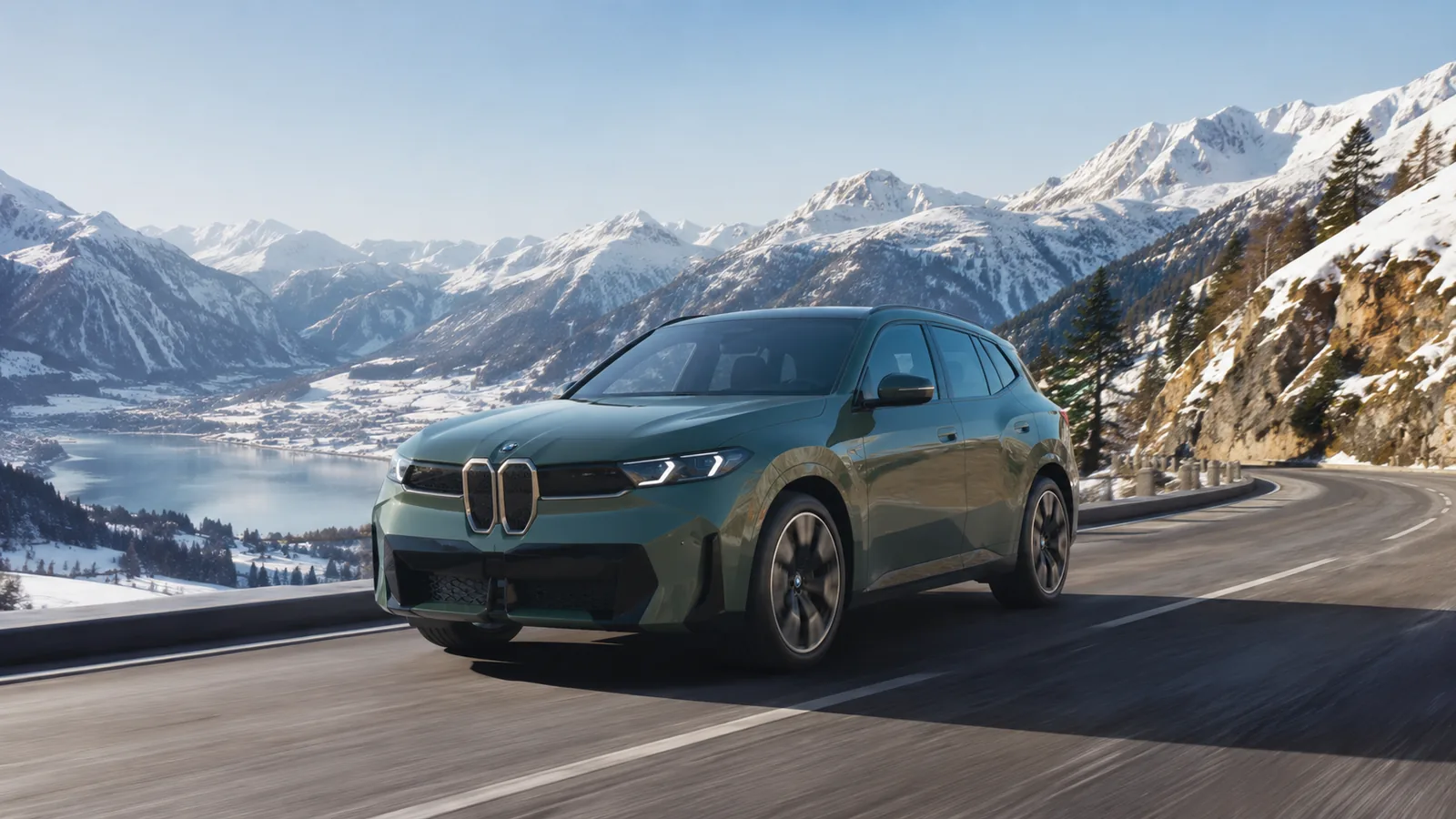
The 2026 iX3 adopts a modern BMW SUV shape with clean, aerodynamic lines. Its squared-off silhouette is softened by aerodynamic contoured surfaces, yielding an excellent drag coefficient (~0.24)carsales.com.au. Up front, the iconic BMW kidney grille has been reimagined: instead of chrome, it features an illuminated trim and the headlights incorporate a bold new LED signature with welcome light “orchestration”. Flush, power-deploying door handles and hidden wipers further tidy the exterior.
BMW iX3 exterior front and profile view showing the illuminated grille and sleek SUV design.
Around back, the iX3’s tail is squared with horizontal LED taillights and minimal overhang. The body stands on 20″ wheels as standard (21″/22″ optional), maintaining a tall stance for ground clearance. GMC-style adaptive air suspension (with a 2300 kg curb weight) lets drivers raise or lower the ride height, aiding aerodynamics on highway drives and clearance off-road. The panoramic glass roof spans the cabin, adding to the sense of openness and also improving airflow over the vehicle.
Overall, despite its large size (4782 mm long), the iX3’s uncluttered surfaces and subtle creases give it a lean, modern look. BMW design teams have largely toned down recent styling extremes here – as one reviewer noted, “the grille design is more restrained than some previous BMW models” yet still attractivestuff.tv. The result is an SUV that looks big but not overly bulky.
Interior and Technology

Panoramic iDrive and Cockpit
The iX3’s interior revolves around BMW’s new Panoramic iDrive system. Instead of a traditional gauge cluster, the driver sees driving information projected onto a wide, panoramic heads-up display along the bottom of the windshield. This pillar-to-pillar “Panoramic Vision” display (≈1100 mm wide) supplements a massive 17.9-inch central touchscreen. The graphics are crisp and can be customized via drag-and-drop, managing functions like navigation, media, and climatestuff.tv.
This setup is complemented by a BMW “squircle” steering wheel with capacitive touch controls and haptic feedback, streamlining the dash to a minimalist design. A 3D-effect HUD projects key data (speed, range) in full view of the drivercarsales.com.au. Reviewers note there is a learning curve – for instance, accessing climate controls requires using the touchscreen – but praise the futuristic appeal. One describes the experience: “initially I thought it was all quite busy … but the key focus is speed and range straight ahead, which works rather well”.
Connectivity is top-notch: wireless Apple CarPlay/Android Auto, in-car Wi-Fi, and integrated streaming apps (Spotify, etc.) via BMW’s OS. Ambient lighting and sustainable trim materials (e.g. open-pore wood, vegan leather) emphasize luxury. Front seats are power-adjustable (controls on door panels) and available in Merino leather; rear seats are roomy enough for taller adults. Overall, the cabin feels spacious (483 L of total interior room) and modern – reviewers particularly liked the unobstructed outward view thanks to slim pillars.
Driver Assistance and Safety
BMW loaded the iX3 with advanced driver aids. Standard safety tech includes:
- Adaptive Cruise Control with Steer Assist – hands-free highway driving up to ~130 km/h with lane-centering. (BMW’s new Motorway Assistant can even change lanes with a glancecarsales.com.au.)
- Lane Keeping Assist and Automatic Emergency Braking with pedestrian/cyclist detection (standard across trims).
- Traffic Sign Recognition and the latest cameras/radars all around.
Carsales notes that all lane/park sensors are active but cautions some features (like lane-keep in twisting roads) may disengage. NHTSA/Euro NCAP safety ratings for the 2026 iX3 have not been published yet, but given BMW’s track record and the amount of active safety tech, we expect it to rate highly. As one verdict put it: “Interior lights turn on/off automatically in vicinity, charge door opens/closes hands-free… AI is getting more intuitive over time” – reflecting BMW’s push for a seamless tech experience.
Performance and Handling
Electric Powertrain
The heart of the iX3 50 xDrive is its dual-motor powertrain. BMW’s sixth-generation eDrive system uses a front and rear motor delivering about 345 kW (462 hp) and 645 Nm of torque. This all-wheel-drive setup gives a lively feel: the launch is smooth and powerful (BMW claims 0–100 km/h in ~4.9 s, which translates to roughly 0–60 mph in under 5 secwired.com). In normal driving, the motors modulate instantly for efficiency, but switchable drive modes (Comfort, Sport, Eco Pro, Adaptive) let the driver dial in more aggressive throttle, steering, and suspension settings.
Braking is almost entirely regenerative (~98% regen), so one-pedal driving is highly effective and energy is recaptured efficiently. Reviewers report that even heavy braking feels smooth and controlled: “it pulls up exceptionally smoothly whether just brushing or stomping the pedal”. The iX3’s suspension is tuned for comfort, with plenty of travel; optional adaptive dampers will become available later to further refine ride quality.
Handling-wise, the iX3 retains BMW’s “Ultimate Driving Machine” DNA. The center of gravity is lower (due to the battery pack) than a normal X3, aiding cornering. Steering is precise and electric-assist, adjusting weight with speed. Carsales notes the steering even has a good “feel” at speed: “The iX3 also offered assured steering in 130 km/h sweepers… yes, there is feel”carsales.com.au. With a 12.1 m turning circle, tight parking maneuvers are manageable. The SUV carries 2300 kg, so it’s heavier than most combustion X3s, but BMW tried to offset that with efficient design – as a result, in spirited driving one tester averaged just 18 kWh/100 km (≈4 mi/kWh) and estimated a real-world range of ~600 km (≈375 mi) from spirited mountain drives.
Driving Experience
Behind the wheel, the iX3 delivers a refined and engaging drive. Acceleration is smooth, with no turbo lag (electric torque is immediate). In everyday use, the ride is very quiet and cushioned – even on highways, the cabin stays hushed, aided by the SUV’s excellent aerodynamic shape. In sportier modes, the electric motors give brisk response. One reviewer found it “more pleasing in its own electrified way”: even in Eco mode there’s ample shove, and Sport mode delivers lively mid-range thrust. The adaptive suspension (with ride-height control) helps absorb bumps well.
Although the iX3 isn’t aimed at hardcore track use, BMW’s engineers have tuned it for balance: minimal body roll, and thanks to the high output motors, it feels confident in twisty roads. For example, testers noted it corners flat and handles its bulk deftly, aided by all-wheel steering (selecting tighter rear wheel angle for agility). The electric platform also brings features not possible in ICE SUVs: “soft stop” one-pedal driving mode, detailed regenerative braking adjustment, and near-instant torque vectoring.
Overall, the driving impression is that of a very competent luxury SUV: smooth, powerful, and responsive, without weird EV traits. As Stuff magazine summed up: “The iX3 has oodles of driver appeal…the twin-motor model…providing a very dynamic experience that lifts it above being just another humdrum EVstuff.tv.” A bonus for owners: true Level 2 hands-free driving assists (curiously called Motorway Assistant) allow short hands-off segments on highways, including automatic lane changes with just a glance indicator.
Range, Charging, and Battery
The iX3’s 108.7 kWh battery is one of the largest in any production EV. BMW claims up to 805 km (500 mi) WLTP range, which roughly translates to about 400 miles EPA in U.S. testing. In practical terms, that means most drivers could comfortably exceed 300 miles per charge under mixed driving. Test drives confirm the efficiency is strong: one editor reported around 4 mi/kWh on a mixed route, comfortably facilitating 300+ mile trips on a single chargestuff.tv.
Charging speed is a major highlight. The iX3 uses an 800V architecture (like Porsche Taycan and newer BMWs) to allow up to 400 kW DC charging. On a cutting-edge station, the iX3 can add ~200 miles of range in about 10 minutes. Even at more common rates, 10–80% takes roughly 21 minutesbmwusa.com, making cross-country charging stops impressively brief. For home charging, iX3 accepts 11 kW on AC, fully recharging in ~11–12 hours from empty.
The SUV also supports Vehicle-to-Load (V2L) output: In markets like Australia it can provide ~3.7 kW output to run power tools or camping equipment from the car’s battery. BMW will enable Vehicle-to-Home (V2H) and Vehicle-to-Grid (V2G) functions in some regions, letting you export power back to the grid, turning the iX3 into a mobile energy resource. This bidirectional capability is still rare but is part of BMW’s vision of future smart-energy integration.
Step-by-step, charging the iX3 works like this:
- Plug In: Connect either an 11 kW AC cable at home or a 150–400 kW DC fast-charger. The onboard system auto-negotiates.
- Start Charging: At a 400 kW charger, the car will typically sit at peak power (400 kW) until about 70% SOC, then taper. At 150 kW chargers (400V), charging is limited to 150 kW.
- Monitor: The dash and HUD show live charge rate and time. About 10 minutes of charge (at 400 kW) yields ~200 mi (320 km) of range.
- Finish: Once you reach 80%, the rate slows. 10–80% takes ≈21 min. The system then holds full SOC safely.
This combination of extreme range and rapid charging means the iX3 effectively eliminates range anxiety: even if you drive hard and cover hundreds of miles, recharging is swift.
Pricing and Availability
BMW confirms the first iX3 xDrive50 (dual-motor) will arrive summer 2026 in the U.S.bmwusa.com, with ordering opening earlier in the year. Pricing is competitive for its class: around $60,000 MSRP for the base xDrive50 in the U.S.. (UK pricing starts at £58,755, which suggests ~€70,000 in Europe). Lower-powered versions (single-motor RWD “eDrive” and base xDrive versions) are planned for 2027, likely with lower pricing but similar range.
For context, that starting price positions the iX3 below luxury rivals like the Mercedes EQE SUV and Jaguar I-Pace, making it an appealing value given its range and tech. BMW is even offering financing incentives at launch; Wired reported an ad citing $60,000 pricewired.com and a strong 8/10 score in their review. Additionally, some countries (like those with incentives for local production) may see subsidized pricing – notably, unlike its predecessor (built in China), the iX3 is manufactured in Hungary without any fossil fuels used in productionyoutube.com.
In summary, the iX3 delivers flagship specs at a mainstream price. Given BMW’s heavy investment (the largest in its history) into the Neue Klasse projectwired.com, the company will want the iX3 to be a commercial success. All signs—range, performance, and price—are on its side.
Frequently Asked Questions (FAQ)
What is the driving range of the 2026 BMW iX3?
How fast can the BMW iX3 2026 accelerate?
How long does it take to charge the iX3?
Does the BMW iX3 support vehicle-to-load or bidirectional charging?
What new technology does the 2026 iX3 have?
When will the 2026 BMW iX3 go on sale and what is its price?
How does the BMW iX3 compare to other electric SUVs?
Conclusion
The 2026 BMW iX3 is a bold step for BMW into the electric future. As Wired notes, it’s “BMW’s first car on its new EV platform”, and it comes loaded with top-tier specs: industry-leading range (~500 mi WLTP), superfast charging, and a powerful dual-motor drivetrain. BMW has also loaded it with cutting-edge tech (Panoramic iDrive, advanced AI, V2X capabilities) and premium features. In our analysis, the iX3 stands out for delivering flagship performance at a relatively mainstream price.
This makes the iX3 a potential game-changer in the luxury EV market. It combines BMW’s driving experience (“Ultimate Driving Machine”) with the practicality of an electric SUV. For buyers who want a high-tech, long-range EV without a super-premium price, the iX3 checks all the boxes. As more units arrive later in 2026, it will be telling to see how it drives in everyday life and how competitors respond.
For more insights on electric SUVs, see FrediTech’s other expert reviews like the [2026 GMC Hummer EV SUV 3X]freditech.com(a 830 hp off-road EV) and the [Rivian R1S Electric SUV]freditech.com (up to 410 mi range, 1,205 hp). These in-depth articles cover similar ground on range, performance, and technology. Together, they give a broad picture of where electric SUVs are heading.