

Tesla’s next-generation Roadster is the most anticipated electric supercar of the decade. First unveiled as a prototype in 2017, the new Roadster promises hypercar performance – Tesla claims a 0–60 mph time of 1.9 seconds, a top speed beyond 250 mph, and a 620-mile electric range on a single chargecarsdirect.com. These specs would outmatch virtually every gas-powered and electric sports car. Pricing is expected to start around $200,000 for the base model, with a special Founders Series ($250,000) limited to just 1,000 unitscaranddriver.com. Despite its supercar ambitions, Musk insists the Roadster will retain some everyday usability (four seats and a glass roof) while packing “crazy” technology beyond any James Bond car.
However, the Roadster has faced numerous delays. Originally slated for a 2020 launch, Tesla has pushed it back multiple times. CEO Elon Musk now suggests a demo by late 2025 and production to start around 2027autoweek.com. In the meantime, Musk has been stoking excitement with teasers like a “SpaceX package” of rocket thrusterselectrek.co. In this in-depth review we’ll break down everything known about the 2025 Tesla Roadster – from design and interior to battery, performance, and that SpaceX tech – citing official figures and expert analysis. We’ll also compare it to other electric models (like the Rivian R1S and GMC Hummer EV) and answer common questions buyers are asking.
Design and Exterior

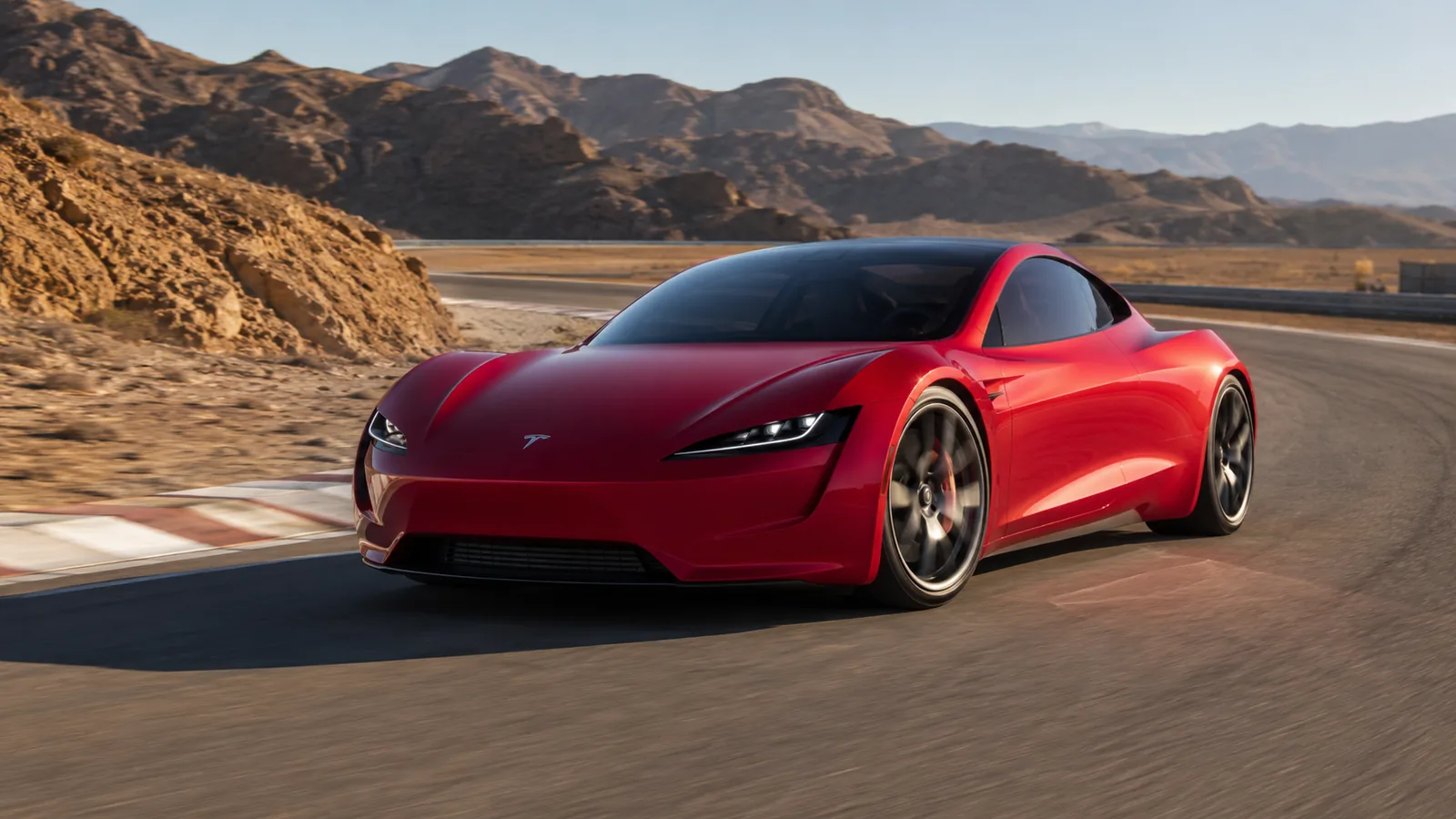
A sleek electric roadster concept (Tesla Roadster style) with a removable roof.
The 2025 Tesla Roadster is expected to have a sleek, low-slung sports-car body. Early prototypes and renderings show a curvaceous coupe profile with aggressive fenders and a Targa-style glass roof that removes and stows in the trunkcarsdirect.com. Tesla’s official specs mention a “lightweight, removable Glass Roof” for open-air drivingtesla.com. With aerodynamic lines, flush door handles, and a fastback rear, the Roadster’s shape is both futuristic and functional. Tesla designers likely updated the 2017 concept’s styling with sharper edges and new lighting, but the overall look remains a modern take on a classic sports car (a four-seat coupe). Elon Musk has hinted that the production version will be “very different from the prototypes” and packed with James Bond–level tech – “crazy” features beyond any one car in movie historyautoweek.com.
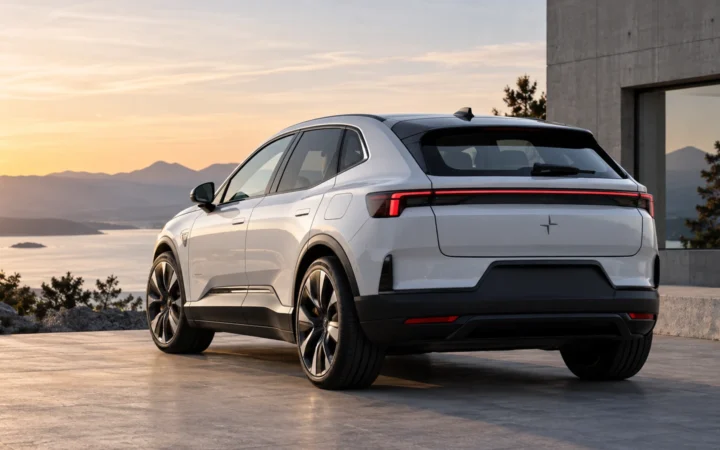
Tesla also confirmed the Roadster will have four seats (2+2 configuration) for the first time in a Tesla sports carcaranddriver.com. However, the rear seats are small (“kid seats”), reflecting a trade-off for performance. In fact, Tesla’s “SpaceX Package” (discussed below) would replace the rear seats with a pressurized gas tank, converting it to a true two-seater for added thrustelectrek.co. Overall, the Roadster’s exterior blends show-car flair with Tesla’s minimalist design language: flush surfaces, a full-width LED light bar, and a giant central touch-screen visible through the windshield. Compared to Tesla’s other models, the Roadster pushes the envelope of what an electric vehicle can look like.
Interior and Comfort
Inside, the 2025 Roadster is expected to marry high-tech minimalism with luxury. Reports indicate four-passenger seating – two front sport seats and two small rear seats – echoing the prototype that was briefly shown at reveal eventscaranddriver.com. Tesla’s signature 15–17 inch touchscreen will dominate the dash, running the latest software and providing navigation, media, and car controls. The front cabin likely mirrors a pared-down Model S or Model X layout: digital gauges (possibly relocated to the windshield), few physical buttons, and premium materials (vegan leather, carbon fiber trim, etc.). A panoramic glass roof will flood the cabin with light; when the roof is removed it stows neatly in the frunk (frontal trunk), giving an open-top experience even at highway speeds.
The rear seats are best for kids or short trips; space is tight but Tesla says they exist to make the Roadster a usable four-seater. If you choose the optional SpaceX thruster package, those back seats will be deleted and replaced by a carbon-fiber pressure tank. Regardlesselectrek.co, Tesla will equip the Roadster with modern comforts: automatic climate control, premium audio, and likely full self-driving hardware (cameras, radar, etc.) for autopilot features. Expect fast charging ports and connectivity (Wi-Fi, LTE) as standard. In short, the interior will be a driver-focused cockpit – lightweight and uncluttered – but with enough luxury touches to match its six-figure price.
Performance and Powertrain
The Roadster’s powertrain is purely electric and all-wheel drive (AWD). Tesla has said the final car will use a tri-motor setup (one motor up front, two in back)en.wikipedia.org – a step up from the dual-motor AWD of the Model S. This arrangement is expected to deliver extreme torque: Tesla’s specification sheet notes ~7,375 lb-ft of wheel torque. That translates to hypercar-level acceleration. Officially, the Roadster will sprint from 0–60 mph in 1.9 seconds, 0–100 mph in 4.2 seconds, and cover the quarter-mile in 8.8 secondscarsdirect.com. Top speed is claimed to exceed 250 mph, making it one of the fastest production cars ever. These numbers come straight from Tesla’s pitches and expert previewsautoblog.com.
In practical terms, such acceleration would rocket past competitors. For comparison, the Rimac Nevera (the current fastest EV) does 0–60 in ~1.74skbb.com, so the Roadster is in the same league. Kelley Blue Book reports Musk even claims under 1 second with the optional thrusters packageautoweek.com. Aside from launch performance, the Roadster’s AWD system will aid handling and stability. Tesla hinted at new torque-vectoring algorithms to split power instantly between wheels. Regenerative braking (powered by the same massive battery) will also recover energy on the track or street. Overall, expect world-record-rivaling performance: one commentator calls it “out of this world”electrek.co. Even without the SpaceX upgrades, the Roadster should lap others – few gas or EV supercars can match its spec sheet.
Battery and Range
The battery pack is the Roadster’s secret weapon. Tesla has confirmed a 200 kWh battery – double the size of any current Tesla model. This enormous energy store is what enables the astonishing range and performance. With that pack, Tesla claims the Roadster can cover 620 miles (≈1000 km) on a single charge. That 620-mile figure likely comes from Tesla’s own testing (similar to the 411-mile EPA rating of the 100 kWh Model S). In the real world, factors like speed, weather, and carrying the heavy thruster system will reduce range. Car & Driver notes that 620 miles will only be “achievable under very light use”caranddriver.com. In more typical mixed driving, expect something lower (perhaps 400–500 miles EPA, which still dwarfs most cars).
Fast charging will be critical for such a large battery. The Roadster will support Tesla’s latest V3 Supercharging (350+ kW) to replenish range quickly. We can expect charging from 10% to 80% in under 30 minutes at a fast charger. Regenerative braking and efficiency features (like adjustable ride height) will also help stretch the 620-mile potential. Importantly, even this massive battery pack will fit under the Roadster’s chassis without overly compromising interior space, thanks to Tesla’s expertise in structural battery integration. In summary, the 2025 Roadster promises unmatched electric range for a performance car, around six times that of many rivalscarsdirect.com.
SpaceX “Rocket Car” Package
One of the most talked-about features is the optional SpaceX package: Elon Musk’s idea to fit the Roadster with mini rocket thrusters for extra boost. The concept (touted on Musk’s Twitter in 2018 and 2024kbb.com) involves up to ten small cold-gas thrusters distributed around the car. In practice, these are not chemical rockets but high-pressure air jets. Tesla would replace the rear seats with a COPV (composite overwrapped pressure vessel) – the same type of tank SpaceX uses on rockets – to store ultra-high-pressure air. An electric pump (using the Roadster’s battery) would refill the tank over time. During acceleration, the car could release bursts of compressed air through nozzles to dramatically increase thrust, reducing 0–60 time potentially below 1 secondautoweek.com.
The thrusters could also be used mid-corner or under braking to add downforce and stability. However, experts are skeptical about practicality. Adding heavy pressure vessels and gas systems increases weight and complexity. Safety and legal issues abound – using high-pressure “rockets” on public roads raises red flags for regulatorsautoweek.com. Analysts note the energy required would tax the battery and reduce range, and tires might not handle the shock of instantaneous thrust. Tesla has also suggested the thrusters may only be demoed initially, not necessarily in final production. In short, the SpaceX package is a radical upgrade that could make the Roadster feel like a science-fiction car, but its real-world benefits (and whether it passes safety reviews) remain uncertainkbb.com. Even without it, the Roadster’s standard performance is already extraordinary.
Technology and Features
As Tesla’s halo car, the Roadster will come loaded with cutting-edge technology. It will feature the latest version of Autopilot/Full Self-Driving hardware – a suite of cameras and sensors – as standard, enabling driver-assist features like Navigate on Autopilot, auto lane changes, and (with a future software upgrade) hands-free city driving. Over-the-air software updates will keep its systems current. The massive central touchscreen and intuitive UI will offer navigation optimized for range and performance driving. We also expect high-end creature comforts: a premium sound system, advanced climate control, and connectivity (Wi-Fi hotspot, Bluetooth, apps).
Given Tesla’s focus on efficiency, the Roadster may debut new software tricks (like predictive drag reduction) to eke out extra range at high speeds. It’s also likely to support bidirectional charging (powering a home or grid from the car’s battery) as seen in other Teslas. Safety tech like a reinforced chassis and multiple airbags is a given – after all, at 250+ mph this car could never exist without them. In summary, the Roadster won’t just be a performance beast; it will carry the hallmark of Tesla innovation: a high-tech, software-defined driving experience that improves over time.
Release Date and Pricing
Tesla has been teasing the Roadster for years. As of late 2025, production is still a few years off. Elon Musk’s latest public comments indicate a demonstration by end of 2025, with an official launch event slated for April 2026 (jokingly on April Fool’s Day)autoweek.com. Full-scale manufacturing is expected to ramp up in 2027–2028en.wikipedia.org. All told, customers should expect to wait until at least the 2027 model year to actually take delivery.
Reservation opened long ago: buyers placed a $5,000 refundable deposit to hold a slot in line. Tesla eventually asked for another $45,000, totaling $50,000 down, in order to confirm a Founders Series spotautoweek.com. If you reserved early, you can still cancel (some high-profile reservation holders have pulled out). For pricing, Tesla has stated a $200,000 base price for the standard Roadster and $250,000 for the Founders Series limited editioncaranddriver.com. The Founders models all sold out (at a $50k premium) – future buyers will only get the standard model. Compared to other supercars, the Roadster’s price is relatively modest given its performance claims. It’s still a six-figure purchase, but Tesla aims to shake up the market by undercutting competitors.
Market Context and Competition
The Tesla Roadster essentially creates its own category. Few production cars can match its claimed acceleration or range. The Rimac Nevera (EV hypercar from Croatia) is one of the only rivals on performance – it does 0–60 in ~1.74 skbb.com. Tesla claims the Roadster will beat that with rocket boost. Other gas and hybrid supercars (Ferrari SF90, Lamborghini Aventador, Porsche 911 Turbo S, etc.) offer high speeds but are slower. Car and Driver notes that even Lamborghini and Ferrari are “left behind” in straight-line speedautoblog.com.
Among electric vehicles, the closest Tesla has is the Model S Plaid sedan (0–60 in 2.0 s) and the Lucid Air Sapphire (claimed ~1.89 s), but those are sedans, not pure sports cars. Outside Tesla, look at GMC’s Hummer EV (830 hp off-road truck) or the Rivian R1S SUV (1205 hp) – both are insanely fast for trucks/SUVs but still much slower in 0–60 than the Roadster. FrediTech’s review of the 2026 GMC Hummer EV 3X highlights 0–60 in ~3.5 sfreditech.com, and our Rivian R1S review shows 0–60 as low as 2.6 s (quad-motor)freditech.com – both impressive, but not in the sub-2-second league.
In short, no direct competitor exists yet. Tesla even admits it – the Roadster is its own benchmark. If successful, it will force the likes of Porsche (Mission R), Ferrari, and others to respond with their own EV supercars. For now, expect the Roadster to hold records that others can only chase.
Conclusion
The 2025 Tesla Roadster represents a bold leap for electric vehicles. With its combination of incredible performance, class-leading range, and futuristic technology, it aims to redefine what an EV supercar can be. Tesla’s claims (1.9s 0–60, 250+ mph top speed, 620-mile range) are nothing short of astonishing. Add to that Elon Musk’s SpaceX-inspired thrusters and you have something straight out of science fiction. While many details (and dates) are still to be proven, the Roadster is a showcase of Tesla’s engineering prowess and ambition. Even if every promise is not realized, it will likely be one of the most powerful production cars ever built. As Musk himself boasted, it could be “no finer car in history”. We’ll keep an eye on this rocket-car: stay tuned to FrediTech for updates as Tesla finally brings the Roadster to life.