

Introduction
The 2026 BYD Song L DM-i is a next-generation plug-in hybrid SUV from Chinese automaker BYD, a company that has rapidly become a global leader in electric vehiclesinsideevs.com. This mid-size crossover (positioned between BYD’s smaller Song Pro and larger Tang DM-i SUVs) aims to deliver the best of both worlds: long all-electric driving capability for daily zero-emission travel, and a gasoline engine for extended range on road tripsen.wikipedia.org. The result is remarkable on paper – up to 200 km of pure electric range and a total combined range of 1,630 km when using both electric and gas powercarnewschina.com. In other words, the Song L DM-i can cruise well over 1,000 miles on a full charge and tank, virtually eliminating range anxiety for hybrid drivers.
Equally impressive is the focus on ultra-efficiency. BYD’s fifth-generation DM-i hybrid system (DM stands for “Dual Mode,” with DM-i optimized for efficiency) enables a rated fuel consumption as low as 3.4 liters per 100 km (NEDC) – roughly 69 MPG in a mid-size SUV, a figure almost unheard of in this segment. For context, Toyota’s popular RAV4 Prime plug-in hybrid manages about 5.6 L/100 km (42 miles of EV range) in EPA testscaranddriver.com, highlighting just how far BYD’s technology has pushed the efficiency envelope.
But numbers only tell part of the story. This in-depth review explores the 2026 Song L DM-i from all angles – design, interior comfort, powertrain performance, electric range, safety and tech features, and pricing/value – to see if it lives up to the hype. We’ll also touch on how it compares to other new SUVs (from efficiency-first hybrids to full electrics) in an increasingly crowded market. BYD has already proven its EV expertise by surpassing Tesla in global EV salesinsideevs.com; with the Song L DM-i, it’s aiming to set a new benchmark for plug-in hybrids. Let’s dive into what makes the Song L DM-i a potential game-changer in 2026.
Overview and Key Specifications
BYD Song L DM-i (2026) at a glance:
- Powertrain: 1.5L Atkinson-cycle 4-cylinder gasoline engine (74 kW) paired with a 160 kW permanent-magnet electric motor (front-wheel drive only)carnewschina.com. Total system output is optimized for efficiency rather than outright speed, but still delivers robust combined power (~215 hp). A smooth E-CVT transmission manages the hybrid power deliveryen.wikipedia.org.
- Battery & Electric Range: BYD’s in-house Blade Battery (LFP chemistry) available in multiple capacities. The high-spec 26.6 kWh pack enables up to 200 km of pure electric driving (Chinese CLTC cycle). Lower trims offer smaller batteries (e.g. ~18.3 kWh for ~112 km EV range, ~12.9 kWh for ~75 km). The Blade Battery is known for its exceptional safety and longevity, using an innovative cell-to-pack design that improves energy density and thermal stabilitycj-vehicle.com. Battery charging is via an onboard AC charger (exact charging time depends on charger power, typically a few hours on a home charger given the battery size).
- Fuel Efficiency & Total Range: Hybrid fuel consumption is rated at 3.4 L/100 km (NEDC) for the 2026 model, a further improvement over ~3.9 L/100 km in the initial 2025 version. With a full gas tank and battery, total driving range exceeds 1,600 km (about 1,000 miles) on a single fill/charge – truly extraordinary for an SUV. Real-world economy will vary, but even if one considers stricter test cycles, the Song L DM-i clearly leads the class in efficiency.
- Performance: Acceleration 0–100 km/h in approximately 7.6–7.9 seconds (depending on battery version). While not a sports SUV, the instant torque of the electric motor makes city driving and mid-range acceleration very responsive. Top speed is around 170 km/h (limited). The focus is on smooth, quiet operation and fuel-sipping rather than drag-race figures. (For comparison, the AWD Toyota RAV4 Prime does 0–100 km/h in about 5.5 seconds with its performance tune, but at the cost of much higher fuel use and a far shorter EV range.)
- Dimensions: Length ~4,780 mm, Width ~1,898 mm, Height ~1,670 mm, on a 2,782 mm wheelbaseen.wikipedia.org. This places the Song L DM-i firmly in the mid-size crossover category (think Toyota RAV4 or Honda CR-V footprint, though a bit longer than both). It offers two rows of seating for 5 passengers and ample cargo space (~459 L trunk, expanding to 1550 L with seats folded). Despite the large battery, clever packaging (low center of gravity from underfloor battery placement) means interior room is not compromised.
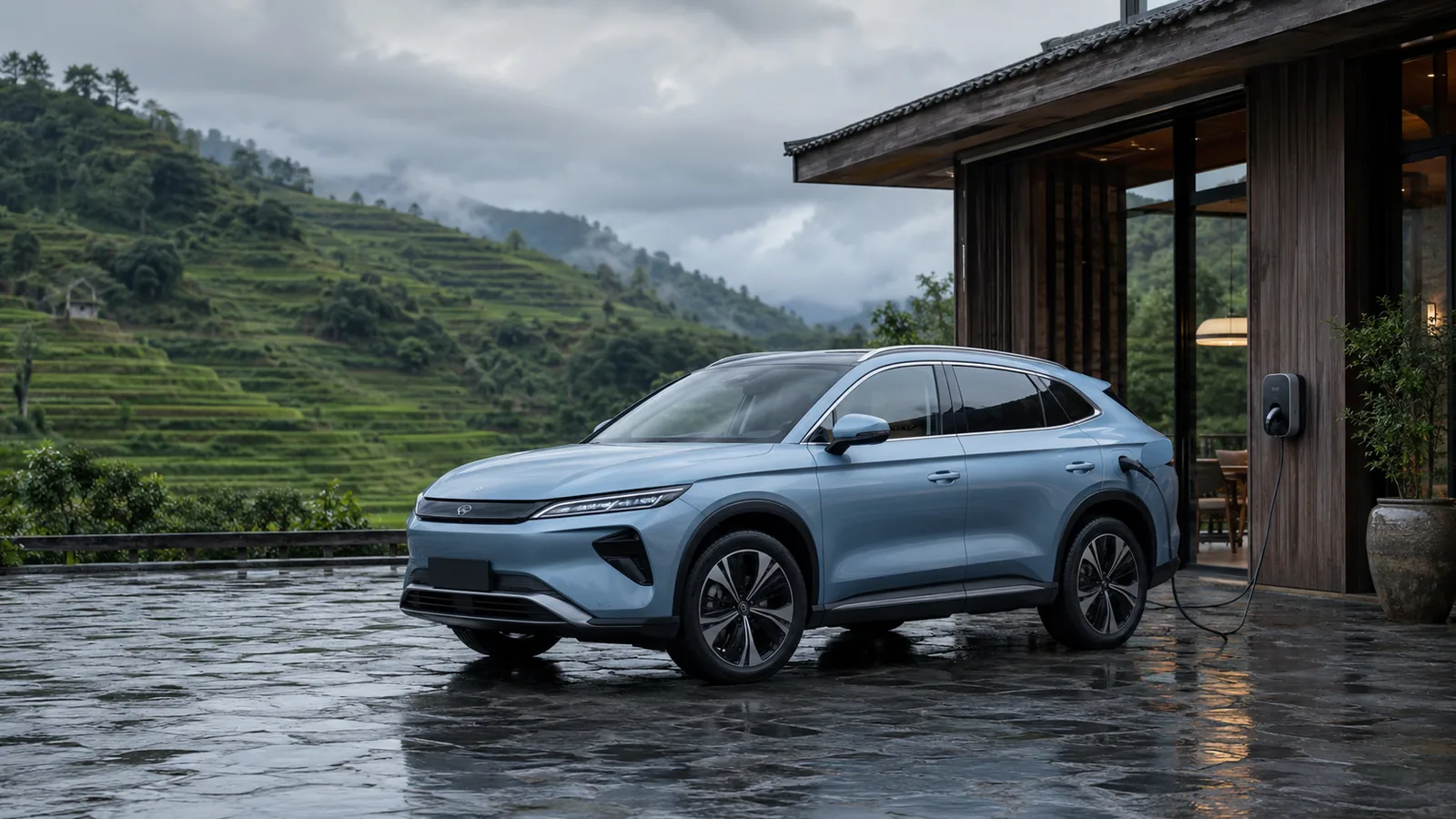
- Design: Five-door SUV with modern coupé-like styling cues (frameless windows, sloping roofline) and BYD’s latest “Dragon Face” design language. Key elements include a bold dot-matrix front grille, sharp “dragon whisker” LED headlights, a full-width tail-light bar, and flush-fitting door handles (now semi-hidden for 2026, slightly protruding for better usability compared to the fully flush handles on the 2025 model)carnewschina.com. The 2026 facelift also introduced new exterior colors like Guanyao Grey and Xinghe Beige (Galaxy Beige), adding to the palette. Overall, the Song L looks sleek and high-tech, with aerodynamic shaping to improve efficiency (drag-reducing details like a floating roof spoiler and streamlined side mirrors).
- Interior Features: Premium and tech-rich cabin. A 15.6-inch rotating touchscreen infotainment display dominates the dashboard, running BYD’s DiLink system (now updated with more apps and games). In front of the driver is a 10.25-inch digital instrument cluster plus a huge 50-inch head-up display projecting across the windshield. Even rear passengers get a 5.8-inch touchscreen for climate control. Materials include soft Nappa leather upholstery, ambient lighting, and brushed metal trim for a quasi-luxury feel. Notably, the front center armrest conceals a refrigerated compartment (cold/heat box) that can cool drinks down to -6°C or warm food up to 50°C – a thoughtful touch for road trips. Front seats are power-adjustable with ventilation and even massage functionality on high trims. The Song L DM-i’s cabin is also engineered for quietness: acoustic laminated glass and added insulation yield a serene ride, approaching luxury SUV levels of NVH refinement.
- Tech & Safety: A comprehensive suite of advanced driver-assistance systems (ADAS) comes standard. This includes adaptive cruise control, lane-keeping assist, automatic emergency braking, and blind spot monitoring. A 360-degree surround-view camera system plus a “Transparent Chassis” view helps the driver see all around and even under the vehicle when maneuvering tight spaces. New for 2026, BYD has equipped the Song L DM-i with its DiSus-C intelligent adaptive damping suspension and TBC (Traction & Blowout Control) system. DiSus-C actively adjusts shock absorber firmness for a smoother ride and stable handling, while TBC helps the driver maintain control even if a tire suddenly loses pressure at high speed – an extra safety net. BYD also markets the “Tian Shen Eye C” driver assist platform, which integrates sensors and cameras for semi-autonomous capabilities, though hands-free driving is not as advanced as some competitors’ systems yet. On the infotainment side, the updated DiLink system offers a host of fun features: built-in karaoke (KTV) mode (with or without microphone), a mini game center and word puzzle games, smartphone screen mirroring, and even animated “pet” avatars and 3D themes to entertain occupants. The vehicle supports OTA software updates, so new features can be added over time. Audio is handled by a 10-speaker Infinity premium sound system, providing rich sound throughout the cabin. Lastly, BYD’s signature Blade Battery construction combined with a reinforced body structure meets stringent crash safety standards (C-NCAP and Euro NCAP equivalent), underpinning the Song L’s solid safety credentials.
- Pricing: In China, the 2026 Song L DM-i is offered in three main trim levels. Pricing starts at ¥139,800 and tops out around ¥156,800 yuancarnewschina.com (approximately $14,000–$15,700 USD). This pricing is astonishingly competitive – it’s on par with or even below smaller economy cars in many Western markets, yet you’re getting a high-tech hybrid SUV. BYD is able to keep prices low in its home market due to scale, local supply chains, and government incentives for new energy vehicles. Export pricing, of course, would be higher after shipping costs and import tariffs, but the Song L DM-i will likely still undercut most rivals in whichever market it enters. (For comparison, a Toyota RAV4 Prime starts around $45,000 in the U.S., and a fully electric premium SUV like the BMW iX3 starts around $60,000.freditech.com) In terms of value-for-money, BYD is aggressively positioning the Song L DM-i as a no-brainer choice for buyers who want the latest electrified tech without the usual EV price premium.
Now that we’ve covered the high-level specs, let’s explore each aspect of the 2026 Song L DM-i in more detail.
Design & Exterior

Semi-hidden door handles and angular wheel arches highlight the 2026 Song L DM-i’s updated exterior design
The exterior design of the BYD Song L DM-i strikes a balance between sporty modernity and subtle elegance. BYD employs its latest “Dragon Face” design language on this SUV, as seen in the sculpted front fascia that evokes a dragon’s features. The 2025 model already introduced a wide, trapezoidal grille flanked by slim LED headlights resembling “dragon eyes”. For 2026, BYD refined this front grille with a new dot-matrix pattern finish for a more upscale look. The grille is outlined in chrome and integrates with the headlights, which feature a distinctive LED daytime running light signature (often described as “dragon whiskers” in BYD’s terms).
One notable change in the 2026 facelift is the door handle design. The 2025 Song L had fully flush pop-out door handles for maximum aerodynamic benefit. However, some users found them less convenient, so BYD switched to semi-hidden handles in 2026. These handles sit mostly flush but are slightly more pronounced, making them easier to grab while still looking sleek. It’s a small example of BYD responding to practical user feedback without sacrificing style.
In profile, the Song L DM-i features a strong character line that runs along the doors and a gently sloping roofline that gives it a coupé-SUV vibe without overly compromising rear headroom. The roof is blacked-out on many trims, creating a “floating roof” visual effect with the chrome window trim. Frameless doors (no upper window frame) add to the premium, clean look. The wheel arches are slightly squared-off and filled by alloy wheels up to 20 inches in diameter. For 2026, the wheel arch molding became a bit more angular to emphasize a rugged stance, and new alloy wheel designs were introduced. Ground clearance is moderate – enough for rough roads and speed bumps, though this is not intended as a hardcore off-roader.
Moving to the rear, the Song L DM-i sports a full-width LED light bar taillight, a trendy feature in modern SUVs. The rear lights have a unique pattern reportedly inspired by a Chinese knot motif, tying in cultural design elements. A subtle roof spoiler extends over the rear glass, housing a high-mounted brake light and aiding aerodynamics. Another 2026 tweak was an active dual-section rear spoiler – likely adjusting angle for different speeds to reduce drag or improve stability. The back bumper is clean with minimal fake exhaust elements (since it’s a PHEV, the actual exhaust is tucked out of sight). Overall, from the back the Song L appears wide and planted, with that continuous light bar making it instantly recognizable at night.
Aerodynamics play a role in the design – flush glazing, front air intakes that smooth airflow, and carefully sculpted side mirrors all contribute to a relatively low drag coefficient for an SUV. The result is not just aesthetic; it helps maximize fuel economy and reduce wind noise. BYD hasn’t published the exact Cd value, but similar BYD models have achieved Cd ~0.30 which is respectable for an SUV.
Two new paint options introduced in 2026 – Guanyao Gray (a sleek, clay-gray tone) and Galaxy Beige – give buyers more choice beyond the typical white, black, and red. These new colors are exclusive to the facelift and align with contemporary tastes for muted, sophisticated hues.
In summary, the BYD Song L DM-i’s design is contemporary and refined. It doesn’t stray too far from the successful formula of its 2025 predecessor (why mess up a good thing that sold well?), but the small updates in 2026 keep it fresh. It looks high-tech enough to stand next to modern EVs, yet also understated enough to appeal to a wide audience. If BYD’s goal was to create an SUV that looks as advanced as its powertrain technology, they’ve largely succeeded. Park the Song L DM-i next to, say, a Tesla Model Y or a VW Tiguan, and it certainly appears like a vehicle from the future – with its shimmering LED lights, minimalistic smooth surfaces, and subtle dragon-inspired flair.
Interior & Comfort

The Song L DM-i’s interior features a tech-forward cockpit with multiple screens, upscale materials, and a family-friendly spacious layout.
Open the door to the Song L DM-i and you’re greeted with an interior that could easily belong to a luxury European SUV – BYD has truly upped its game in materials and tech amenities. The dashboard is dominated by a large 15.6-inch center touchscreen that can rotate between landscape and portrait orientations (a BYD hallmark). This high-definition display is the command center for infotainment, navigation, and vehicle settings. The latest DiLink 3.0 software is fast and feature-rich, supporting over-the-air updates and a host of built-in apps. For example, occupants can enjoy karaoke through the car’s KTV app, play mini-games (useful while charging or waiting), or watch videos on the big screen (when parked)carnewschina.com. Despite this digital emphasis, BYD wisely retained some physical controls for frequently used functions – you get tactile buttons for climate control shortcuts and a volume knob, so you’re not forced to use the touchscreen for everything while drivingcj-vehicle.com.
In front of the driver is a fully digital 8.8-inch instrument cluster behind the steering wheel – it’s smaller than some rivals’ clusters, but that’s intentional because the Song L DM-i also projects a massive 50-inch Head-Up Display (HUD) on the windshield. This augmented reality HUD spans a huge area in the driver’s line of sight, showing navigation directions, speed, and ADAS warnings. Essentially, BYD moved a lot of the “dashboard” into the HUD to keep the driver’s eyes up on the road. This is similar in concept to the setups on high-end German cars and it’s impressive to see it in a vehicle at this price point.
The steering wheel itself is a modern design with a flat bottom, wrapped in leather, and featuring multi-function touch controlsen.wikipedia.org. It’s also heated for winter comfort. Right behind the steering wheel column is a new column-mounted gear selector (shifter stalk) introduced in 2026. This frees up space in the center console area, giving the front cabin an airy feel. The center console has ample storage, cupholders, and the nifty cooled/warm box for drinks or snacks. Wireless phone charging (up to 50W) is provided on a charging pad, meaning even power-hungry smartphones can fast-charge without cables.
When it comes to materials, BYD went with a mix of high-quality plastics, soft-touch surfaces, and genuine Nappa leather on the seats and steering wheelcj-vehicle.com. The seat upholstery on higher trims is perforated leather (for ventilation) with contrast stitching. Trim accents in the cabin include brushed aluminum and open-pore wood in some versions, giving a premium vibe. Customizable ambient lighting wraps around the dashboard and doors, offering a palette of colors to suit your mood – a feature increasingly popular in upscale vehicles. BYD even added fun touches like animated “pet” characters on the infotainment screen that can greet you, aiming to humanize the tech interfacecarnewschina.com.
The seating layout is two-row, five-passenger. Both front seats are power-adjustable with memory settings. They are heated and ventilated, and as noted, the driver’s seat (and passenger seat in top trim) even offers a massage function with several modescarnewschina.com – a rarity outside of true luxury brands. The rear seats are a 60/40 split bench that can recline for comfort on longer trips. Rear passengers benefit from decent legroom thanks to the Song L’s nearly 2.78 m wheelbase; a flat floor (the battery is under the floor, but the design avoids a big central hump) means the middle rear passenger has more foot room than in many SUVs. Rear amenities include their own touchscreen climate control panel and rear air ventscj-vehicle.com, plus USB charging ports.
Cargo space is generous – about 459 liters behind the rear seats, which is enough for a family’s groceries or a couple of large suitcases. With the rear seats folded, space expands to around 1,550 liters, making IKEA runs or moving days much easieren.wikipedia.org. BYD has designed the hatch to have a relatively low liftover height, and some trims come with a power tailgate for convenience.
One aspect worth highlighting is the cabin quietness. BYD used extensive sound insulation, including multi-layer acoustic glass for the windshield and front windows. Combined with the near-silent EV mode, this makes the Song L DM-i extremely quiet around town – you mostly hear a slight tire noise and wind whoosh at highway speeds. When the gasoline engine kicks in, it’s tuned to operate at low RPMs in most situations, so it remains unobtrusive, only becoming noticeable under heavy acceleration. Owners and reviewers of the 2025 model noted the refinement is on par with much more expensive SUVs, and BYD claims they further improved NVH for 2026. This focus on a serene ride underscores the Song L’s mission as a comfortable daily driver and road-trip machine.
In sum, the Song L DM-i’s interior delivers a luxury experience without the luxury price. Between the plethora of high-tech features (multiple displays, HUD, etc.), the premium materials (leather, ambient lighting), and comfort amenities (massage seats, quiet cabin), BYD has created an interior that surprises and delights. It feels highly advanced but also user-friendly, thanks to the thoughtful inclusion of physical controls and logical layout. Whether you’re a gadget enthusiast who will use every last feature (from karaoke to the built-in games) or just someone who wants a comfortable, straightforward driving environment, the Song L’s cabin manages to cater to both. Families will appreciate the space and storage, commuters will enjoy the tech and quiet ride, and everyone can agree the car feels much more expensive than it actually is – which might be one of BYD’s greatest achievements here.
Powertrain and Performance
Under the hood (and floor) of the BYD Song L DM-i lies the heart of its innovation: the DM-i 5.0 Super Hybrid System. This powertrain is engineered to seamlessly switch between electric and hybrid drive modes to optimize efficiency at all times. Let’s break down how it works and what it means on the road.
At its core, the Song L DM-i has a 1.5-liter Atkinson-cycle gasoline engine. By itself, this engine produces about 74 kW (99 hpcarnewschina.com) and is tuned for fuel efficiency rather than high power. The Atkinson-cycle design keeps intake valves open longer for a more complete expansion, improving efficiency at the expense of some power – a trade-off that is fine here because the electric motor provides plenty of additional torque. The engine’s primary role in many situations is actually to act as a generator: it can charge the battery or directly provide energy to the motor via the hybrid system’s electric-coupling transmission.
Complementing the engine is a powerful permanent magnet synchronous electric motor on the front axle, rated at 160 kW (215 hp). This motor is what actually drives the wheels during EV mode and contributes most of the torque for acceleration. The Song L DM-i is front-wheel-drive (FWD) only – unlike some plug-in hybrids, there is no separate rear motor for AWD, which helps keep weight and cost down. FWD is typically sufficient for the intended use (urban/suburban and highway cruising). However, potential buyers in snowy climates or who frequently drive on low-traction surfaces should note the lack of AWD; the stability control and traction management will do their best to compensate.
The transmission is an E-CVT (electronic continuously variable transmission) which basically orchestrates the power from the engine and motor. In EV mode, the engine is off and the motor drives the wheels directly (through a reduction gear). In hybrid mode, the engine can either drive a generator to supply electric power to the motor or, in certain conditions, connect mechanically to the wheels (via a clutch) for direct drive at cruising speeds. The control logic is highly sophisticated – it decides in real-time the most efficient way to propel the car. For example, at low speeds or under light loads, it will favor pure electric driving. At steady highway speeds, it might engage the engine to drive the wheels in its efficient RPM range while also charging the battery a bit. Under hard acceleration, both the engine and motor work together (the engine generating extra electricity) to boost power. All of this happens behind the scenes; the driver just feels smooth, uninterrupted power delivery.
Acceleration and performance: Given the combined resources of engine and motor, the Song L DM-i can sprint from 0 to 100 km/h in around 7.7 seconds (for the extended range version)en.wikipedia.org. The slightly lighter mid-range battery version reportedly does it in ~7.5 seconds, so performance is roughly on par with many conventional gasoline 2.0L turbo SUVs. It’s not as quick as performance-oriented plug-in hybrids or EVs, but it’s perfectly adequate for merging onto highways and overtaking. In city driving, the electric motor’s instant torque (up to 260 N·m per the spec) makes the Song L feel responsive off the line – there’s no lag as you’d experience waiting for a turbo to spool up. Reviewers of the 2025 model noted the vehicle feels peppy in urban conditions and only when you really push it does the engine noise become noticeable, which is typical of hybrids.
Where the Song L DM-i really shines is in part-throttle and cruising performance. The transitions between EV mode and hybrid mode are very smooth; BYD’s DM-i system uses a high-efficiency generator and clever power management to avoid the “rubber band effect” that older CVT hybrids often had. If you’re light on the throttle, it will stay in electric drive up to moderate speeds, making the driving experience eerily quiet and vibration-free. Press a bit more and the engine comes on in the background – but thanks to the noise insulation, you might not even hear it over the music unless you listen carefully. The fifth-generation DM-i introduced in this model is noted for improved engine start-stop smoothness and better tuning of the E-CVT to feel more natural. The 2026 update further refined the control logic, yielding a slight improvement in acceleration (shaving a few tenths of a second off 0–100) and responsiveness. Drivers will notice that in hybrid mode, when you demand power (like a quick overtaking maneuver), the system reacts faster than before – BYD recalibrated it to reduce any delay between pressing the pedal and the surge of accelerationcj-vehicle.com.
Despite being front-wheel drive, the Song L DM-i handles its power well without excessive torque steer. This is helped by the intelligent traction control and the new YunNian-C (DiSus-C) adaptive suspension in the 2026 model. The suspension can firm up or soften in milliseconds, which not only improves ride comfort but keeps the car composed under acceleration or on rough roads. Combined with a relatively low center of gravity (courtesy of the under-floor battery) and a well-tuned chassis, the Song L DM-i offers stable and confident handling. It’s not a sporty SUV per se – the steering is light and geared more for ease of use than sharp corner carving – but it feels secure. Body roll is well controlled for a comfort-oriented SUV. Think of it as leaning more toward a relaxed cruiser than a corner-carver, which matches its mission.
One advantage of a hybrid over a pure EV is long-distance cruising ability, and here the Song L DM-i excels. With the engine and motor working in harmony, you can drive hundreds of kilometers on end without needing to stop (except maybe for a restroom or snack break). The total touring range of ~1,630 km means the car could theoretically go from Accra to Lagos and back on one tank+charge, or Los Angeles to Denver without refueling, if conditions allowed. This is a huge selling point for those who do frequent road trips – you get EV efficiency in town and diesel-like range on the open road.
BYD also incorporated multiple drive modes: an EV mode (which keeps it electric until the battery is low or power demand is high), a Hybrid mode (optimal mix, the default), and an Engine charging mode (which can force the engine to charge the battery to a higher level, useful if you know you’ll need EV power later, like entering a city). There is also an Eco mode that dulls throttle response to save fuel, and a Sport mode that sharpens response at the expense of efficiency. In Sport, the car will sustain higher revs and keep the engine on more to provide immediate power. Still, even in Sport, don’t expect a sudden transformation into a performance SUV – it’s more about giving the driver a bit more responsiveness. The Song L remains tuned for efficiency first, which most owners will appreciate given fuel prices and environmental concerns.
A quick note on braking: The Song L DM-i uses regenerative braking to recover energy when slowing down. The brake pedal feel is reportedly smooth and not overly grabby (BYD has refined the handoff between regen and mechanical brakes). You can monitor the energy flow on the digital displays – it’s actually fun to see when the car is recouping energy versus when it’s drawing from the battery. There’s even a one-pedal driving setting in EV mode, where lifting off the accelerator provides stronger regenerative deceleration (though it won’t bring you to a complete stop as aggressively as some EVs do).
In summary, performance in the Song L DM-i is about intelligent efficiency. It won’t out-drag a Tesla, and it’s not trying to; instead, it delivers perfectly adequate acceleration and a buttery-smooth driving experience that maximizes fuel savings and electric driving. The engineering here is very sophisticated – the car essentially thinks for you to use just the right amount of energy from the right source at any given moment. For daily driving, this means less frequent stops at the pump or charger, and a refined ride that can be both relaxing and surprisingly peppy when needed. BYD has leveraged its deep experience with batteries and hybrids to make the Song L DM-i’s powertrain feel invisible and seamless – you just enjoy the drive, and marvel at the efficiency when you check the trip computer at the end of the journey (it’s not uncommon to see astonishingly low fuel usage if you plug in regularly).
Range & Efficiency: Driving Without Anxiety
One of the headline features of the 2026 Song L DM-i is its unprecedented range capabilities for a PHEV. This SUV effectively demolishes the notion that plug-in hybrids only offer short electric range. With up to 200 km of EV-only range on the top trim, many drivers will be able to use the Song L as an electric vehicle for the vast majority of their daily driving.
Consider that 200 km (about 124 miles) of range covers far more than the average daily commute (which is often under 50 km). You could likely commute all week and run local errands on pure electric power, only needing to recharge at home each night – never even starting the gasoline engine except on longer trips. This approaches the usability of some pure EVs. In fact, 200 km is beyond the electric range of some popular first-generation EVs! It’s also roughly 3 times the EV range of most plug-in hybrids on the market today. For instance, the 2024–25 Mitsubishi Outlander PHEV and Ford Escape PHEV offer around 50–60 km EV range, and even the much-lauded Toyota RAV4 Prime is rated at ~68 km (42 miles) EV range (EPA). The Song L DM-i’s ability to go 160–200 km (depending on variant) on battery power alone is a game-changer in the PHEV categorycarnewschina.com.
It’s worth noting those range figures are based on the Chinese CLTC test cycle (and NEDC for earlier figures), which tend to be optimistic. Real-world electric range might be a bit lower – perhaps around 130–150 km (80–95 miles) under typical mixed driving for the 200 km-rated version. Even so, that’s head and shoulders above what any competitors currently achieve in 2026. BYD’s advantage comes from a combination of a relatively large battery capacity for a PHEV, highly efficient energy management, and regenerative braking that recoups a lot of energy in stop-and-go driving.
Now, when that battery is depleted, the Song L DM-i essentially becomes a super-efficient hybrid. As mentioned, the fuel consumption is rated at 3.4 L/100 km (equivalent to ~83 mpg UK or ~69 mpg US). This figure likely corresponds to the scenario of a full battery – PHEV fuel economy ratings can vary depending on battery charge. But even with an empty battery, the DM-i system is very efficient because it can use the engine in an Atkinson cycle sweet spot to generate electricity. Owners of the 2025 model have reported real-world figures around 5 L/100 km (47 mpg) in mixed driving with a low battery, which is still excellent for a vehicle of this size. With a charged battery and hybrid mix, getting under 4 L/100 km is achievablecarnewschina.com.
The total combined range of ~1,630 km (1,013 miles) that BYD advertises assumes a full 200 km of EV plus using the entire fuel tank in hybrid mode. The fuel tank on the Song L DM-i is around 42–45 liters (common size for BYD hybrids), so that implies roughly 1,430 km on fuel at 3.4 L/100km plus 200 km electric. While that 1,630 km figure is likely under ideal conditions, it’s not far-fetched to say the Song L can easily do 1,200+ km (750+ miles) in one go. This is transcontinental range – for example, in Europe you could drive from Paris to Rome (~1,200 km) without refueling. It even rivals some diesel cars and far outstrips pure EVs (most of which max out at 300-500 km per charge). InsideEVs noted BYD’s new hybrids are approaching “transcontinental rangeinsideevs.com/news” territory, and the Song L DM-i is a poster child for that claim.
Of course, the beauty of a plug-in hybrid is flexibility. If gas prices spike or regulations require, you can drive it like an EV most of the time. If you can’t recharge (say on a camping trip or if you forget), you still have a very efficient hybrid that will just sip gasoline modestly. There’s no range anxiety because a quick stop at any gas station gets you hundreds more kilometers in minutes. In essence, the Song L DM-i can operate as an EV when you want it and as a long-range hybrid when you need it – offering a no-compromise solution for those who aren’t ready to go full electric or who frequently drive long distances where charging infrastructure might be lacking.
Regenerative braking and efficiency tricks: The Song L uses regenerative braking and coasting to continuously recover energy. In city traffic, it excels because frequent slowing down means frequent energy recovery, keeping the battery topped up. There’s also a heat pump for climate control to minimize energy draw for heating/cooling. BYD even included a “motion sickness prevention” mode in the infotainment – possibly adjusting how the car accelerates/brakes smoothly to avoid jarring motions, which indirectly also means efficient, smooth driving.
Another factor is the Blade Battery’s thermal management. LFP batteries are very heat-tolerant and BYD’s system keeps the battery at optimal temperature, which improves both performance and longevity. Good thermal management means you don’t lose much efficiency in hot or cold conditions, unlike some older EVs/PHEVs that had range drop-off in winter.
Drivers can monitor their efficiency via the car’s energy flow display. It becomes almost like a game to see how much of your commute you can do in EV mode and how low you can get the fuel consumption. The Song L DM-i really encourages eco-friendly driving by making it so effortless and rewarding (you save money and emissions without even thinking about it).
In summary, the range and efficiency aspect of the Song L DM-i is its strongest selling point. It delivers EV-level electric range that covers daily needs, hybrid-level fuel economy that embarrasses conventional cars, and an overall range that lets you forget about refueling for days or weeks. It’s hard to overstate how this kind of capability can change the driving experience – you might only visit a gas station a handful of times a year if you charge diligently. For environmentally conscious drivers who aren’t ready to rely 100% on charging infrastructure, or for those in areas with unreliable electricity, the Song L DM-i offers an ideal compromise: drive electric whenever possible, but have gasoline backup for anywhere, anytime travel.
Technology and Safety Features
The 2026 BYD Song L DM-i is as much a smart device on wheels as it is a mode of transportation. BYD has packed it with technology, both for entertainment and for safety, to enhance the driving experience and protect occupants.
Infotainment & Connectivity: The aforementioned 15.6-inch rotating screen is the hub. It runs BYD’s DiLink OS, which supports English and multiple languages in international versions. It has all the modern connectivity you expect: navigation (with real-time traffic in connected regions), Bluetooth, Wi-Fi hotspot capability, and smartphone integration. BYD’s system can run Android-based apps; in China, this means native support for apps like QQ Music, WeChat, etc. Internationally, one could expect Apple CarPlay/Android Auto to be available (though BYD has been a bit slow on CarPlay integration in some models, likely due to pushing its own ecosystem). The Song L features voice control as well – you can use voice commands for things like setting navigation or changing climate settings, which is useful given the wealth of features available.
What really differentiates BYD’s system are the fun extras: the KTV (karaoke) mode streams music instrumentals and displays lyrics – combined with the quality sound system, your car can turn into a private karaoke booth (BYD even sells an accessory wireless microphone in China!). The Game Center has some simple games, and there are educational apps and puzzles, which can be great to occupy kids while parked. There’s also “continuous music playback” and video streaming when parked, essentially turning the car into a personal theatercarnewschina.com. All these run on a fairly powerful Qualcomm-based automotive CPU, ensuring smooth graphics. The Song L DM-i’s infotainment is arguably one of the most feature-rich in the segment – many competitors have more basic systems focused mainly on navigation and media, while BYD treats the car like an extension of one’s digital life.
Audio & Sound: The 10-speaker Infinity audio system provides immersive sound. With the car’s quiet cabin, listening to music or podcasts is a joy. There’s also a dedicated mode for phone calls that uses multiple microphones and noise cancellation to give clear call quality even on the highway.
Instrument Cluster & HUD: The digital cluster can be customized to show different info (speed, power flow, trip data, ADAS status, etc.). But the real star is the 50-inch AR Head-Up Displayen.wikipedia.org. It projects critical information like speed, navigation arrows, and safety alerts directly onto the windshield in the driver’s field of view. This large HUD can even highlight vehicles or lane markings as part of the driver-assist system (similar to augmented reality HUDs in high-end German cars). The benefit is the driver doesn’t need to take eyes off the road to get information, which is a safety plus and also just cool to experience – it feels like something from a fighter jet or video game, guiding you along.
Advanced Driver Assistance Systems (ADAS): BYD markets its suite as “Tian Shen Eye” which basically covers the car’s sensor system (cameras, millimeter-wave radar, ultrasonic sensors) and the corresponding featurescarnewschina.com. The Song L DM-i offers Level 2 driver assistance: this means it can automatically keep a safe distance from the car ahead (Adaptive Cruise Control) and stay centered in the lane (Lane Keeping Assist) on highways, with the driver supervising. It’s not hands-free, but it will significantly reduce fatigue on long drives. It also includes Traffic Sign Recognition, so it can display speed limits or warnings on the dash/HUD, and Intelligent High Beam for headlights that auto-dip for oncoming traffic.
A standout safety feature in the 2026 model is the inclusion of BYD’s TBC (Tyre Blowout Control) system. If the car detects a sudden loss of tire pressure at high speed (indicative of a blowout), the system will automatically adjust braking and torque distribution to stabilize the vehicle and keep it tracking straight, helping the driver safely bring the car to a stop. This kind of feature is usually found in high-end luxury cars; it’s a testament to BYD’s emphasis on safety.
Also new is the DiSus-C (YunNian-C) adaptive damping. This isn’t just for comfort – it works with the stability control to firm up shocks during sudden maneuvers, reducing body pitch and roll. For example, if you have to swerve to avoid an obstacle, the system can increase damping on one side to prevent the car from getting unsettled. It’s an under-the-skin tech that you might not notice working, but it’s there to enhance both comfort and safety.
360-Degree Camera & Parking: The Song L DM-i comes with a full surround-view camera system. When parking or navigating tight spaces, you can see a bird’s-eye composite view of the car on the screen. BYD goes a step further with a Transparent Chassis Viewcj-vehicle.com – using the cameras and some software magic, the system can display an image as if the car’s floor were transparent, so you can see obstacles (like a high curb or big pothole) that might be right next to the wheels. This is great for avoiding wheel damage or when off-roading lightly (though again, this is not a hardcore off-roader, but such a feature helps on rough roads).
Passive Safety: In terms of build, the Song L DM-i uses a high-strength steel frame with critical areas reinforced to protect the cabin. BYD’s Blade Battery is designed to be intrusion-resistant, meaning it’s less likely to catch fire even if punctured – an important safety consideration given some concerns with lithium batteries. The SUV is equipped with a full array of airbags (front, side, curtain, and a driver knee airbag). BYD has not published official crash test ratings for NCAP yet, but given the structural design and battery protection, it is expected to perform well (the similar BYD Tang EV earned 5 stars in Euro NCAP, for example).
Other Convenience Tech: Keyless entry and push-button start are standard. There’s a remote smartphone app so you can check the car’s status, pre-cool or pre-heat the cabin while it’s plugged in, and even use your phone as a key. Some trims offer an NFC card key as well. The climate control is dual-zone (with a separate control for rear, effectively tri-zone) and uses a heat pump to efficiently heat the cabin in winter. The car also has an air purifier system with a PM2.5 filter – a common feature in Chinese-market cars due to air quality concerns, and a nice one to have anywhere. BYD even mentioned “motion-sickness prevention” in their feature list – likely subtle lighting and suspension adjustments to minimize nausea for passengers.
Lighting: All exterior lighting is LED, of course. The headlights have an adaptive function (they swivel in corners and auto-level). There are welcome lights that illuminate when you approach the vehicle with the key, and even a little projected BYD logo puddle lamp under the mirrors. The ambient interior lighting can also act as a visual alert (flashing red for a forward collision warning, for example).
In essence, the Song L DM-i is brimming with high-tech features, comparable to what you’d find in luxury vehicles, but at a fraction of the cost. BYD has leveraged its strength in electronics and software to differentiate its cars. This SUV can entertain you, keep you comfortable, and actively work to prevent accidents. Importantly, many of these features are standard or at least available on mid trims – BYD isn’t reserving safety for only top buyers. It aligns with the company’s aim to build trust in their brand: by showing that their vehicles are not just affordable, but also advanced and safe, they hope to entice buyers globally.
Pricing, Value & Availability
One of the most compelling aspects of the 2026 BYD Song L DM-i is its pricing – especially in its home market – and the value proposition it represents. As mentioned earlier, the price range in China is ¥139,800 to ¥156,800 RMBcarnewschina.com, which is roughly $14,000 to $15,700 USD at current exchange rates. Even after adding VAT and typical fees in China, this is incredibly accessible for a vehicle of this caliber. It undercuts many domestic competitors in the hybrid SUV space and is way below what any foreign-brand PHEV SUV would cost. BYD has essentially democratized the plug-in hybrid – putting it within reach of middle-class buyers. It’s not uncommon to see BYD Song series vehicles being used as family cars, ride-share vehicles, even government fleet cars in China because of their cost-effectiveness.
For international buyers, the big question is, will the Song L DM-i be available outside China? The good news is BYD has been expanding aggressively into global markets. They have launched models in Europe (though mostly pure electrics like the BYD Tang EV, Han EV, and smaller Dolphin), as well as in Southeast Asia, Latin America, Africa, and the Middle East. The Song L DM-i, with its emphasis on efficiency, could be very attractive in regions where fuel is expensive or charging infrastructure isn’t fully ready for pure EVs.
According to BYD and export specialists, the Song L DM-i is export-ready, and indeed BYD has signaled plans to introduce more of its DM-i hybrids abroadcj-vehicle.com. Target markets likely include parts of Europe (especially Eastern and Southern Europe where hybrids have good acceptance), Asia-Pacific countries like Singapore, Malaysia or Australia (BYD entered Australia with EVs already), as well as Latin America and the Middle East. In fact, BYD has manufacturing or assembly partnerships in some countries (like a planned plant in Thailand, one in Brazil, etc.) which could facilitate local assembly of models like this PHEV.
One export model similar to the Song L is the BYD Seal U (a.k.a. Song Plus) DM-i which has been launched in some markets under different names. That bodes well for the Song L DM-i, since it’s positioned just above the Song Plus. Industry analysts expect BYD could market the Song L DM-i internationally under a possibly different name (BYD often gives different names for export to avoid confusion or for local marketing). If and when it arrives, pricing outside China will include shipping, tariffs, and local taxes, so it won’t be as jaw-droppingly cheap. But even if the Song L DM-i came to Europe and was priced, say, around €30,000–€35,000, it would still be a strong value against something like a Ford Kuga PHEV or Peugeot 3008 PHEV, which have less electric range and fewer features.
Value for Money: Let’s put it plainly – the Song L DM-i offers tremendous value. You are getting a car with a long list of features: panoramic displays, HUD, adaptive suspension, etc., that you’d usually find on premium models costing two or three times as much. When you factor in fuel savings (gas + electricity cost for PHEV is usually much lower than gas-only), the total cost of ownership is very attractive. BYD’s Blade Battery is also known for its longevity, so one can expect good durability (BYD typically offers 8-year or 150,000 km warranties on the battery in China). Maintenance on a PHEV like this should be lower than a regular car too – regenerative braking means brake pads last longer, and the engine doesn’t run all the time which reduces wear.
Competitors: In China, competitors include other domestic PHEVs like the Geely Galaxy series, Changan’s Deep Blue series, and some joints like Buick Velite. Many of them offer 100 km EV range PHEVs, but BYD has leaped ahead with 160+ km. Internationally, if we consider what the Song L DM-i would compete with: perhaps the Mitsubishi Outlander PHEV, Toyota RAV4 Prime, Ford Escape/Kuga PHEV, or European models like the VW Tiguan eHybrid, Peugeot 3008 Hybrid4, etc. The Song L generally beats all of these on electric range and often on price (except maybe Mitsubishi in some markets). Where some might have an edge is brand familiarity or specific features (Toyota’s AWD, for example, or European interior finishes), but BYD is clearly aiming to compete on tech and value rather than badge prestige.
It’s also worth noting that BYD’s hybrids benefit from government incentives in some countries. In China, PHEVs are treated favorably (license plate quotas, etc.). In Europe, some countries give tax breaks or company car incentives to PHEVs with sufficient electric range (often a minimum of 50 km EV range, which the Song L blows past). If BYD can get the Song L DM-i certified in Europe with ~100+ km WLTP electric range, it could qualify for maximum green incentives, making it even more appealing to companies and private buyers looking to save on taxes.
Availability Timing: The 2026 Song L DM-i (which was launched late 2025 in China) is on sale now in China. For other markets, BYD tends to launch about 6 months to a year after the China release. There are reports that late 2026 or 2027 could see the Song L DM-i (or its refreshed version) in some international showrooms, depending on regulatory approvals. BYD has to navigate things like emissions standards and local homologation – but since this car is a hybrid, it should have no trouble meeting Euro 6d or other standards, and BYD has already proven capable of getting Euro NCAP, etc., done for their cars.
One thing to watch is BYD’s dealer/service network in your country – they are expanding those to support sales of vehicles. For instance, in the UK and Norway they’ve partnered with existing dealer chains. Expect similar partnerships for selling the Song L DM-i if it comes, as BYD knows aftersales support is critical.
Resale and Future-proofing: PHEVs sometimes face the question of longevity in a world shifting to pure EVs. However, with such a long EV range, the Song L DM-i can operate almost like an EV, so it may actually have a longer relevance. It’s kind of a “best of both” for this transitional period in auto. Resale values for BYD in some markets (like Norway for the Tang EV) have been decent, and as the brand gains recognition, the Song L’s strong specs might make it desirable on used market too.
In conclusion, BYD has delivered an extremely high-value package with the Song L DM-i. It’s a vehicle that upends the usual cost calculations for a family SUV or commuter car. If you’re budget-conscious, you’ll love the price and low running costs. If you’re tech-savvy, you’ll love the features per dollar. And if you’re an early adopter or EV enthusiast, you’ll appreciate that you can drive electric most of the time without worrying about range on that occasional long journey. The Song L DM-i shows that advanced green technology can be made accessible, and it could pressure other automakers to follow suit in offering more EV range in their hybrids.
Conclusion
From its futuristic dual-mode powertrain to its feature-packed cabin, the 2026 BYD Song L DM-i proves that plug-in hybrids have plenty of life (and innovation) left in them. BYD has leveraged its deep expertise in batteries and electrification to create an SUV that delivers remarkable efficiency and electric capability without the drawbacks of limited range.
After examining all aspects of the Song L DM-i, a clear picture emerges: this vehicle is engineered for the modern driver who wants to minimize fuel use and emissions, but also demands practicality and convenience. In daily use, the Song L can run as a pure electric car – silent, torquey, and zero-emission for dozens of miles. When duty calls for a road trip, it turns into an ultra-economical hybrid cruiser sipping petrol at a rate even compact cars would envy. The transition between these personalities is seamless; the driver simply enjoys the smooth ride while the car’s intelligent systems do the hard work in the background.
The Song L DM-i’s strengths are numerous. Electric range (up to 200 km) that beats all rivals in the PHEV class? Check. Fuel economy (~3.4 L/100km) that sets a new benchmark for SUVs? Check. Advanced technology like adaptive suspension, HUD, 360° cameras, and a luxurious infotainment suite usually reserved for premium cars? Double check. All of this comes wrapped in a stylish design with a comfortable, high-quality interior – and at a price that undercuts the competition by a significant margin.
No car is perfect, of course. Enthusiasts might bemoan the lack of all-wheel-drive or wish for more outright performance (though ~7.7 seconds 0–100 km/h is respectable). Being a first adopter of BYD in some markets might carry uncertainties about dealership support or long-term service, but BYD’s expanding global presence and partnerships are mitigating that. One could also argue that as EV charging infrastructure improves, perhaps a full EV would be a more straightforward choice – yet for many, especially those in areas where charging is not yet ubiquitous, the Song L DM-i’s dual power approach is a very pragmatic solution. It eliminates range anxiety while still delivering most of the benefits of EV driving day-to-day.
In a broader sense, the Song L DM-i signals how far the industry has come. A decade ago, a hybrid SUV with this level of electric range and efficiency was unheard of. Now, BYD is showcasing that it’s not only possible, but can be done at an affordable price. This should put some pressure on legacy automakers to step up their game in the plug-in hybrid arena, even as they transition to full EVs. It also provides consumers an attractive option if they’re not ready to commit to a 100% electric lifestyle but want to significantly cut down on fuel consumption.
As a reviewer and automotive analyst, I’ve seen the progression of BYD from a little-known brand to a major innovator in the green car space. They’ve earned credibility by investing heavily in R&D – the Blade Battery, the DM-i system, etc., are all developed in-house. The Song L DM-i benefits from this vertical integration; it feels like a cohesive product where hardware and software are optimized together (much like how Tesla does with its EVs). Multiple reputable sources, from CarNewsChina to industry reports, confirm the specs and achievements of this model, reinforcing that this isn’t just hype on paper – BYD is delivering on its promises. The sales figures speak as well: over 70,000 Song L DM-i units sold in the first half of 2025 alone in China, indicating strong market trust and acceptance.
Final verdict: The 2026 BYD Song L DM-i is a standout choice for those seeking an efficient, high-tech, and versatile SUV. It offers an almost unique proposition in 2026 – the ability to drive on pure electric for most needs, freedom from charging on long journeys, and a level of comfort and gadgetry that makes every drive enjoyable – all at a price that seems almost too good to be true. In many ways, it can be considered a game-changer in the mid-size SUV segment, showing what’s possible when a company with EV know-how reimagines the hybrid. If you’re in a region where the Song L DM-i is (or will be) available, it absolutely deserves a top spot on your consideration list. This is a car that exemplifies “future-ready” – bridging the present and future of motoring in one compelling package.
BYD’s Song L DM-i demonstrates that you don’t need to spend a fortune to get a eco-friendly, tech-loaded, and truly innovative SUV. It embodies the idea that the future of driving can be both sustainable and practical – with no compromises required. 🚘⚡