

Introduction
Apple’s iPhone 13 family, unveiled in September 2021, spans from the pocket-friendly iPhone 13 Mini to the feature-rich iPhone 13 Pro Max. The lineup brought significant upgrades over the previous generation, including a more efficient A15 Bionic chip, improved cameras, bigger batteries and brighter Super Retina XDR displays. Apple Newsroom.
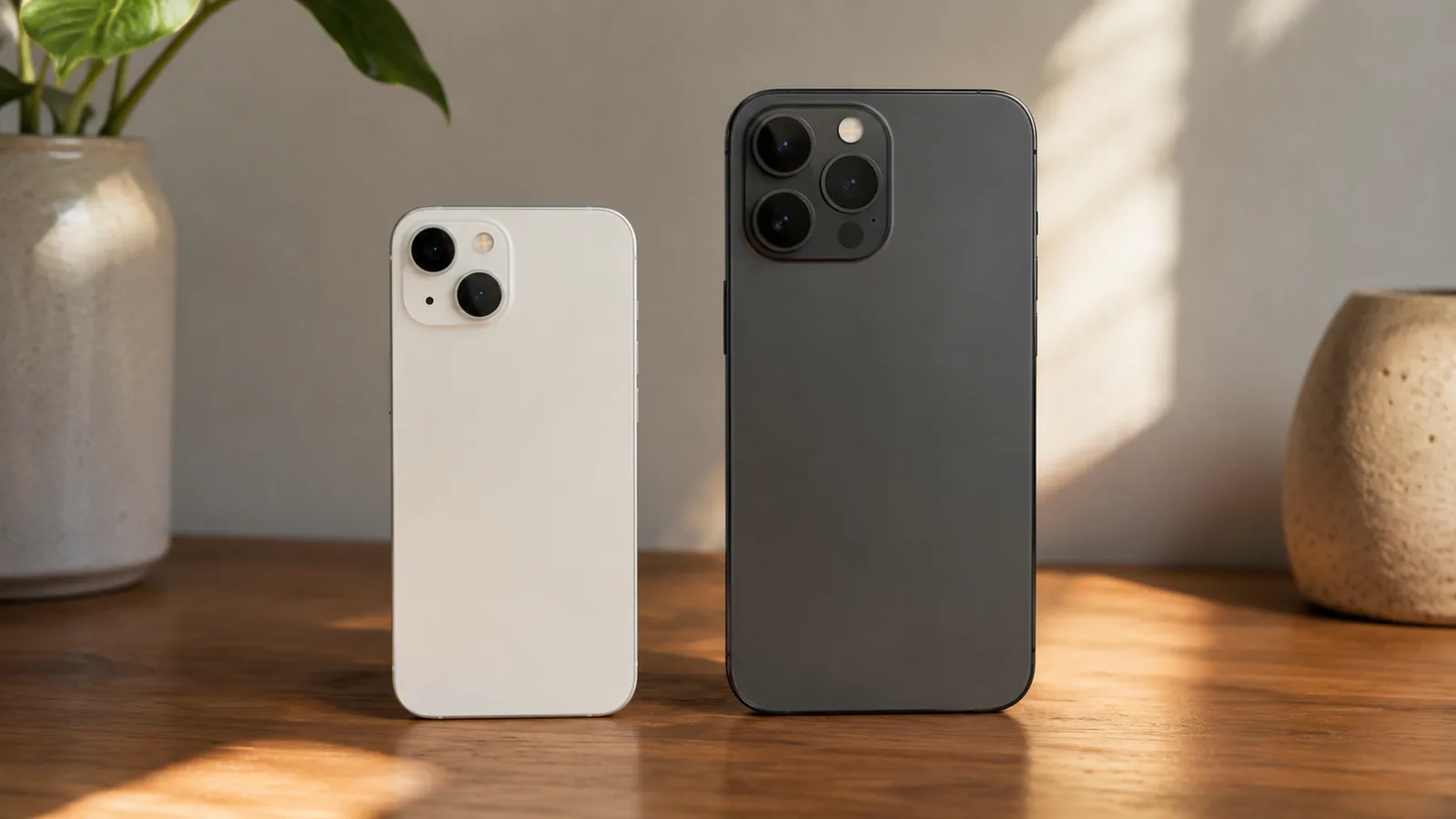
However, the differences between the smallest and largest models are dramatic. The iPhone 13 Mini measures just 5.18 inches high and weighs about 141 grams, while the iPhone 13 Pro Max stretches to 6.33 inches high and weighs 240 grams. That size gap affects display experience, battery life, camera capabilities, comfort and price. Apple Support and Apple Support.
This comprehensive comparison dissects every major area of both devices, from design and performance to real-world use cases, so you can confidently decide which iPhone 13 model suits your lifestyle.
.freditech-article-img { border-radius: 12px; display: block; height: auto; margin: 18px auto; max-width: 100%;
}
.freditech-figure { margin: 18px auto; max-width: 100%;
}
.freditech-figure img { border-radius: 14px; display: block; height: auto; max-width: 100%; object-fit: cover; width: 100%;
}
.freditech-figure figcaption { font-size: 0.95rem; margin-top: 0.5rem; opacity: 0.85; text-align: center;
}
.freditech-table-wrap { overflow-x: auto; margin: 18px 0 26px;
}
.freditech-accessory-table { width: 100%; min-width: 700px; border-collapse: collapse; border-top: 1px solid #f1a983; border-bottom: 1px solid #f1a983; font-size: 15px; line-height: 1.5;
}
.freditech-accessory-table th { background: #ffffff; color: #111827; font-weight: 800; text-align: left; padding: 12px 14px; border-bottom: 2px solid #f1a983;
}
.freditech-accessory-table td { color: #111827; padding: 12px 14px; border-bottom: 1px solid #f1a983; vertical-align: top;
}
.freditech-accessory-table tr:nth-child(even) td { background: #fae2d5;
}
.freditech-accessory-table tr:nth-child(odd) td { background: #ffffff;
}
.freditech-accessory-table th:first-child,
.freditech-accessory-table td:first-child { width: 190px; min-width: 190px;
} @media (max-width: 600px) { .freditech-accessory-table { font-size: 14px; } .freditech-accessory-table th, .freditech-accessory-table td { padding: 10px 12px; } }
{getToc} $title={Table of Contents} $count={Boolean} $expanded={Boolean}
Overview of the iPhone 13 Lineup
Apple announced four iPhone 13 models during its California Streaming event on September 14, 2021, with pre-orders opening on September 17 and general availability beginning on September 24. Apple Newsroom.
The iPhone 13 series improved on the iPhone 12 family by introducing:
- A15 Bionic chip: A 6-core CPU and a 16-core Neural Engine designed for faster performance, improved efficiency and advanced computational photography. Apple Support.
- Brighter Super Retina XDR displays: The standard iPhone 13 and 13 Mini reach 800 nits typical brightness, while the Pro models reach 1000 nits typical brightness.
- Longer battery life: Apple estimated that the iPhone 13 Mini lasts up to 1.5 hours longer than the iPhone 12 Mini, while the iPhone 13 Pro Max lasts up to 2.5 hours longer than the iPhone 12 Pro Max.
- Improved cameras: Dual-camera systems on the iPhone 13 and 13 Mini, and triple-camera systems on the Pro models, with features like sensor-shift optical image stabilization, Photographic Styles and Cinematic Mode. Apple Newsroom.
While these upgrades apply to the whole lineup, Apple clearly differentiated the Mini and Pro Max models for different buyers. The Mini focuses on portability and affordability, while the Pro Max packs the most advanced display, battery and camera hardware available in a 2021 iPhone.
Design and Build Quality
Size and Weight
iPhone 13 Mini: At 5.18 × 2.53 × 0.30 inches, or 131.5 × 64.2 × 7.65 mm, and only 141 grams, the iPhone 13 Mini is designed for one-handed use. Its compact chassis fits easily in smaller pockets and bags, making it ideal for commuters, students and users who dislike oversized phones. Apple Support.
The Mini uses an aluminum flat-edge frame, glass back, Ceramic Shield front cover and an IP68 water-resistance rating for protection against dust and accidental water exposure.
iPhone 13 Pro Max: With dimensions of 6.33 × 3.07 × 0.30 inches, or 160.8 × 78.1 × 7.65 mm, and a weight of 240 grams, the Pro Max is substantially larger and heavier. Its stainless-steel frame gives it a premium feel but also adds weight.
Like the Mini, the Pro Max features a Ceramic Shield front and an IP68 rating. Users with smaller hands may find one-handed use challenging, but the larger body enables a bigger screen, larger battery and more advanced camera system.
Craftsmanship and Materials
Apple uses different frame materials for the two models. The iPhone 13 Mini uses aircraft-grade aluminum, while the iPhone 13 Pro Max uses surgical-grade stainless steel for added durability and a more premium finish.
- iPhone 13 Mini colours: Pink, blue, midnight, starlight and (PRODUCT)RED. Macworld.
- iPhone 13 Pro Max colours: Graphite, gold, silver and Sierra Blue. Apple Newsroom.
Environmental Considerations
Apple highlighted sustainability across the iPhone 13 lineup. The iPhone 13 Pro Max uses recycled rare-earth elements in magnets, recycled tin in the solder of the logic board, and recycled gold on the main logic board and camera wiring. Apple also removed plastic wrap from the packaging to reduce waste.
As an Amazon Associate, I earn from qualifying purchases.

.freditech-amazon-ad-mini { position: relative; width: 100%; max-width: 380px; margin: 18px auto; overflow: hidden; border-radius: 12px; box-shadow: 0 5px 16px rgba(0,0,0,0.14); font-family: Arial, sans-serif; background: #000;
}
.amazon-disclosure-mini { margin: 0; padding: 6px 8px; background: #f7f7f7; color: #444; font-size: 10px; line-height: 1.3; text-align: center;
}
.freditech-amazon-ad-mini a { text-decoration: none; color: #fff; display: block; position: relative;
}
.freditech-amazon-ad-mini img { width: 100%; height: auto; display: block;
}
.ad-overlay-mini { position: absolute; inset: 0; background: linear-gradient(to right, rgba(0,0,0,0.72) 0%, rgba(0,0,0,0.32) 55%, rgba(0,0,0,0.05) 100%); display: flex; flex-direction: column; justify-content: center; padding: 14px;
}
.top-badge-mini { display: inline-block; background: #ff9900; color: #000; font-size: 9px; font-weight: 700; padding: 4px 8px; border-radius: 30px; width: max-content; margin-bottom: 6px;
}
.ad-overlay-mini h2 { color: #fff; font-size: 19px; line-height: 1.1; margin: 0 0 6px; max-width: 230px; font-weight: 800;
}
.ad-overlay-mini p { font-size: 11px; line-height: 1.4; max-width: 240px; margin: 0 0 9px; color: #f2f2f2;
}
.cta-btn-mini { display: inline-flex; align-items: center; justify-content: center; background: #ff9900; color: #111; font-size: 11px; font-weight: 700; padding: 7px 12px; border-radius: 7px; width: max-content;
}
@media (max-width: 480px) { .freditech-amazon-ad-mini { max-width: 320px; border-radius: 10px; } .ad-overlay-mini { padding: 11px; } .ad-overlay-mini h2 { font-size: 17px; } .ad-overlay-mini p { font-size: 10px; } .cta-btn-mini { font-size: 10px; padding: 6px 10px; }
}
Display and Viewing Experience
Screen Size, Resolution and Refresh Rate
| Feature | iPhone 13 Mini | iPhone 13 Pro Max |
|---|---|---|
| Display type | Super Retina XDR OLED | Super Retina XDR OLED with ProMotion |
| Size | 5.4 inches | 6.7 inches |
| Resolution | 2340 × 1080 pixels at 476 ppi | 2778 × 1284 pixels at 458 ppi |
| Refresh rate | 60Hz | Adaptive 10Hz to 120Hz ProMotion |
| Brightness | 800 nits typical, 1200 nits peak HDR | 1000 nits typical, 1200 nits peak HDR |
| Contrast ratio | 2,000,000:1 | 2,000,000:1 |
The iPhone 13 Mini uses a smaller 5.4-inch OLED panel, making it comfortable for one-handed use. Its refresh rate is capped at 60Hz, which is fine for everyday tasks but lacks the ultra-smooth scrolling of the Pro Max.
The iPhone 13 Pro Max features a ProMotion display with an adaptive refresh rate between 10Hz and 120Hz. This technology automatically raises the refresh rate for gaming or scrolling and reduces it for static content to save battery. Apple Newsroom.
The Pro Max also offers higher typical brightness at 1000 nits, compared with 800 nits on the Mini, making it easier to view outdoors.
Real-World Viewing
For reading articles, messaging and casual web browsing, the Mini’s 5.4-inch screen is adequate and extremely pocketable. Video enthusiasts, gamers and users who watch movies or edit photos will appreciate the Pro Max’s expansive 6.7-inch canvas and smoother 120Hz refresh rate. Both screens support HDR10 and Dolby Vision, but the Pro Max feels more immersive because of its larger size and higher typical brightness.
Performance and Hardware
A15 Bionic: Same Foundation, Different GPU
Both models are powered by Apple’s A15 Bionic chip, which pairs a 6-core CPU with a 16-core Neural Engine. The difference lies in the graphics processor. The iPhone 13 Mini uses a 4-core GPU, while the iPhone 13 Pro Max uses a 5-core GPU.
The extra GPU core in the Pro Max enables stronger sustained graphics performance, which benefits high-end gaming, intensive visual apps and ProRes video workflows. For everyday tasks such as messaging, browsing, streaming, social media and photography, both phones still feel fast and responsive.
Storage Options
Apple doubled the base storage for the iPhone 13 lineup to 128GB. The iPhone 13 Mini is available in 128GB, 256GB and 512GB configurations, while the iPhone 13 Pro Max adds an exclusive 1TB option suitable for professionals handling large photo and video files. Macworld.
RAM and Multitasking
Apple does not publicly list RAM, but teardown reports indicate that the iPhone 13 Mini contains 4GB of RAM, while the iPhone 13 Pro Max has 6GB. The extra memory on the Pro Max allows more apps to stay active in the background and supports advanced camera features such as ProRes video. Still, Apple’s iOS optimization helps both devices handle daily multitasking smoothly.
Cameras and Photography
Hardware Differences
The iPhone 13 Mini uses a dual 12MP camera system with a main wide camera and an ultra-wide camera. The wide camera has an ƒ/1.6 aperture, while the ultra-wide camera has an ƒ/2.4 aperture and a 120-degree field of view. Sensor-shift optical image stabilization helps reduce blur by stabilizing the main sensor.
The iPhone 13 Pro Max features a pro triple-camera system: a 12MP wide camera with an ƒ/1.5 aperture, a 12MP ultra-wide camera with an ƒ/1.8 aperture and a 120-degree field of view, and a 12MP telephoto lens with an ƒ/2.8 aperture and 3x optical zoom.
The Pro Max’s wide camera has larger 1.9-micron pixels, helping it perform better in low light. Its ultra-wide lens also introduces autofocus and macro photography, allowing subjects as close as 2cm to fill the frame. The telephoto lens supports 3x optical zoom in and 2x optical zoom out, creating a 6x optical zoom range.
Computational Photography and Video Features
Both models benefit from Photographic Styles, Cinematic Mode, Smart HDR 4, Night Mode and Deep Fusion. Photographic Styles apply custom tone and warmth adjustments across scenes while preserving skin tones. Cinematic Mode records 1080p video with a shallow depth-of-field effect and allows users to adjust focus after shooting.
The Pro Max adds ProRes video recording, a professional codec designed for higher color fidelity and lower compression, plus a LiDAR scanner that improves autofocus in low light and supports depth-sensing for AR apps. These features make the Pro Max the better choice for creators and professionals.
Real-World Photography Examples
- Everyday snapshots: The iPhone 13 Mini’s dual cameras capture excellent photos with natural colours and good dynamic range. For casual photography, family moments, social media posts and landscapes, the Mini provides more than enough capability.
- Macro and telephoto: If you enjoy close-up photography or need optical zoom, the Pro Max is clearly ahead. Macro mode can capture intricate details from very close range, while the telephoto lens offers 3x optical zoom without relying on digital zoom.
- Video workflows: Cinematic Mode is available on both models, but the Pro Max’s ProRes support makes it more suitable for professional video production. A wedding videographer, for example, can record ProRes footage on the Pro Max, transfer it to a Mac and retain higher color fidelity during editing. Apple Newsroom.
Battery Life and Charging
Capacity and Official Estimates
Apple does not publish battery capacities, but teardown reports list the iPhone 13 Mini at around 2,406 mAh and the iPhone 13 Pro Max at around 4,352 mAh. This gives the Pro Max a major advantage in endurance. MacRumors.
In Apple’s own battery life ratings, the iPhone 13 Mini supports:
- Up to 17 hours of video playback.
- Up to 13 hours of streamed video playback.
- Up to 55 hours of audio playback.
- Fast charging up to 50% in around 30 minutes with a compatible 20W adapter.
- MagSafe wireless charging up to 15W and Qi charging up to 7.5W.
The iPhone 13 Pro Max extends those numbers significantly:
- Up to 28 hours of video playback.
- Up to 25 hours of streamed video playback.
- Up to 95 hours of audio playback.
- Fast charging up to 50% in around 30 minutes with a compatible 20W adapter.
- MagSafe wireless charging up to 15W and Qi charging up to 7.5W.
Real-World Battery Life
In everyday use, the Mini can comfortably last a full day for moderate users who mainly check messages, browse the web, use social media and stream music. Heavy gaming, long video calls or extended streaming may require a mid-day top-up.
The Pro Max is widely regarded as the battery champion of the 2021 iPhone lineup. Many users can push it through a very long day, and lighter users may stretch it close to two days under mixed use. Apple also stated that the Pro Max offers up to 2.5 hours longer battery life than the iPhone 12 Pro Max.
Charging Considerations
Both phones support MagSafe accessories, enabling magnetically aligned wireless charging and easy attachment of wallets, battery packs and mounts. Because Apple does not include a power adapter in the box, buyers should budget for a 20W USB-C charger to achieve fast-charging speeds. The Pro Max’s larger battery takes longer to fill completely, while the Mini charges faster due to its smaller cell.
Connectivity and Additional Features
5G and Network Support
Both phones support 5G with more bands than their predecessors. The iPhone 13 Mini supports sub-6GHz and mmWave 5G on compatible models, while the Pro Max also supports broad 5G coverage. Apple’s Smart Data Mode automatically switches to LTE when 5G speeds are not needed to help conserve battery.
LiDAR and Pro Features
The Pro Max includes a LiDAR scanner, which is absent on the Mini. LiDAR improves autofocus in low-light photography and powers augmented reality experiences. The Pro Max also supports ProRes video recording, making it better suited for professional video workflows.
Security and Biometrics
Both models use Face ID facial recognition through Apple’s TrueDepth camera system. Neither phone includes Touch ID, so face authentication remains the only biometric method. Both devices launched with iOS 15 and continue to benefit from Apple’s long software support cycle, privacy features and ecosystem integration.
Pricing and Value
According to Macworld’s pricing breakdown, the iPhone 13 family launched with the following starting prices:
- iPhone 13 Mini: $699 for 128GB, $799 for 256GB and $999 for 512GB.
- iPhone 13 Pro Max: $1,099 for 128GB, $1,199 for 256GB, $1,399 for 512GB and $1,599 for 1TB.
Although street prices have dropped since 2021, the Mini remains the more affordable option and appeals to budget-conscious buyers who do not need pro-level camera tools, ProMotion or the largest battery. The Pro Max commands a higher price, but professionals may find that premium justified by its superior display, camera system, battery life and storage options.
Resale and Longevity
Historically, Pro Max models tend to retain strong resale value because of their larger batteries, bigger screens and advanced camera systems. However, the Mini’s lower purchase price can offset depreciation for buyers who simply want a compact iPhone at a reasonable cost. Both phones should remain useful for several years thanks to Apple’s long software support cycle.
Step-by-Step Decision Guide
To decide which model is right for you, evaluate the following factors:
- Desired screen size and portability: Choose the iPhone 13 Mini if you want a phone that easily slips into a pocket. Choose the Pro Max if you want a large 6.7-inch display for media, gaming or productivity.
- Camera requirements: For everyday snapshots, both phones perform well. Choose the Pro Max if you need macro photography, 3x optical zoom, LiDAR or ProRes video.
- Battery life expectations: Light and moderate users may be satisfied with the Mini. Power users, gamers and travellers should consider the Pro Max’s much longer battery life.
- Budget: The Mini launched at $699, making it much more affordable than the Pro Max’s $1,099 starting price.
- Future-proofing: The Pro Max offers more storage, more RAM, a 5-core GPU, LiDAR and ProRes. If you plan to keep your phone for years and want the most capable hardware, the Pro Max is the stronger long-term choice.
Real-World Scenarios
For Commuters and Casual Users
If you commute daily and prefer a phone that fits easily in one hand while holding a coffee, bag or bus handle, the iPhone 13 Mini excels. Its lightweight 141g design and small footprint make it easy to slip into slim jeans or a small handbag. Apple Support.
Battery life remains adequate for a full day of texting, email, browsing and streaming music, while the dual-camera system captures high-quality images for social media. For more day-to-day details, see our in-depth FrediTech review: iPhone 13 Mini Review: Compact Powerhouse in 2025.
For Content Creators and Professionals
Photographers, videographers and power users will appreciate the iPhone 13 Pro Max. Its triple-camera system with macro mode and 3x optical zoom opens creative possibilities that the Mini cannot match. Apple Newsroom.
The larger display, 5-core GPU, ProMotion refresh rate and longer battery life support demanding workflows, whether editing photos on the go or recording 4K ProRes footage. Combined with the 1TB storage option, the Pro Max is the more professional tool. For more details, read FrediTech’s comprehensive iPhone 13 Pro Max review.
For Students and Budget-Minded Users
Students and users who mainly need a phone for messaging, schoolwork, browsing and streaming may prefer the Mini’s lower price and portability. Pair it with Apple’s ecosystem, including iCloud, AirPods and Apple Watch, and you still get important features like 5G, Face ID and Cinematic Mode without paying Pro Max prices.
If you are considering accessories, our guides to AirPods Pro 2nd Generation and Bose QuietComfort Ultra headphones can help you build a better mobile setup.
Conclusion
The iPhone 13 Mini and iPhone 13 Pro Max represent two extremes within the same generation. The Mini offers compactness, affordability and enough performance for most daily tasks. Its dual cameras, Super Retina XDR display and A15 Bionic chip make it a capable device for everyday use, especially for people who dislike large phones.
The iPhone 13 Pro Max, on the other hand, is a powerhouse. Its large 120Hz display, pro-grade triple-camera system, macro capabilities, LiDAR scanner, 5-core GPU and massive battery make it ideal for creatives, gamers and users who want the most complete iPhone 13 experience. The trade-offs are size, weight and price.
Ultimately, the right choice depends on your priorities. Choose the iPhone 13 Mini for portability and value. Choose the iPhone 13 Pro Max for battery life, professional camera tools, a larger display and the most future-proof hardware in the iPhone 13 family.
FAQ: Your Questions Answered
What are the main differences between the iPhone 13 Mini and the iPhone 13 Pro Max?
Do both phones support 5G?
How long does the battery last on each model?
Does the iPhone 13 Mini have the same processor as the Pro Max?
Are cases or accessories interchangeable between the two models?
Which phone is better for gaming?
Does the iPhone 13 Mini have a LiDAR scanner?
Are the cameras in the iPhone 13 Mini and Pro Max the same quality?
Related Posts:
Looking for more Apple coverage? Check out our related guides: