

Introduction
Apple’s iPhone 13 series debuted in September 2021 as the successor to the iPhone 12. While it was not a radical redesign, the iPhone 13 and the smaller iPhone 13 Mini introduced meaningful improvements that remain relevant for many buyers. The phones feature Apple’s A15 Bionic chip, brighter Super Retina XDR displays, larger batteries, upgraded dual-camera systems with Cinematic Mode and Photographic Styles, and a smaller notch for more screen real estate.
This comprehensive overview breaks down the specifications, real-world performance, camera quality, battery life, design, and differences between the two models, helping buyers decide whether Apple’s 2021 flagships still make sense in the used and refurbished market.
{getToc} $title={Table of Contents} $count={Boolean} $expanded={Boolean}
.freditech-article-img { border-radius: 12px; display: block; height: auto; margin: 18px auto; max-width: 100%;
}
.freditech-table-wrap { overflow-x: auto; margin: 18px 0 26px;
}
.freditech-accessory-table { width: 100%; min-width: 720px; border-collapse: collapse; border-top: 1px solid #f1a983; border-bottom: 1px solid #f1a983; font-size: 15px; line-height: 1.5;
}
.freditech-accessory-table th { background: #ffffff; color: #111827; font-weight: 800; text-align: left; padding: 12px 14px; border-bottom: 2px solid #f1a983;
}
.freditech-accessory-table td { color: #111827; padding: 12px 14px; border-bottom: 1px solid #f1a983; vertical-align: top;
}
.freditech-accessory-table tr:nth-child(even) td { background: #fae2d5;
}
.freditech-accessory-table tr:nth-child(odd) td { background: #ffffff;
}
.freditech-accessory-table th:first-child,
.freditech-accessory-table td:first-child { width: 190px; min-width: 190px;
} @media (max-width: 600px) { .freditech-accessory-table { font-size: 14px; } .freditech-accessory-table th, .freditech-accessory-table td { padding: 10px 12px; } }
Key Specifications at a Glance
| Specification | iPhone 13 | iPhone 13 Mini |
|---|---|---|
| Display | 6.1-inch Super Retina XDR OLED; 2532 × 1170 resolution; 800 nits typical brightness and 1,200 nits HDR peak. | 5.4-inch Super Retina XDR OLED; 2340 × 1080 resolution; 800 nits typical brightness and 1,200 nits HDR peak. |
| Dimensions | 5.78 × 2.82 × 0.30 inches, or 146.7 × 71.5 × 7.65 mm; 174 g. | 5.18 × 2.53 × 0.30 inches, or 131.5 × 64.2 × 7.65 mm; 141 g. |
| Chipset | A15 Bionic with 6-core CPU, 4-core GPU and 16-core Neural Engine. | Same A15 Bionic configuration. |
| Storage options | 128GB, 256GB and 512GB. | 128GB, 256GB and 512GB. |
| Battery capacity | Approx. 3,240 mAh; Apple rates it for up to 19 hours of video playback. | Approx. 2,438 mAh; Apple rates it for up to 17 hours of video playback and 13 hours of streamed video. |
| Water resistance | IP68 rating; up to 6 metres for up to 30 minutes. | Same IP68 rating. |
| Main cameras | Dual 12MP camera system: wide ƒ/1.6 and ultra-wide ƒ/2.4 with 120-degree field of view, sensor-shift OIS and 2x optical zoom out. | Identical dual-camera system. |
| Front camera | 12MP TrueDepth camera with Portrait mode, Night mode, Deep Fusion and Cinematic Mode. | Same 12MP TrueDepth camera with Cinematic Mode. |
| Starting price in 2021 | US$799 for the 128GB model. | US$699 for the 128GB model. |
| Colours | Pink, blue, midnight, starlight and (PRODUCT)RED. | Same colour options. |

.freditech-amazon-ad-mini { position: relative; width: 100%; max-width: 380px; margin: 18px auto; overflow: hidden; border-radius: 12px; box-shadow: 0 5px 16px rgba(0,0,0,0.14); font-family: Arial, sans-serif; background: #000;
}
.amazon-disclosure-mini { margin: 0; padding: 6px 8px; background: #f7f7f7; color: #444; font-size: 10px; line-height: 1.3; text-align: center;
}
.freditech-amazon-ad-mini a { text-decoration: none; color: #fff; display: block; position: relative;
}
.freditech-amazon-ad-mini img { width: 100%; height: auto; display: block;
}
.ad-overlay-mini { position: absolute; inset: 0; background: linear-gradient(to right, rgba(0,0,0,0.72) 0%, rgba(0,0,0,0.32) 55%, rgba(0,0,0,0.05) 100%); display: flex; flex-direction: column; justify-content: center; padding: 14px;
}
.top-badge-mini { display: inline-block; background: #ff9900; color: #000; font-size: 9px; font-weight: 700; padding: 4px 8px; border-radius: 30px; width: max-content; margin-bottom: 6px;
}
.ad-overlay-mini h2 { color: #fff; font-size: 19px; line-height: 1.1; margin: 0 0 6px; max-width: 230px; font-weight: 800;
}
.ad-overlay-mini p { font-size: 11px; line-height: 1.4; max-width: 240px; margin: 0 0 9px; color: #f2f2f2;
}
.cta-btn-mini { display: inline-flex; align-items: center; justify-content: center; background: #ff9900; color: #111; font-size: 11px; font-weight: 700; padding: 7px 12px; border-radius: 7px; width: max-content;
}
@media (max-width: 480px) { .freditech-amazon-ad-mini { max-width: 320px; border-radius: 10px; } .ad-overlay-mini { padding: 11px; } .ad-overlay-mini h2 { font-size: 17px; } .ad-overlay-mini p { font-size: 10px; } .cta-btn-mini { font-size: 10px; padding: 6px 10px; }
}
Design and Build Quality
Smaller Notch and Flat-Edge Aluminum Frame
Apple re-engineered the front TrueDepth system for the iPhone 13 series, shrinking the notch while preserving features like Face ID. Both models retain the flat-edge aluminum frame introduced with the iPhone 12 and use Ceramic Shield glass on the front.
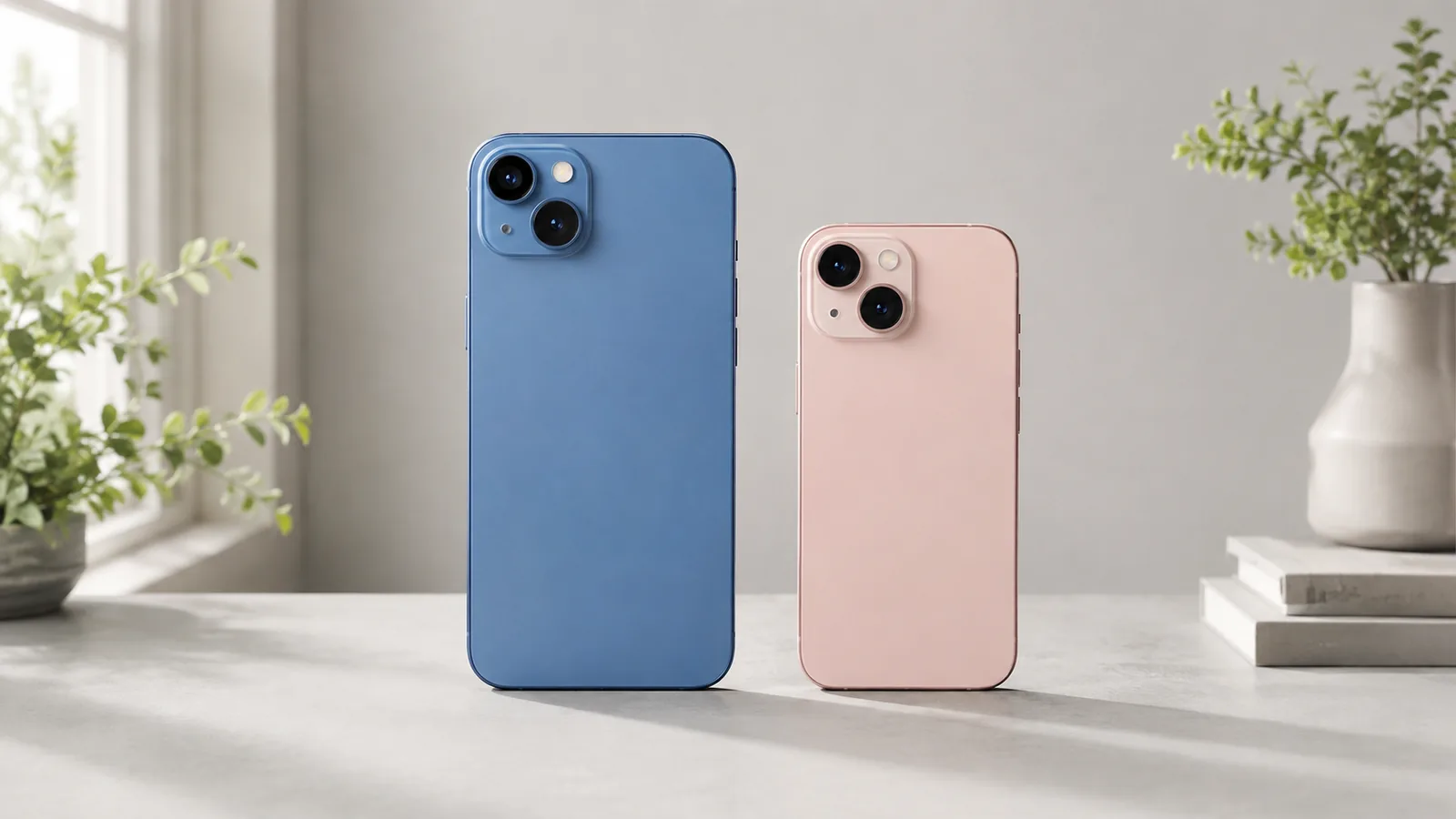
The iPhone 13 measures 146.7 × 71.5 × 7.65 mm and weighs 174 g, while the iPhone 13 Mini is more pocket-friendly at 131.5 × 64.2 × 7.65 mm and 141 g. Apple’s official technical specifications confirm the sizes and weight for both models. View iPhone 13 tech specs and view iPhone 13 Mini tech specs.
The redesigned rear camera module arranges the two lenses diagonally rather than vertically to accommodate the larger sensors. This visual change also helps distinguish the iPhone 13 series from the iPhone 12 generation. Apple’s announcement highlights the updated dual-camera layout and improved internal design.
Colour Options and Environmental Considerations
Both phones launched in pink, blue, midnight, starlight and (PRODUCT)RED. Apple also emphasised sustainability, noting the use of recycled materials in magnets, camera components, logic boards and packaging. The company also removed plastic wrap from the packaging as part of its environmental goals. Apple Newsroom.
Water Resistance
An IP68 rating means the iPhone 13 and iPhone 13 Mini can withstand submersion to 6 metres for up to 30 minutes. This makes them durable against spills, rain and accidental water exposure, although Apple still does not recommend intentionally using the phones underwater. Apple Support.

Display and Audio Experience
Both models feature OLED Super Retina XDR screens with HDR support, True Tone and Haptic Touch. The iPhone 13’s 6.1-inch panel has a 2532 × 1170 resolution at 460 ppi, while the Mini’s 5.4-inch display uses a 2340 × 1080 resolution at 476 ppi. Typical brightness is 800 nits, with peak HDR brightness reaching 1,200 nits, allowing comfortable viewing indoors and outdoors.
The display experience is one of the biggest differences between the two models. The iPhone 13 is easier to recommend for users who stream videos, read articles, edit photos or type often, because its larger 6.1-inch screen gives more room. The iPhone 13 Mini, however, remains one of the few truly compact flagship phones, making it ideal for users who prefer one-handed use and pocket-friendly design.
Stereo speakers deliver loud and clear sound, making both phones suitable for watching videos, listening to podcasts and gaming without headphones. Revibe’s review notes that the audio quality remains strong and comparable to the previous generation, while still offering an enjoyable media experience. Read Revibe’s iPhone 13 review.
Performance: A15 Bionic and Efficiency
Apple’s A15 Bionic chip powers both phones. It uses a 5-nanometer process with nearly 15 billion transistors, a 6-core CPU, a 4-core GPU and a 16-core Neural Engine. Apple said the A15’s CPU was up to 50% faster and the GPU up to 30% faster than competing smartphone chips at launch. The Neural Engine performs up to 15.8 trillion operations per second, enabling features like Live Text, computational photography and on-device machine learning. Apple Newsroom.
Real-World Performance
In everyday use, the iPhone 13 and 13 Mini remain smooth for messaging, browsing, social media, video streaming, photography, banking apps and casual gaming. The A15 Bionic is still powerful enough for modern iOS updates, and the phones continue to feel responsive for most tasks.
External reviewers generally praised the A15’s efficiency and speed. AppleInsider’s review roundup highlighted that meaningful upgrades such as better battery life, a faster chip and a smaller notch made the iPhone 13 series a worthwhile improvement. Read AppleInsider’s review roundup. Revibe’s testing also found smoother multitasking and quicker photo processing compared with older models like the iPhone 11 and iPhone 12. Read Revibe’s review.
Camera System: Larger Sensors and Cinematic Mode
Apple redesigned the dual-camera system to improve light gathering and video performance. The main 12MP wide camera uses 1.7 µm pixels and was described by Apple as the biggest sensor ever in a dual-camera iPhone at launch. Combined with sensor-shift optical image stabilization, the camera captures more light for brighter, cleaner photos.
The 12MP ultra-wide camera offers a 120-degree field of view and improved lens correction. Computational photography features such as Smart HDR 4, Deep Fusion, Night Mode and Photographic Styles help users capture better photos in different lighting conditions while adjusting tone and warmth in a more personalised way.
Cinematic Mode and Advanced Video
Both iPhone 13 models introduced Cinematic Mode, which records videos with a shallow depth of field and allows focus transitions. Cinematic Mode captures 1080p at 30fps and stores footage in Dolby Vision HDR. Users can edit focus points after recording, giving casual creators a simple way to produce more dramatic videos.
Standard video recording supports 4K at up to 60fps, slow motion at 1080p, time-lapse and extended dynamic range. The TrueDepth front camera also supports Cinematic Mode, Photographic Styles and HDR video recording.
Real-World Imaging Impressions
AppleInsider’s roundup notes that reviewers appreciated the larger sensors and sensor-shift OIS for sharper, cleaner photos with less noise. Cinematic Mode was praised as impressive, although some reviewers noted that the artificial blur could occasionally look imperfect. AppleInsider.
Revibe’s review highlighted that the new camera arrangement and larger lenses improved low-light photography and helped the iPhone 13 Mini deliver photo quality close to larger iPhones from the previous generation. Revibe.
Battery Life and Charging
Battery Capacity and Endurance
Apple increased battery capacity in both models. The iPhone 13 has an estimated 3,240 mAh battery, while the iPhone 13 Mini has an estimated 2,438 mAh battery. Macworld’s battery comparison lists the approximate capacities and watt-hour ratings for both models. Macworld.
According to Apple, the iPhone 13 delivers up to two and a half hours longer battery life than the iPhone 12, while the iPhone 13 Mini adds up to one and a half hours compared with the iPhone 12 Mini.
In real-world use, the iPhone 13 is the better choice for users who need stronger all-day battery life. The iPhone 13 Mini is much improved over the 12 Mini, but its smaller battery still makes it less ideal for heavy gaming, long video calls, navigation or all-day streaming.
Charging and MagSafe
Both phones support MagSafe wireless charging up to 15W, standard Qi wireless charging up to 7.5W and fast charging via Lightning. With a compatible 20W adapter, Apple says the phones can charge up to 50% in around 30 minutes. Apple Support.
Apple ships the phones with a USB-C to Lightning cable but no power adapter in the box. MagSafe remains one of the strongest accessory advantages of the iPhone 13 series, supporting compatible chargers, wallets, cases, mounts and stands.
Connectivity and 5G
The iPhone 13 series supports more 5G bands than the iPhone 12 series, improving compatibility across global networks. Apple’s Smart Data mode can automatically switch to LTE to conserve battery when full 5G speed is not needed.
Both models also support Wi-Fi 6, Bluetooth 5.0, NFC for Apple Pay, and dual-SIM connectivity through nano-SIM and eSIM. For everyday users, this means the iPhone 13 and 13 Mini remain reliable for calls, mobile data, wireless audio, payments and international travel.
Software Features: iOS 15 and Beyond
The iPhone 13 shipped with iOS 15, bringing features such as Focus modes, redesigned notifications, FaceTime improvements with spatial audio and Portrait mode, Live Text, improved Apple Maps and stronger privacy tools.
Since release, the iPhone 13 series has continued receiving major iOS updates, helping it remain useful years after launch. This long-term software support is one of the main reasons older iPhones continue to hold value in the refurbished and second-hand market.

Pricing and Value in the Used Market
When launched, the iPhone 13 cost US$799 and the iPhone 13 Mini cost US$699 for the 128GB models. Apple also offered monthly instalments and trade-in discounts at launch. Apple Newsroom.
Today, these models are commonly found through carriers, renewed sellers and refurbished marketplaces at lower prices. For many buyers, the standard iPhone 13 offers a strong balance of performance, camera quality, battery life and software support at a more affordable price than newer flagship iPhones.
Buyers should consider whether they need Pro features such as a 120Hz ProMotion display, telephoto camera, stainless steel build or ProRAW support. For many everyday users, the standard iPhone 13 remains the better value choice. The iPhone 13 Mini is best for those who specifically want a smaller phone.
Real-World Verdicts
Review Roundup
AppleInsider compiled early reviews and found consensus that the iPhone 13’s bigger batteries and improved cameras made it a solid upgrade. The review roundup highlighted that even though the spec sheet looked incremental, upgrades such as larger batteries, a faster chip and a smaller notch added up to meaningful improvements. AppleInsider.
Reviewers generally concluded that focusing on the fundamentals, especially battery life and camera quality, made the iPhone 13 series more useful than it might appear from the outside. The iPhone 13 Mini received praise for its compact design, although battery life remained the main compromise for heavy users.
Long-Term Experience
Revibe’s long-term review emphasised that the iPhone 13 remains an excellent device with strong performance, improved cameras and better battery life. The review also praised the high-quality build, MagSafe convenience and attractive colour options.
Should You Buy One?
Who Should Choose the iPhone 13?
- Everyday users seeking value: With strong performance, good cameras and reliable battery life, the iPhone 13 remains a balanced choice.
- Content creators on a budget: Cinematic Mode and Photographic Styles make video and photo creation more accessible.
- Users upgrading from iPhone 11 or earlier: You will notice improvements in display quality, battery life, camera performance and 5G support.
Who Should Consider the iPhone 13 Mini?
- Small-phone enthusiasts: At 5.4 inches and 141 g, the Mini remains one of the most compact flagship iPhones.
- Users who want flagship features in a smaller size: The Mini offers nearly identical performance, camera quality and 5G support compared with the standard iPhone 13.
- Moderate users: Battery life is improved compared with the iPhone 12 Mini and should be enough for lighter daily use.
Potential Drawbacks
- Battery life for power users: Even with improvements, the Mini may not last all day for heavy streaming, gaming or navigation.
- No ProMotion display: Neither model has a 120Hz refresh rate, which remains reserved for Pro models.
- No telephoto camera: Users who need optical zoom should consider an iPhone 13 Pro or newer Pro model.
- Lightning instead of USB-C: The iPhone 13 series still uses Lightning, so users with newer USB-C accessories may need extra cables.
Additional Resources
Looking for more? Check out these related articles and official resources:
- iPhone 13 Mini Review: Compact Powerhouse in 2025 – FrediTech’s in-depth review of the mini model.
- AirPods Pro 2nd Generation: A Comprehensive Review – discover how Apple’s flagship earbuds pair with your iPhone.
- Bose QuietComfort Ultra: The Ultimate Guide to Premium Noise-Canceling Headphones – alternative premium headphones that complement your Apple ecosystem.
- Apple official technical specifications: iPhone 13 and iPhone 13 Mini.
- Macworld battery capacity comparison: See iPhone battery capacities.
Frequently Asked Questions
When were the iPhone 13 and iPhone 13 Mini released?
How long does the iPhone 13 battery last?
What cameras do the iPhone 13 and iPhone 13 Mini have?
Do the iPhone 13 and iPhone 13 Mini support 5G?
Is the iPhone 13 still worth buying?
Is the iPhone 13 Mini still a good small phone?
About the Author: Wiredu Fred is a technology journalist and SEO strategist at FrediTech & Modern Collective. He specializes in smartphones, audio gear and emerging tech. His hands-on testing and clear explanations help readers make informed purchasing decisions.