
Introduction: redefining the three‑row EV
Electric vehicles are no longer niche, and the Rivian R1S proves how far the segment has come. Rivian, a US start‑up founded in 2009, built its reputation on the R1T pickup and quickly followed with the R1S electric SUV. The 2026 model year (and its 2025 predecessor) feature three rows of seating, up to 1,205 horsepower, an available 410‑mile range and a cabin full of premium touches. Off‑roaders appreciate the adjustable air‑suspension and 15‑inch ground clearance, while parents value the SUV’s family‑friendly cargo flexibility. This review dives into the R1S’s design, performance, range, technology, safety and ownership experience. It draws on real‑world tests and official specifications to help you decide if Rivian’s largest model fits your lifestyle.

Overview of the Rivian R1S
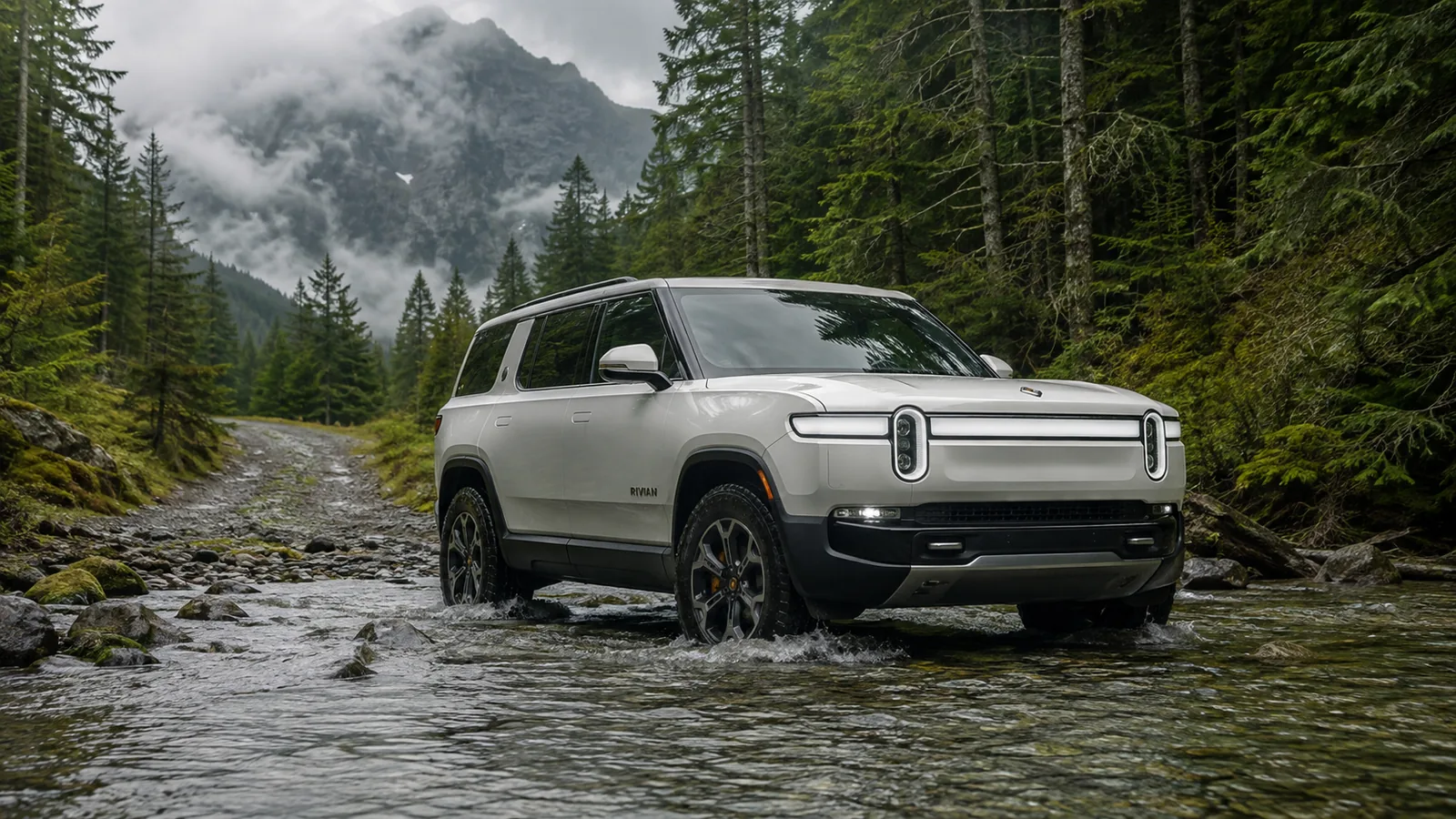
The R1S shares its underlying skateboard architecture with the R1T pickup but packages it in a more conventional SUV body. Dual‑, tri‑ and quad‑motor powertrains deliver between 533 hp and 1,205 hpcarsdirect.com. Battery options include Standard (≈ 270 miles), Large (≈ 329 miles) and Max (≈ 410 miles) packs. Adjustable air‑suspension provides from 9.5 to 15 inches of ride height to balance highway efficiency with off‑road clearance. A 15.6‑inch infotainment touchscreen anchors the minimalist dash, and the seven‑seat cabin incorporates a frunk, split tailgate and fold‑flat second and third rows. With these fundamentals, the R1S competes with luxury‑electric SUVs like the BMW iX and Lucid Gravity while offering towing up to 7,700 poundscarsdirect.com.
Key specifications
Item | R1S Dual‑motor | R1S Tri‑motor | R1S Quad‑motor |
Horsepower | 533 hp (standard) up to 665 hp with performance tune | 850 hp | 1,205 hp |
Range (EPA est.) | 258 – 410 mi (depending on battery) | ≈ 330–410 mi | estimates pending (Rivian claims >400 mi) |
0‑60 mph | 4.5 sec (dual) to 3.0 sec (tri) | ~3.0 sec | 2.6 sec |
Towing | up to 7,700 lb | same | same |
Seating | 7 passengers | 7 passengers | 7 passengers |
Starting price (2026) | $78,885 (Dual Standard); $85,885 (Dual Large); $92,885 (Dual Max) | $107,795 (Tri Max) | not yet released (expected >$120,000) |
Note: these values may vary with wheel choice, options and future updates.
Design and interior: space meets sustainability
Exterior styling
The R1S adopts a boxy yet aerodynamic shape reminiscent of classic SUVs. Its distinctive LED light bar spans the nose and tail, while rounded corners soften the otherwise squared‑off profile. Optional 20‑, 21‑ and 22‑inch wheels change appearance and efficiency; all‑terrain tires sacrifice a few miles of range but allow more off‑road grip. The adjustable air‑suspension lowers the body at highway speeds to reduce drag and raises it for rough trails or water fording.
Cabin materials and layout
Rivian’s cabin combines vegan leather seats, open‑pore wood accents and a panoramic glass roof to create an inviting atmosphere. According to Car and Driver, faux‑leather seating surfaces are standard, and the frunk adds 10 cubic feet of cargo spacecaranddriver.com. The interior uses a clean, horizontal layout dominated by the 15.6‑inch central screen; physical buttons are limited to window switches and a volume knob.

Seating configuration
- First and second rows: Edmunds notes that access is easy thanks to wide‑opening doors and the air‑suspension’s ability to lower the ride height when parkededmunds.com. The second row slides forward for third‑row access. Seats are comfortable but could benefit from adjustable bolsters and thigh extensions.
- Third row: The pass‑through to the rearmost seats is narrow, making it best for children or short trips. Legroom accommodates passengers up to about 6 feet tall.
- Climate control: The system cools the cabin quickly, though adjusting the direction of vents via the touchscreen is more tedious than using physical controls.
Cargo flexibility
With all seats up, the R1S offers 17.6 cubic feet of cargo space—enough for a couple of suitcases or a week’s worth of groceries. Folding the third row yields 90.7 cubic feet, and with both the second and third rows folded, the floor becomes nearly flatedmunds.com. A two‑piece split tailgate simplifies loading; the upper portion raises like a traditional SUV liftgate, while the lower section drops like a pickup tailgate. Car and Driver reports additional capacities: a 10 cu ft frunk, 18 cu ft behind the third row, 49 cu ft behind the second row and 91 cu ft with seats folded.
Performance and driving dynamics
Motor configurations and acceleration
The R1S offers four powertrains:
- Dual Motor Standard – two motors (one front, one rear) delivering 533 horsepower. This setup accelerates from 0 to 60 mph in around 4.5 seconds and tows up to 7,700 lb.
- Dual Motor Performance – an upgraded inverter that boosts output to 665 hp. Expect a 0‑60 mph time around 4 seconds.
- Tri Motor – three motors producing 850 hp. The two rear motors enable torque vectoring; acceleration drops to 3 seconds.
- Quad Motor – four motors providing 1,205 hp and 1,198 lb‑ft of torque. Car and Driver measured 0 to 60 mph in 2.6 seconds, making the R1S quicker than many sports cars.
Suspension and ride quality
An air‑spring suspension comes standard. Drivers can choose multiple ride heights: lowest (≈ 9.5 inches) for efficiency and easier entry, standard for everyday driving, or off‑road (≈ 15 inches) for maximum clearancecaranddriver.com. The system also adjusts damping to balance comfort and handling. Off‑road modes adjust throttle response, regenerative braking and stability control to suit surfaces like mud, snow or sand.
On pavement, the R1S handles surprisingly well for its nearly 7,000‑pound curb weightcaranddriver.com. The battery pack mounted under the floor lowers the centre of gravity, reducing body roll. Steering is precise but lacks the tactile feedback of a sports car. Tri‑ and quad‑motor models can send more power to the rear wheels, creating a rear‑bias that improves handling.
Towing and payload
All versions of the R1S are rated to tow 7,700 pounds and carry a 1,764‑pound payload. When towing heavy trailers, range decreases by roughly half, so careful planning is required on long road trips.
Range, charging and efficiency
Battery packs and range estimates
Rivian offers three battery sizes:
- Standard – about 270 miles of EPA‑estimated range. Ideal for commuters or as a second vehicle.
- Large – increases range to roughly 329 miles (Edmunds lists 329 mi for dual‑motor large pack). This battery balances cost and range.
- Max – extends range to 410 miles. Rivian says the Max‑pack dual‑motor R1S is the longest‑range electric SUV available. EPA ratings for tri‑ and quad‑motor Max models are pending; early estimates are around 390–400 mi.
Charging speeds
Earlier R1S models used the CCS port and supported up to 210 kW DC fast charging. For 2026, Rivian will adopt the North American Charging Standard (NACS) connector, enabling direct access to Tesla’s Supercharger network and planned charge rates of 300 kW or higher. With today’s chargers, a 0–80 % charge takes about 45 minutes, while a full charge on a 240‑V Level 2 home charger requires 9–12 hours, depending on battery sizeedmunds.com.
Real‑world efficiency
The EPA rates the dual‑motor R1S at 72–94 MPGe city and 63–77 MPGe highway. Real‑world consumption varies with wheel size, tires and climate control use. Edmunds testers found that the Large battery delivered around 330 miles in mixed driving, even with all‑terrain tires, validating Rivian’s estimates. Off‑road adventures or high‑speed highway driving will reduce range.
Infotainment and connectivity
A large 15.6‑inch touchscreen dominates the centre of the dashboard. Unlike many competitors, Rivian does not support Apple CarPlay or Android Autocaranddriver.com. Instead, it uses a proprietary interface built on the navigation and entertainment systems. Maps are responsive and can locate charging stations by network. Over‑the‑air updates continually add features, though early owners have reported occasional software bugs.
Ports and charging options
The cabin provides eight USB ports and two wireless charging pads. Bluetooth connectivity allows multiple phones to pair, and the Rivian smartphone app acts as a digital key. A removable Bluetooth speaker under the centre console can be used outside the vehicle for tailgating or camping.
Audio and sound systems
A standard 18‑speaker audio system delivers crisp sound, while an optional 19‑speaker premium system with a subwoofer offers richer bass. For audiophiles, FrediTech’s guide to the best car audio systems provides recommendations on aftermarket upgrades that can complement the R1S’s built‑in setup (see Top 5 Rivian R1S vs R1T Differences for links to audio gear).
Safety and driver‑assistance
Active safety features
The R1S includes Rivian’s Autonomy Platform, which uses 11 cameras, five radars and 38 sensors. Standard driver‑assistance features include:
- Automatic emergency braking – detects pedestrians and other vehicles and can apply brakes automatically.
- Forward‑collision warning – warns the driver of an impending collision.
- Lane‑keeping assist – provides gentle steering inputs to keep the vehicle centred in its lane.
- Blind‑spot monitoring and rear cross‑traffic alert.
- Adaptive cruise control with stop‑and‑go functionality.
- Automatic parking – uses cameras to detect parking spaces and steer the vehicle into them.
Rivian also offers an optional Highway Assist system that combines adaptive cruise control and lane‑centering for semi‑hands‑free driving. Unlike GM’s Super Cruise or Ford’s BlueCruise, Rivian’s system still requires drivers to keep their hands on the wheel and eyes on the road.
Structural safety and crash ratings
The National Highway Traffic Safety Administration (NHTSA) and Insurance Institute for Highway Safety (IIHS) have not yet published crash‑test results for the R1S. However, its heavy battery pack and rigid skateboard platform provide a low centre of gravity and good crash‑energy management. Car and Driver notes that the R1S’s long wheelbase, wide track and advanced sensors contribute to stable handlingcaranddriver.com.
Warranty coverage
Rivian’s warranty package includes:
- Basic coverage: 5 years/60,000 miles (Edmunds lists 4 years/50,000 miles for earlier models).
- Battery and drivetrain: 8 years/175,000 miles. Standard battery models may have 8 years/120,000 miles coverage, while Large and Max packs extend to 150,000 miles.
- Rust perforation: 8 years/unlimited miles.
- Roadside assistance: 4 years/50,000 miles.
Rivian’s direct‑sales model means pricing is fixed, and customers order vehicles online. Service centres are growing but not yet as widespread as established brands; mobile technicians handle routine maintenance and minor repairs at owners’ homes.
Ownership experience and real‑world impressions
Day‑to‑day livability
Real‑world owners praise the quiet cabin, instant torque and handsome styling. Families appreciate the frunk for storing messy gear separate from the cabin and the adjustable tailgate for picnic seating. The optional camp kitchen (a slide‑out stove and sink available as an accessory) makes the R1S a weekend‑warrior dream. However, some early owners on Rivian forums report software bugs, inconsistent ride comfort and occasional difficulty accessing the third row. Rivian regularly releases over‑the‑air updates to address issues, so the experience is improving.
Maintenance and servicing
Because the R1S is an EV, maintenance requirements are lighter than those of gasoline SUVs—no oil changes, spark plugs or emissions checks. Tire rotations, brake inspections and cabin filters comprise most routine services. Rivian provides mobile service for minor repairs and will tow your vehicle free of charge if necessary.
Charging infrastructure and long‑distance travel
Rivian’s Adventure Network of DC fast chargers is growing, but it lags behind Tesla’s Supercharger network. The adoption of NACS will open the door to Tesla’s 17,000+ stations in North America, mitigating range anxiety. Planning apps integrated into the infotainment system help route through charging stops and calculate energy consumption based on speed, elevation and weather.
Comparison with competitors
GMC Hummer EV SUV
The Hummer EV offers similar off‑road credentials but weighs over 9,000 pounds and starts above $100,000. Its third row is nonexistent, and efficiency is lower than the R1S.
BMW iX and Mercedes‑Benz EQE SUV
Luxury brands like BMW and Mercedes provide polished interiors, advanced driver aids and established dealer networks. However, they lack the R1S’s towing capacity and off‑road prowess. The iX and EQE generally cost less in base trim but have shorter range (≈ 300 miles). Buyers seeking a more road‑biased SUV might prefer them.
For a deeper breakdown of BMW’s latest electric SUV, read our detailed 2026 BMW iX3 review, covering performance, range, interior features, and real-world usability.
Volvo EX90 and Lucid Gravity
Upcoming three‑row EVs from Volvo and Lucid promise around 300–400 miles of range and upscale cabins. Until they arrive, the R1S remains one of the few three‑row electric SUVs on the market.
Step‑by‑step guide: planning your R1S purchase
- Define your priorities. Consider how far you typically drive, whether you tow, and how often you carry seven passengers. These factors will determine whether the Standard, Large or Max battery suits you and whether you need the performance of tri‑ or quad‑motor versions.
- Check federal and regional incentives. The R1S is built in Normal, Illinois, and may qualify for US federal EV tax credits. Availability depends on battery components and your income. Ghanaian buyers should check local import duties and any government incentives for electric vehicles.
- Build your configuration online. Use Rivian’s configurator to select exterior colour, wheel size, interior theme and accessories like the camp kitchen or roof rack. Base models come well equipped; common upgrades include all‑terrain tires, a premium audio system and a power‑folding tonneau cover.
- Schedule a demo drive. Rivian operates experience centres and mobile demo drives in major cities. During the drive, test the ride comfort, acceleration, driver assistance features and ease of access to the third row.
- Plan your charging strategy. If you have off‑street parking, install a Level 2 home charger. Evaluate public charging networks along your regular routes, considering Rivian’s current Adventure Network and upcoming access to Tesla’s Superchargers.
- Consider aftermarket accessories. FrediTech’s Expert Car Reviews & Industry Insights section recommends phone holders, camping gear and audio upgrades that enhance the ownership experience. When purchasing accessories, ensure they are compatible with the R1S’s air‑suspension and interior layout.
Conclusion
The Rivian R1S is one of the most versatile electric vehicles available. It combines supercar‑quick acceleration with family‑friendly practicality, long‑distance range and legitimate off‑road capability. The adjustable air‑suspension and configurable battery options allow buyers to tailor the SUV to commuting, road‑tripping or overlanding. Downsides include the lack of smartphone mirroring (CarPlay/Android Auto), a tight third row and a high price, especially for tri‑ and quad‑motor models. Yet for adventurers seeking a single vehicle that can tow, haul and explore without burning fossil fuels, the R1S stands out.
Frequently asked questions
What is the range of the Rivian R1S?
Does the R1S have a third row?
How fast does the R1S charge?
What is the towing capacity of the R1S?
Does the R1S qualify for tax credits?
How does the R1S compare to the R1T pickup?
Are there any known issues with the R1S?
Author credentials
Wiredu Fred is an automotive technology journalist and the founder of FrediTech, a platform that delivers expert reviews of cars, gadgets and technology products. He has over a decade of experience analysing electric vehicles, emerging technologies and consumer trends. His hands‑on approach to testing and his ability to translate complex engineering concepts into everyday language make his insights valuable to readers seeking trustworthy information.