
Samsung’s Galaxy A55 5G is the 2024 successor to the popular A54, aiming to refine the mid-range smartphone experience with 5G connectivity. Packed with a 6.6-inch 120Hz AMOLED display, a 50 MP triple-camera system, and a hefty 5,000 mAh battery, the Galaxy A55 5G promises a blend of premium features and affordable pricing. But does it truly deliver as a mid-range marvel, or is it merely a minor upgrade over its predecessor? In this in-depth review, we’ll explore the Galaxy A55’s design, display, performance, cameras, battery life, and more. Read on for a step-by-step breakdown of the A55 5G’s strengths and weaknesses, real-world examples, and how it stacks up against competitors in 2025.

Introduction
The Samsung Galaxy A series has built a reputation for offering great value in the mid-range smartphone market. The Galaxy A55 5G continues this trend, bringing some notable improvements over last year’s A54. It introduces a refreshed design with premium materials, an updated processor with AMD graphics, and promises extended software support. Priced around £439 in the UK / €469 in Europe (approximately $400 via import)androidauthority.com, the A55 5G sits in a competitive bracket against the likes of Google’s Pixel 8a and OnePlus’s mid-rangers. Notably, Samsung did not officially release the A55 in the U.S., possibly to steer consumers toward the pricier Galaxy S23 FE and newer modelsphonearena.com. Despite that, the A55 has generated buzz internationally for being one of Samsung’s best mid-range phones in its price tier.
In the sections that follow, we’ll dive into the Galaxy A55 5G’s design and build quality, the display and audio performance, the hardware and software (processor, gaming, and One UI experience), the camera capabilities (with real-world photo examples), and the battery life and charging speeds. We’ll also consider how it compares to top competitors and whether it’s worth your money. Let’s start by looking at what Samsung changed (and what stayed the same) in the A55’s design.
Design and Build Quality
Premium Look with Metal and Glass
Samsung gave the Galaxy A55 5G a subtle yet meaningful design upgrade. The phone features an “iconic” flat frame design with a metal chassis, moving up from the plastic frame of the A54samsung.com. This metal frame, combined with Corning Gorilla Glass Victus+ on the front, makes the A55 feel more solid and durable in hand. In fact, Gorilla Glass Victus+ is a notable improvement over the A54’s Gorilla Glass 5, offering greater scratch and drop resistance for a phone at this price tierandroidauthority.com. The back of the device, however, is not Victus+; Samsung confirmed the rear panel doesn’t use the same glass (likely a standard glass or high-quality plastic). The overall build exudes a premium vibe, closer to Samsung’s flagship Galaxy S series design language than before.
IP67 water/dust resistance adds to the durability credentials of the A55samsung.com. This rating means the phone can survive being submerged in up to 1 meter of fresh water for up to 30 minutes, and it’s protected from dust ingress. While you shouldn’t take it swimming for long, it will handle accidental splashes and rain without issue – a welcome feature in a mid-range device (the A55’s predecessor also had IP67). Notably, this is shy of the IP68 rating found on Samsung’s flagship S series (e.g., the S25 Ultra) which can go a bit deeper and longerfreditech.com, but for everyday use IP67 is plenty robust.
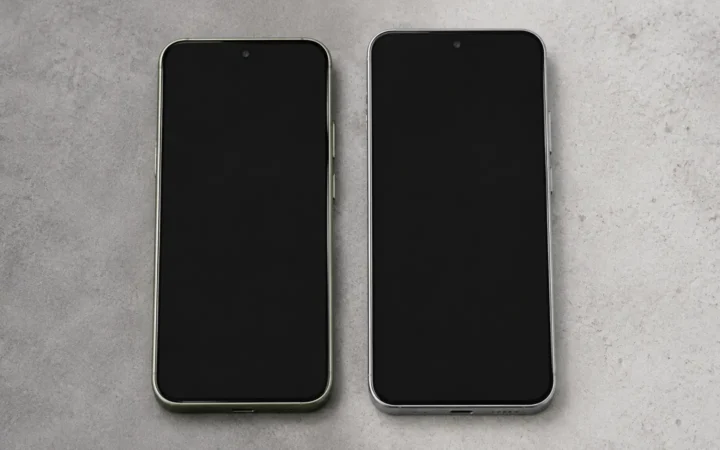
The size and weight have increased slightly. The Galaxy A55 measures 161.1 × 77.4 × 8.2 mm and weighs about 213 gen.wikipedia.org. It’s a hefty phone – roughly 11 g heavier than the A54 (202 g) – due in part to that new metal frame and possibly a larger cooling system. While 213 grams is noticeable, the ergonomics are still comfortable thanks to rounded edges and a slightly curved back that sits well in the palm. The phone feels sturdy and substantial, though one-handed use can be a stretch on this 6.6-inch device. No headphone jack is present – like many modern phones, the A55 omits the 3.5 mm audio jackandroidauthority.com, so you’ll be relying on USB-C or Bluetooth for audio.
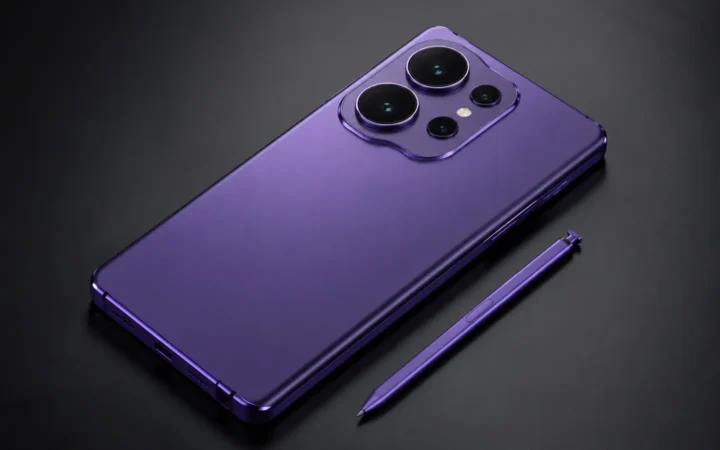
Samsung offers the Galaxy A55 5G in four “Awesome” color options: Awesome Ice Blue, Awesome Lilac, Awesome Lemon, and Awesome Navysamsung.com. These trendy colorways give consumers some fun choices beyond the typical black/gray. Our review unit’s Awesome Ice Blue finish looks stylish and does a decent job hiding fingerprints on the rear. The triple camera module adopts Samsung’s now-signature minimalist vertical layout – three individual lens cutouts with a subtle bump – similar to the flagship Galaxy S series design. It’s a clean look that many will appreciate for its simplicity.
Overall, the Galaxy A55 scores well on design for a mid-range phone. Premium materials and water resistance are standout features at this price. The phone feels more high-end than its predecessor, and build quality inspires confidence. If coming from older A-series models, you’ll immediately notice the uplift in hand-feel. Just keep in mind that the weight is on the higher side, and you’ll need to use USB-C audio or wireless earbuds (which is the norm nowadays).
Display and Audio
Vivid 120Hz AMOLED Display
Front and center on the Galaxy A55 5G is its 6.6-inch Super AMOLED display. Samsung consistently delivers excellent screens, and the A55 is no exception. This panel has a Full HD+ resolution (1080 × 2340), yielding a sharp ~396 ppi densityen.wikipedia.org. It also boasts a 120Hz adaptive refresh rate, which makes scrolling and animations feel smooth. The high refresh rate adapts based on content to save battery when 120Hz isn’t needed. Whether you’re browsing the web or gaming, the fluidity is a noticeable step up from 60Hz screens.
In terms of brightness and outdoor visibility, the Galaxy A55 impresses. Samsung equipped it with up to 1,000 nits peak brightness in High Brightness Mode (HBM)samsung.com. In everyday use, this means the screen remains readable under sunlight and harsh lighting. Independent testing showed excellent screen readability in bright conditions, with natural color rendering even outdoorsdxomark.com. The AMOLED technology delivers the usual deep blacks and vibrant colors, and it supports HDR10+ for high dynamic range content. Streaming videos on YouTube or Netflix is a pleasure – you get punchy contrast and vivid hues, and the adaptive brightness handles changes in ambient light well. One thing to note: in very dark rooms, the auto-brightness can actually go a bit high, making the screen uncomfortably bright at nightdxomark.com. You may need to manually adjust brightness in bedtime scenarios.
The display is flat (not curved at the edges) which many users prefer for reducing accidental touches and making screen protectors easier to apply. There’s a hole-punch cutout at the top center for the selfie camera. Surrounding bezels are thin, though a slight chin is present at the bottom. Overall, this is one of the best displays in the mid-range segment, rivaling even more expensive phones in terms of color and smoothness. Samsung’s expertise in screens shines through here.
Audio: Stereo Speakers, No Jack
For audio, the Galaxy A55 features stereo speakers – one bottom-firing speaker and the earpiece doubling as a second speaker – which produce loud and fairly balanced sound. Music and videos have great sound quality for a phone in this class, with decent stereo separationphonearena.com. High volumes are impressively clear with minimal distortion, and there’s even a hint of bass which is often lacking in mid-range phone speakers. Samsung’s tuning provides an enjoyable experience for hands-free video watching or gaming without headphones.
As mentioned earlier, there is no 3.5 mm headphone jack on this deviceandroidauthority.com. This means wired audio requires a USB-C to 3.5 mm adapter (not included) or USB-C headphones. For most users, Bluetooth earbuds or headphones will be the go-to. The A55 supports the latest Bluetooth 5.3 standarden.wikipedia.org, ensuring strong wireless audio connectivity and compatibility with high-quality codecs (depending on your headset). Call quality through the earpiece is loud and clear, and with noise cancellation microphones, voice calls sound fine even in noisy environments.
One quirk for audio enthusiasts: unlike Google’s Pixel 8a, the Galaxy A55 does not support wireless charging or FM radio – features sometimes tangentially related to the device hardware but worth noting for completenessandroidauthority.com. Wireless charging is a convenience some mid-rangers (like the Pixel 8a) now offer, but Samsung omitted it here, likely to keep costs downandroidauthority.com. Given the price segment, the absence of wireless charging is understandable (most phones around $400 don’t have it). As for Dolby Atmos, Samsung’s software does include Dolby Atmos support for enhancing sound when using headphones or Bluetooth speakers, offering presets for movies, music, etc. It can widen the soundstage a bit for a more immersive audio experience.
In summary, the Galaxy A55’s display is a standout feature – it’s large, crisp, very bright, and ultra-smooth with 120Hz refresh. Consuming media or gaming on this screen is a joy, especially given the HDR support and strong outdoor visibility. The audio holds its own with stereo speakers that are surprisingly good for a mid-range phone. While you won’t get a headphone jack or wireless charging, these omissions are relatively minor in light of the excellent overall multimedia experience the A55 provides.
Performance and Software
Processor and Performance Overview
Under the hood, the Samsung Galaxy A55 5G is powered by the Exynos 1480 chipset – Samsung’s in-house octa-core SoC for mid-range devicesen.wikipedia.org. This chip is noteworthy because it’s the first mid-range smartphone chipset with an AMD GPU onboard. Specifically, the Exynos 1480’s graphics are handled by the Xclipse 530 GPU, co-developed with AMD and based on the RDNA 2 architecture. On the CPU side, the Exynos 1480 uses a similar core configuration to the previous Exynos 1380 (4× Cortex-A78 performance cores + 4× Cortex-A55 efficiency cores) but with higher clock speeds (up to 2.7 GHz on the A78 cores). In essence, Samsung gave the CPU a boost while introducing a more powerful GPU.
So how does this translate to real-world performance? In benchmarks, the Galaxy A55 shows a modest improvement in CPU speed and a larger jump in multi-core performance over the A54 – about a 21% multi-core boost in Geekbench testsandroidauthority.com. This means better handling of multitasking and heavy apps compared to its predecessor. However, the A55’s CPU still lags behind some closest rivals like Google’s Pixel 8a (Tensor G3 chip) and the OnePlus 12R (Snapdragon chipset) in raw CPU powerandroidauthority.com. Graphics performance has similarly improved over the A54, yet the AMD GPU doesn’t leapfrog competitors – in GPU stress tests, the A55 trails behind the Pixel 8a’s Adreno GPU and OnePlus’s offering. The good news is that Samsung’s thermal design is effective: a Wild Life stress test showed 99% stability, indicating virtually no throttling during extended heavy loads. The phone’s internal cooling and the efficient 5 nm chip keep performance consistent with no major overheating observed in tests.
In everyday use, the Galaxy A55 5G feels snappy and smooth. Navigating One UI, switching between apps, and multitasking are handled with ease – you won’t notice slowdowns in typical scenariosandroidauthority.com. Our unit (with 8 GB RAM) kept several apps in memory without aggressive refreshes. Gaming performance is solid for a mid-ranger: graphically demanding titles like Genshin Impact run at low to medium settings with stable frame rates. We were even able to push some settings towards high at 60 fps in certain games, which is impressive at this price. The AMD GPU and the four high-performance cores show their strengths in real-world gaming – even some console emulators (PS2, GameCube) ran at playable speeds. That said, this is not the most powerful mid-range phone on the market (devices closer to $600 will outperform it), but the A55 holds its own and then some. As one reviewer summarized: “The Galaxy A55 5G is far from the most powerful mid-range phone, but it performed surprisingly well with some demanding apps.”androidauthority.com
Memory configurations for the A55 include 6 GB, 8 GB, or even 12 GB of RAM (region-dependent), paired with 128 GB or 256 GB of internal storage. If you need more space, Samsung happily provides a microSD card slot supporting up to 1 TB expansionaurashop.africa. This is a big advantage over many competitors (for example, Google’s Pixel 8a has no expandable storage). Our 256 GB review unit had ample space, but power users and media hoarders will appreciate the microSD flexibility – you can keep tons of photos, videos, or offline music without worrying about running out of storage.
Security is handled by an in-display fingerprint scanner (optical). It’s reasonably fast and accurate in our use – not quite as instantaneous as ultrasonic scanners on premium models, but reliable for daily unlocking. You also get standard face unlock (2D image-based using the selfie camera), which works fine in good light but is less secure than the fingerprint. The phone supports Samsung Knox for hardware/software security, and features like Secure Folder for encryption of private data.
One UI 6.1 (Android 14) and Software Updates
Out of the box, the Galaxy A55 5G runs Android 14 with Samsung’s One UI 6.1 on topandroidauthority.com. Samsung’s One UI is feature-rich and user-friendly, with a clean design and customization options. If you’ve used a Samsung phone recently, you’ll feel right at home. The interface is smooth on the 120Hz display, and animations are fluid. One UI offers nice perks like an Always-On Display, theme support, a good Dark Mode implementation, and Samsung’s edge panel shortcuts. It’s also quite polished – in our testing, we encountered no bugs or crashes.
Samsung has made a strong commitment to software support for its devices. The Galaxy A55 5G is slated to receive four major OS updates and five years of security patches. This is an excellent update policy in the Android world, especially for a mid-range phone. It means the A55 (launched on Android 14) can expect updates up to Android 18 (likely through 2027–2028)en.wikipedia.org, and security updates into 2029. While it’s not quite Google’s industry-leading 7-year update promise on the Pixel 8a, Samsung’s pledge is among the best you’ll find on Androidandroidauthority.com. For comparison, many mid-range phones only guarantee 2–3 years of updates. So, you can buy the A55 knowing it will stay current with new features and remain secure for a long time – great for the longevity of your investment.
One thing the A55 does not get from Samsung’s latest software push are the fancy “Galaxy AI” features that launched with the flagship S25 series. There’s no on-device generative AI assistant or specialized AI tricks in the camera beyond the standard scene optimizer. For instance, Samsung’s flagship Galaxy S25 Ultra introduced new AI-powered features (like “Now Brief” personalized feeds)freditech.com, but those haven’t trickled down to the mid-range A55. In fact, Samsung confirmed the A55 “doesn’t offer any generative Galaxy AI features” seen on high-end devicesandroidauthority.com. That’s not a big loss, as core Android 14 features and Google’s own AI features (e.g. Google Assistant, Live Translate) are still present. But it’s worth noting if you were expecting the latest AI tricks – those remain exclusive to pricier models for now.
When it comes to pre-installed apps, Samsung still has room for improvement. The Galaxy A55 comes with the usual Samsung apps (which often duplicate Google apps – like Samsung Internet vs Chrome, etc.), plus a suite of Microsoft apps (Office, OneDrive, LinkedIn) and third-party apps like Facebook, Netflix, and Spotify pre-loaded. In total, there’s quite a bit of bloatware out of the box. While you can uninstall or disable many of these, it’s annoying to see nearly a dozen apps you might not want. Worse, during initial setup Samsung presents an unskippable “Recommended Apps” screen – even if you decline, the phone still auto-installs some bloatware games like Candy Crushandroidauthority.com. This aggressive bloatware push has been criticized, as it detracts from an otherwise great software experience. As an informed user, you might need to spend some time cleaning up the app drawer after setup. On the plus side, Samsung’s core apps (Gallery, Samsung Health, etc.) are well-made, and services like Samsung Pay and Secure Folder add genuine value. Just be prepared to do a bit of app housekeeping on day one.
Connectivity: The Galaxy A55 5G, as the name implies, supports a broad range of 5G bands (Sub-6 GHz; no mmWave, which is fine at this price). It’s a dual-SIM device in many regions (nanoSIM + eSIM or dual nanoSIM)en.wikipedia.org. Other connectivity features include Wi-Fi 6 (802.11 a/b/g/n/ac/ax) with dual-band support, Bluetooth 5.3, NFC for Google Pay/Samsung Pay, and USB-C 2.0 port (for charging/data). There’s no HDMI-out or DeX support (reserved for higher-end phones). Location (GPS) works with all major satellite systems and was accurate during navigation use. The call reception and mobile data performance during our review were solid, with the phone maintaining good signal on 5G and quickly falling back to 4G where 5G wasn’t available.
In summary, the Galaxy A55 5G delivers strong performance for everyday tasks and moderate gaming, thanks to the upgraded Exynos 1480 chip. It’s not a performance champ against higher-priced rivals, but it’s reliable and smooth for the vast majority of use cases – even exceeding expectations in some demanding apps. The generous RAM and storage options, plus microSD slot, are big positives in this class. On the software side, One UI 6.1 is feature-packed and user-friendly, and Samsung’s commitment to 4 OS upgrades means this phone will stay fresh for years. The main downside in software is the heavy pre-load of apps – something Samsung has become notorious forandroidauthority.com. If you don’t mind uninstalling a few unwanted apps, you’ll find the A55’s software experience to be one of the most complete on any mid-range Android phone.
Camera Quality
Triple Camera Setup (50 MP Main + 12 MP Ultrawide + 5 MP Macro)
On paper, the Galaxy A55 5G’s camera system looks similar to its predecessor: a 50 MP primary camera, a 12 MP ultrawide, and a 5 MP macro lens, plus a high-resolution 32 MP front camera for selfiesandroidauthority.com. Indeed, Samsung carried over the fundamental camera hardware from the A54 – even the sensor specs are the same. The primary 50 MP sensor (1/1.56″ size, f/1.8 aperture, with Dual Pixel PDAF and Optical Image Stabilization) is a Sony IMX906en.wikipedia.org. By default it outputs 12 MP images via pixel binning (combining pixels for better light capture), though you can shoot full 50 MP resolution if needed. The ultrawide camera uses a 12 MP Sony IMX258 sensor with a 123° field of view – great for wide landscapes or group shots, albeit without autofocus. The 5 MP macro is a basic fixed-focus shooter for close-ups; its inclusion is more to pad the spec sheet, as the quality is limited (5 MP without autofocus usually yields mediocre macro shots, but we’ll touch on that). The front-facing 32 MP selfie camera (Sony IMX616, f/2.2) captures detailed selfies and supports portrait mode and up to 4K videoen.wikipedia.org.
While hardware is unchanged, Samsung has worked on software processing. Let’s break down image quality in various scenarios:
- Daylight Photography (Main camera): In good lighting, the Galaxy A55’s 50 MP main camera can capture excellent shots. Photos come out with plenty of detail, thanks to the relatively large sensor and pixel binning. Colors are vibrant – sometimes overly vibrant. Samsung’s processing leans towards punchy saturation and high contrast. This can make images “pop,” but at times it oversaturates to a ridiculous degree, making things like reds and greens look unnaturally vividandroidauthority.com. For example, a photo of a red object might appear almost neon on the A55’s screen. HDR (high dynamic range) processing is aggressive; it usually brings out shadow detail well, but occasionally introduces a halo effect around high-contrast edges (as noted in some test shots of tree leaves against sky). These instances aside, daylight photos are generally pleasing and sharp. The phone handles exposure well, and with OIS, images are usually shake-free. It’s safe to say the A55 is a capable point-and-shoot camera in daylight, easily good enough for social media and casual photography. Samsung’s Scene Optimizer tends to boost saturation and brightness, so some users might prefer turning it off for more natural results.
- Ultrawide Camera: The 12 MP ultrawide lets you capture a much broader scene, which is great for cityscapes or tight indoor spaces. In daytime, ultrawide shots have decent color consistency with the main camera, though a bit softer in detail (as expected with the smaller sensor). There is some noticeable drop in sharpness towards the edges of the ultrawide photos – common for this class of lens. In mixed lighting or dusk, the ultrawide struggles more: detail drops and noise increases. Samsung doesn’t provide autofocus or any fancy stabilization on the ultrawide, so it’s very much a secondary lens. Overall, it’s serviceable but “a clear step down in detail and noise compared to the main sensor” in challenging lightingandroidauthority.com. Still, for broad daylight or well-lit scenes, it adds versatility to the camera setup.
- Macro Camera: The inclusion of a 5 MP macro lens is fairly standard for Samsung’s mid-range phones, but its usefulness is limited. With no autofocus, you have to carefully position the phone at the correct distance (a few centimeters away) to get a sharp macro shot. When you do hit the focus sweet spot, results are just okay – fine for a quick close-up of a flower or insect, but the resolution and clarity don’t match what a good main camera crop could achieve. It’s more of a fun add-on; many users may try it once or twice and forget about it. It would’ve been preferable to see a telephoto lens or a depth sensor instead at this price, but those are rare in mid-range devices.
- Low-Light and Night Mode: The Galaxy A55’s main camera has a fast f/1.8 aperture and OIS, but the sensor, while large for mid-range, can only do so much in low light. Without Night mode, low-light shots are often dark and noisy, with loss of detail in shadows. The phone tends to keep shutter speeds relatively slow (thanks to OIS), which can introduce motion blur if anything in the scene moves. The good news: Samsung’s Night Mode (or “Nightography,” as their marketing calls it) is quite effective. It brightens the scene significantly, pulls up shadow detail, and curbs noise, albeit sometimes at the cost of fine detail. The A55’s Night mode produces usable photos in very dim settings, though it can occasionally go overboard and look a bit unnatural. Importantly, Samsung has reduced the shutter lag in low light that plagued some earlier Galaxy A modelsandroidauthority.com. On the A55, you still need to hold still for a second after pressing the shutter (to allow image stacking), but it’s faster and the camera app more clearly indicates when it’s processing. A reviewer noted the low-light capture is improved over the Galaxy A34 which had a notorious delayandroidauthority.com. It’s advisable to use Night mode for most shots after dark; otherwise, you may end up with underexposed images. The ultrawide lens, lacking OIS and with a smaller aperture (f/2.2), doesn’t fare well in low light – Night mode helps a tiny bit, but don’t expect miracles there.
- Portrait Mode: Using either the 50 MP main or the 32 MP front camera, the A55 can take portraits with background blur (bokeh). Edge detection is hit-or-miss. In our tests, portrait shots of people sometimes had depth estimation errors, where parts of the subject (like hair or a shoulder) were mistakenly blurredandroidauthority.com. When it works, the subject stands out nicely with a pleasing blur to the background. But it’s not as consistent as Google’s Pixel phones, which excel in this area. This is one aspect where the mid-range A55 shows its limits – the processing isn’t at the level of higher-end devices for portraits. Still, for casual use, you can get some nice portraits, just maybe take a few to ensure you get a clean cutout. The front camera’s portraits also suffer occasionally from separating the subject (you) from a complex background.
- Selfie Camera: The 32 MP front camera captures very detailed selfies in good lighting. By default it may apply some skin smoothing (which can be toned down or disabled if you prefer a natural look). Colors are generally accurate, and the wide field of view fits a lot in the frame. In low light, the lack of autofocus and smaller sensor means selfies can get soft or a bit grainy. The screen flash helps in a pinch for a dark environment. You can also take portrait-mode selfies with blurred backgrounds – again, decent but sometimes you’ll notice a bit of blurring where it shouldn’t be (e.g., around hair). As a positive, Samsung’s camera app offers fun features like filters and AR stickers for the front camera, and those run smoothly on the A55.
Video: The Galaxy A55’s main camera can record video up to 4K at 30 fps, and the ultrawide and front camera also support 4K30. There is no option for 4K at 60 fps, which some users might miss – 4K60 is not supported, and some critics call this omission unacceptable at this price pointandroidauthority.com. Most mid-rangers (and even some flagships like Pixel 8a) also stick to 4K30, so it’s not unusual, but 60fps aficionados will have to drop to 1080p (which can do 60 fps). The 1080p60 footage is smooth. Overall video quality in daylight is quite good: the 4K footage from the main camera is detailed and colorful, with effective optical image stabilization (OIS) smoothing out hand shakes. There’s also electronic stabilization (EIS, or VDIS as Samsung calls it) which works in 1080p to further steady the videosamsung.com. In challenging lighting, the A55 benefits from Super HDR processing in video to balance highlights and shadowssamsung.com. The result is decent dynamic range for casual videos. In low light, videos get noisier and you’ll see the limits of the sensor – grain in dark areas and softer details. The microphone quality is fine for everyday use (voices come through clearly). One missing feature compared to some higher-end phones is a “Pro video” mode with extensive manual controls, but the included video mode does allow resolution switching and basic stabilization toggle.
Camera verdict: The Galaxy A55 5G is a competent camera phone for its price, but it won’t beat the category leaders. In good conditions, it captures photos that will make most users happy – detailed and vibrant, ready to share. The camera struggles more in low light and with the ultrawide lens, and it can’t quite match the consistency or quality of the Google Pixel 8a’s camera systemandroidauthority.com (which is known for class-leading image processing). If photography is your top priority in a mid-range phone, you might find alternatives like the Pixel offer better point-and-shoot results, especially at night. However, the A55 is not far behind and offers more versatility with its triple lens setup (the Pixel 8a lacks a macro and has only dual cameras). For everyday snaps, social media, and memory capturing, the A55 will serve you well. Just keep expectations realistic for the macro lens and very dark scenes.
One bright spot: Samsung’s camera app is feature-rich, even on the A55. You get modes like Pro (manual controls for the main camera), Panorama, Food mode, slow motion (up to 720p @ 480fps for short burstsen.wikipedia.org), and Fun mode (with Snapchat filters integrated). There’s also an Edit Suggestions feature and Object Eraser that can be handy for quick photo touch-upssamsung.com. Samsung continues to refine its image processing with software updates too, so the camera performance could see slight improvements over time with firmware updates.
Battery Life and Charging
All-Day Battery Endurance
Battery life is a strong suit for the Galaxy A55 5G. It comes with a 5,000 mAh lithium-ion battery, a capacity that has become standard for Samsung’s A-series and provides excellent longevityen.wikipedia.org. Coupled with the efficient 5 nm Exynos 1480 chip and adaptive refresh rate display, the A55 delivers reliable all-day battery life and then some. In real-world usage tests, the phone managed well over 9 hours of screen-on time during a typical day of mixed usageandroidauthority.com. This included web browsing, social media, streaming video, listening to podcasts, and some gaming. For many users, that translates to roughly a full day and a half on a single charge. Lighter users (mostly calls, messaging, and occasional browsing) might even stretch to two full days before needing to plug in.
These findings are backed up by independent battery evaluations. DXOMark, for instance, praised the Galaxy A55’s “great autonomy in all use cases,” noting that it excelled in battery endurance across various scenariosdxomark.com. Whether you’re a heavy user or not, it’s reassuring that the phone won’t conk out before day’s end. The adaptive 120Hz display likely helps by dialing down to 60Hz or lower when static content is on screen, saving power. And Samsung’s One UI offers additional power-saving modes if you need to extend battery life further (like Medium and Maximum Power Saving, which limit performance and background activity).
For context, the Galaxy A55’s battery life is on par with its predecessor A54 (which was already good) and competes well against peers. It outlasts some higher-end phones thanks to the efficient mid-range processor. Only devices with significantly faster charging (which encourage frequent quick top-ups) or enormous batteries (like some 6,000 mAh phones) would feel noticeably different.
Charging Speed and Lacking Charger
When it is time to recharge, the Galaxy A55 supports 25W “Super Fast Charging” over USB-Cen.wikipedia.org. This is the same charging spec Samsung has used on several A-series generations. In practice, the charging speed is decent but not class-leading. Using a compatible 25W USB Power Delivery (PD) charger, the A55 goes from 0 to 100% in about 80–85 minutesandroidauthority.com. Samsung’s official number is slightly above 80 minutes for a full charge, which we confirmed in our testing (around 1 hour 25 minutes for full). You can reach about 50% charge in roughly 30 minutes. This is much faster than old 10W or 15W standards, but notably slower than some rival mid-rangers from Chinese brands that advertise 60W, 80W or higher (often hitting 100% in under 45 minutes). For example, the OnePlus Nord series or Xiaomi’s Redmi phones sometimes include those super-fast charging capabilities which make Samsung’s 25W feel middling.
That said, the A55’s charging is actually slightly better than Google’s Pixel 8a (which takes around 100 minutes for a full charge at its 18W rate)androidauthority.com. So Samsung sits somewhere in the middle – not slow, but not competitive with the fastest. If you’re coming from an older phone that took 2 hours to charge, the A55 will feel fast. But if you’ve experienced 45W+ charging, Samsung’s 25W will seem just okay.
One important omission: Samsung does not include a charger in the box for the Galaxy A55 5G. You only get a USB-C cable. This has been Samsung’s policy for most phones lately (as an eco-friendly move to reduce e-waste). So, you’ll need to use an existing USB-C PD charger or purchase one separately to achieve that 25W fast charging. If you use a lower-power adapter (like an old 10W or a non-PD charger), your charging times will be longer. We recommend getting a Samsung 25W charger or any reputable USB-C PD charger with 25W (or higher) output to maximize charging speedandroidauthority.com.
As mentioned earlier, wireless charging is not supported on the Galaxy A55. This feature is still rare in mid-range phones; Google’s Pixel 8a includes it, but most others do not. So, you’ll be charging via cable exclusively. Not a dealbreaker for most, but if you’ve invested in wireless chargers at home or work, note that the A55 won’t be able to use them.
On the plus side, the A55’s battery health should be solid over time – Samsung’s batteries are known for longevity, and the phone’s software has battery protection features (like adaptive charging that learns your routine to avoid overcharging at night). And because the device has such good battery life, you might find you don’t need to charge every single night, potentially extending the overall lifespan of the battery.
In summary, the Galaxy A55 5G is a battery champ in the mid-range class. It reliably gets you through busy days with juice to spare, thanks to its 5,000 mAh capacity and efficient hardwareandroidauthority.com. Charging at 25W is fine – not the fastest around, but not painfully slow either, with a full charge in just under an hour and a half. The lack of an in-box charger and no wireless charging are minor downsides to consider. If you value battery endurance and are okay with moderate charging speeds, the A55 will leave you satisfied. Many users have reported easily seeing 1.5 to 2 days per charge under moderate useaurashop.africa, which is a significant quality-of-life benefit.
Price, Value and Competitors
The Samsung Galaxy A55 5G launched at £439 in the UK and €469 in Europe for its base configuration (typically 6 GB RAM/128 GB storage)androidauthority.com. It wasn’t officially released in North America, but you can find the global model through online retailers for around $380–$400 USD (for 8 GB/128 GB) as of late 2025androidauthority.com. Over time, prices may dip with sales, making it even more attractive. At its price, the A55 is positioned as an upper mid-range device – a step below Samsung’s Fan Edition (FE) or older flagships, but above budget models like the Galaxy A3x series.
For the price, the Galaxy A55 offers a lot: a premium build (glass front, metal frame, IP67 rating)samsung.com, an excellent display, strong battery life, and the assurance of long software support. These are aspects that justify its cost and differentiate it from cheaper phones. It’s a sensible, safe choice for someone who wants a reliable all-rounder.
However, competition in this segment is fierce. Let’s briefly compare a few notable alternatives:
- Google Pixel 8a: Priced similarly (around $499 at launch, though Google often discounts it), the Pixel 8a is one of the A55’s biggest rivals. The Pixel offers a flagship-grade Google Tensor G3 chip and Google’s famed camera software, resulting in better performance, wireless charging support, and superior photo quality especially in low lightandroidauthority.com. It also boasts an unmatched 7 years of updates (through 2030). Where the Galaxy A55 fights back is with a larger battery (Pixel 8a has ~4300 mAh vs 5000 mAh, though the Pixel is very optimized), a microSD slot (Pixel has none), and arguably a nicer display (Pixel 8a is 6.1″ 60Hz OLED vs A55’s 6.6″ 120Hz). The Pixel is great for camera enthusiasts and software longevity; the A55 is better for media consumption (bigger 120Hz screen) and expandable storage. Both are excellent mid-rangers, but if camera and AI features are your priority, the Pixel 8a edges out. If you want the Samsung ecosystem and a more balanced feature set (with that card slot and 120Hz), the A55 is the one.
- OnePlus 12R (or Nord series): Depending on region, OnePlus has devices like the 12R or Nord 3 in this price range. These often come with very fast charging (e.g., 100W), a powerful Snapdragon or Dimensity chip, and clean software. The OnePlus 12R, for example, offers near-flagship performance with a Snapdragon 8+ Gen1 chip for around $500, but it might sacrifice camera quality or software update length (OnePlus usually provides 3 OS updates). Samsung’s A55 can’t match OnePlus on raw speed, but it provides better water resistance and longer updates. Also, OnePlus phones lack microSD and historically their camera systems have been average in the mid-range. So it’s a trade-off: performance vs. durability/support. If you want gaming performance and ultra-fast charging, a OnePlus could appeal; if you want a more well-rounded device, the A55 is strong.
- Samsung’s own lineup – Galaxy S23 FE or older S-series: Samsung released the S23 FE in late 2024 at a higher price (~$599). The S23 FE has a flagship-grade processor (Snapdragon 8 Gen1), a telephoto camera, and wireless charging – more premium features. In fact, some theorize Samsung didn’t sell the A55 in the US to push people to the S23 FEphonearena.com. However, the S23 FE also costs more and has a smaller battery (4500 mAh). Older flagships like the Galaxy S22 or S23 can sometimes be found around $500 by 2025. Those will have superior processors and cameras, but usually worse battery life and only a couple years of updates left. The Galaxy A35 5G, a step down in Samsung’s lineup (cheaper), offers a very similar experience to the A55 for less money, albeit with a slower chip and maybe slightly lesser build. In fact, one could argue “you can get almost the same experience with the cheaper Galaxy A35 5G”phonearena.com – meaning if budget is tight, an A35 or A34 might suffice for many users. But the A55 gives you that extra performance headroom, better build, and longer support.
- Other Brands: Xiaomi’s Redmi Note series or Poco phones often pack high specs (like 108 MP cameras, super fast charging) at lower prices, but they may not have the software polish or warranty support in all regions. Motorola’s mid-rangers (e.g. Moto G series) might offer near-stock Android but typically have weaker cameras or displays. The Galaxy A55 stands out by being a jack-of-all-trades – it doesn’t have a glaring weakness, whereas many rivals do (e.g., one might have great charging but an inferior display, another might have a great camera but poor battery, etc.). Samsung’s advantage is in offering a very balanced package with the trust of the Samsung brand and extensive service network.
Value-wise, the Galaxy A55 5G is a strong offering at its price. It particularly shines for users who want a phone that “just works” reliably across all aspects, without needing to micromanage battery or worry about a feature missing. It’s a bit on the pricier side of mid-range, so if your budget allows and you prefer Samsung’s ecosystem (with apps like Samsung Health, SmartThings, etc.), the A55 is easy to recommend. If you can find it on sale, it becomes an even better deal.
However, if you prioritize specific features, you might choose differently: e.g., camera buffs might lean Pixel, speed demons might lean OnePlus, bargain hunters might consider a slightly lower model like the A35 or last year’s A54. Samsung has definitely made the A55 a “safe, sensible” choice, as one review put itandroidauthority.com. It’s not the flashiest or most ground-breaking device, but it ticks the important boxes for a phone in 2025 – 5G, great screen, long battery, good camera, durable design, and long-term support.
Conclusion
So, is the Samsung Galaxy A55 5G a mid-range marvel or just a minor update? In conclusion, it leans more towards marvel – albeit a sensible, incremental one. Samsung took a winning forumla from the A54 and polished it: the A55 boasts a sturdier build with a sleek metal frame and Gorilla Glass Victus+ frontsamsung.com, bringing a touch of flagship feel to the mid-range. Its 6.6″ 120Hz AMOLED display is among the best you’ll find under $500, delivering vibrant visuals and smooth performance for both work and play. The new Exynos 1480 chipset isn’t a game-changer in raw power, but it provides a snappy, lag-free daily experience and even surprises in gaming with the help of that AMD GPU. Meanwhile, the 5,000 mAh battery ensures you can enjoy the phone all day without battery anxiety, and Samsung’s commitment to 4 years of OS updates gives it an edge in longevityandroidauthority.com.
The camera setup, while essentially carried over from last year, still holds up well – a reliable 50 MP main shooter that can take excellent shots in good light, supplemented by useful ultrawide and macro options. It’s not the very best camera phone in its class (Google’s Pixel 8a has the crown there), but the A55 is good enough for the vast majority of users, producing share-worthy photos and videos with minimal effort.
Of course, no phone is perfect. The Galaxy A55 has some notable downsides: its charging speed is merely average (and no charger included), there’s no wireless chargingandroidauthority.com, and Samsung’s insistence on bundling bloatware and unsolicited apps is frustrating. Performance, while solid, isn’t at the level of some similarly priced rivals – heavy multitaskers or those seeking top-end gaming performance might find alternatives with more powerful chipsets. Also, the phone wasn’t officially released in some markets (like the US), which could make warranty support a consideration if you import it.
However, when you step back and look at the whole package, the Samsung Galaxy A55 5G gets a lot right. It feels modern, fast, and polished. It “ticks all the boxes as a decent follow-up” to its predecessor, as one expert review notedexpertreviews.co.uk. Samsung didn’t reinvent the wheel here – instead, they refined it to be tougher, a bit faster, and longer-lasting. For consumers, that means a phone that’s easy to recommend if you want dependability and quality in the mid-range segment.
Final verdict: The Galaxy A55 5G is a well-rounded mid-range phone that offers a bit of everything: high-quality display, durable design, good cameras, strong battery life, and robust software support. It may not thrill spec enthusiasts looking for headline-grabbing features, but it delivers where it counts for everyday use. If you’re after a phone in the $400–$500 range that you can trust to perform day in and day out, the Galaxy A55 5G is absolutely worth considering. Samsung played it safe with this update – and in a competitive market, that strategy results in a device that’s solid, reliable, and satisfying to use.
FAQ: Samsung Galaxy A55 5G
Is the Samsung Galaxy A55 5G waterproof?
The Galaxy A55 5G is water and dust resistant with an IP67 ratingsamsung.com. This means it can handle being submerged in up to 1 meter of fresh water for up to 30 minutes, and it’s protected from dust ingress. It’s perfectly safe from rain or accidental splashes. However, you should not take it for extended swims or expose it to saltwater/pool water. The water resistance can diminish over time, so always ensure the SIM port is sealed and avoid high-pressure water.
How long does the Galaxy A55 5G battery last?
Battery life on the A55 5G is excellent. With its large 5000 mAh battery, most users can get 1.5 to 2 days of use on a single chargeaurashop.africaandroidauthority.com. In practical terms, that included over 9 hours of screen-on time in mixed usage testsandroidauthority.com. If you’re a heavy user (lots of gaming or video streaming), expect about a full day. Lighter use (calls, texts, web) can stretch into a second day. Its battery endurance was praised in reviews for being one of the best in its classdxomark.com. Standby drain is also minimal thanks to software optimizations.
Does the Galaxy A55 5G support fast charging and wireless charging?
It supports fast wired charging up to 25W (Samsung’s Super Fast Charging)en.wikipedia.org. Using a 25W USB-C PD charger, it takes roughly 80-85 minutes to fully charge from 0 to 100%androidauthority.com. You get about 50% in half an hour. Wireless charging is not supported on the A55 5Gandroidauthority.com – you’ll need to plug in with a cable to charge. Also note, the phone does not come with a charger in the box (only a cable), so you should use an existing charger or buy a compatible 25W adapter to achieve the top charging speed.
What are the camera capabilities?
The Galaxy A55 5G features a triple rear camera setup: a 50 MP main camera (with OIS), a 12 MP ultrawide, and a 5 MP macroandroidauthority.com. The main camera takes excellent shots in daylight with vibrant colors (sometimes a bit oversaturated)androidauthority.com, and it performs decently at night especially with Night Mode engaged. It can record video up to 4K @ 30 fps (no 4K@60). The 12 MP ultrawide is great for fitting more in the frame, though its quality is best in good lighting. The 5 MP macro is fun for extreme close-ups but has fixed focus and modest quality. On the front, there’s a 32 MP selfie camera that can also do 4K video and portraits. Overall, it’s a versatile camera system for a mid-range phone. It may not beat a Pixel in low-light or have telephoto zoom, but it covers wide angles to selfies well. Reviewers found it to be “decent for the price”androidauthority.com – excellent for casual photography, with the main lens being the star.
What processor does the Galaxy A55 use, and is it good for gaming?
The Galaxy A55 5G is powered by Samsung’s Exynos 1480 octa-core processor with an AMD Xclipse 530 GPUandroidauthority.com. It’s a mid-range chip that offers smooth everyday performance and can handle gaming at moderate settings. In fact, it showed about a 21% performance boost over the Galaxy A54 in multi-core testsandroidauthority.com. For gaming, it can run popular titles like PUBG, Call of Duty Mobile, or Genshin Impact at medium graphics smoothly – even pushing close to 60 fps in some casesandroidauthority.com. It’s not as powerful as flagship processors, so very demanding games might not reach highest settings, but it performed surprisingly well with some demanding apps and games in testingandroidauthority.com. Thermal management is excellent (no significant throttling)androidauthority.com. So yes, the A55 is quite capable for casual to moderate gaming needs.
How long will the Galaxy A55 5G receive software updates?
Samsung has committed to 4 years of major Android OS updates and 5 years of security updates for the Galaxy A55 5Gandroidauthority.com. Since it launched with Android 14 (One UI 6.1), it should get updates up through Android 18, roughly until 2028, and security patches until 2029. This level of support is one of the best in the Android realm (only Google currently exceeds it with 7 years on the Pixel 8 series). It means the A55 will remain updated with new features and security for a long time, prolonging its lifespan. Buying this phone, you can be confident it won’t be obsolete in a year or two – Samsung is treating it almost like a flagship in terms of support, which is great for usersandroidauthority.com.
Does the Galaxy A55 5G have a headphone jack or microSD slot?
The Galaxy A55 does not have a 3.5mm headphone jackandroidauthority.com. This follows the recent trend – Samsung removed headphone jacks from most of its mid-range and premium phones. For wired audio, you’ll need to use a USB-C adapter or USB-C headphones. On the other hand, the phone does have a microSD card slot for storage expansion, which is a big plus. You can add up to 1TB microSD card to increase storageaurashop.africa. The microSD slot is shared with the SIM tray (a hybrid SIM slot). Many competitors (like Google Pixel or OnePlus) have no expandable storage, so Samsung wins points here.
How does the Galaxy A55 5G compare to the Galaxy A54 5G?
The A55 is a refinement of the A54. Key differences:
- The design & build: A55 uses a metal frame (A54 was plastic frame) and Victus+ front glass (A54 had older Gorilla Glass 5). A55 is a bit heavier and larger. Both have IP67 water resistance.
- Processor: A55’s Exynos 1480 is a clock-bumped, slightly upgraded version of A54’s Exynos 1380, with the same CPU cores but faster and a new AMD-based GPU. A55 is about 15-20% faster in CPU and GPU benchmarksandroidauthority.com.
- Display: Both have 6.6″ 1080p 120Hz AMOLED displays. The A55’s gets brighter (1000 nits HBM)samsung.com, whereas A54 was around 800 nits. So slight improvement in outdoor visibility.
- Camera: Hardware is essentially the same (50+12+5 MP and 32 MP front). Image processing on A55 is a bit tweaked (less shutter lag, etc.), but results are similar. No major camera jump, though A55 adds some new software editing features.
- Battery & Charging: Both have 5000 mAh batteries with 25W charging. Endurance is similar; A55 might be slightly better due to chip efficiency. Charging time remains ~1.3-1.5 hours on both.
- Software: A54 launched on Android 13, will get updates up to Android 17. A55 launches on Android 14 and will get up to Android 18. So A55 has one extra year of updates.
- Overall, the A55 is an iterative upgrade – a bit tougher, a bit faster, slightly better battery optimization, and longer support. If you have an A54, there’s no urgent need to upgrade, as one review called the A55 “a boring update, but still a solid mid-ranger”phonearena.com. But if choosing between the two now, the A55 is the better long-term buy.
Why is the Galaxy A55 5G not available in the USA?
Samsung did not officially release the Galaxy A55 5G in the United States (at least initially). A likely reason, as speculated by analysts, is that Samsung wanted to promote the Galaxy S23 FE (Fan Edition) and its carrier deals, steering mid-range buyers to that insteadphonearena.com. The S23 FE has a higher MSRP and better profit margin, so keeping the A55 out of the US avoids undercutting Samsung’s own lineup. Additionally, the A54 was sold unlocked in the US, but perhaps sales were modest, leading Samsung to skip the A55 in that market. That said, you can import the international A55 (which has broad network compatibility) via Amazon or other retailers for use in the USandroidauthority.com. Just note it may not support certain carrier-specific 5G bands fully, and warranty support would be international. By 2025, there’s also the Galaxy A56 on the horizon which might officially reach more markets.
Is the Samsung Galaxy A55 5G worth buying?
If you’re looking for a phone around $400–$500 that excels in display quality, battery life, and has a premium build with long-term updates, the Galaxy A55 5G is highly worth considering. It’s a great all-rounder – you get a high-refresh AMOLED screen, durable design, good cameras, strong battery endurance, and Samsung’s reliable software with Knox security. It’s particularly a great choice for those who value a combination of features (water-resistance + microSD + nice screen) that not many phones offer together in this range. However, if your top priority is having the absolute best camera in a mid-range phone, or the fastest chip, you might find better choices (e.g., Pixel 8a for camera, or a OnePlus for performance). For most users though, the A55 hits the sweet spot. Reviews describe it as a “safe, sensible, and solid mid-ranger”androidauthority.com – which sums it up well. It may not be flashy, but it’s a phone you’ll enjoy using day to day for years. If that’s what you want, then yes, the Galaxy A55 5G is worth it.