
Choosing laboratory equipment is a significant investment for any research facility, clinical lab or educational institution. Modern labs rely on a diverse range of instruments—from microscopes and centrifuges to incubators, biosafety cabinets, centrifuges and spectrophotometers—to conduct experiments, diagnose diseases and ensure safety. With so many options, how do you choose the right instruments and ensure they deliver accurate results over the long term? This guide demystifies the process of evaluating, purchasing and maintaining laboratory equipment. We discuss important factors such as fit for purpose, technical specifications, total cost of ownership, vendor support and regulatory compliance. We also provide step‑by‑step guidance, examples, market statistics and best practices for maintenance and calibration. Whether you are setting up a new lab or upgrading existing tools, this comprehensive resource will help you make informed decisions.

{getToc} $title={Table of Contents} $count={Boolean} $expanded={Boolean}
Why Choosing the Right Lab Equipment Matters
Laboratory instruments underpin every stage of scientific discovery and clinical diagnostics. They help researchers analyse samples, monitor reactions and ensure experiments are reproducible. However, purchasing the wrong equipment can have serious consequences. As a World Health Organization (WHO) review notes, inappropriate purchases waste scarce resources and adversely affect patient servicespmc.ncbi.nlm.nih.gov. In developing countries and well‑funded research centres alike, careful selection is essential to ensure equipment matches the lab’s needs and budget.
Beyond financial considerations, equipment must deliver accurate data. Poorly chosen instruments may lack sensitivity or precision, resulting in faulty results and wasted time. They also influence staff safety and workflow efficiency. Choosing robust equipment that meets regulatory standards protects personnel from hazards (e.g., chemical exposure or infectious agents) and supports compliance with quality control frameworks such as Good Laboratory Practice (GLP) or Clinical Laboratory Improvement Amendments (CLIA).
Finally, high‑quality equipment has long‑term benefits. It enhances the lab’s reputation for reliability, attracts funding, and reduces the risk of downtime. In short, selecting the right equipment is a strategic investment in the lab’s success.
Understanding Laboratory Equipment Categories
Before diving into selection criteria, it’s helpful to categorize laboratory equipment by function. Each category has unique considerations.
Basic Laboratory Instruments
- Pipettes and dispensers: Used for precise liquid handling; available in single‑channel and multi‑channel formats. Consider adjustable volume ranges, ergonomic design and compatibility with disposable tips.
- Balances: Analytical and precision balances measure mass to varying degrees of accuracy (from 0.1 mg to 0.01 mg or lower). Evaluate capacity, resolution, calibration options and environmental controls (e.g., draft shields).
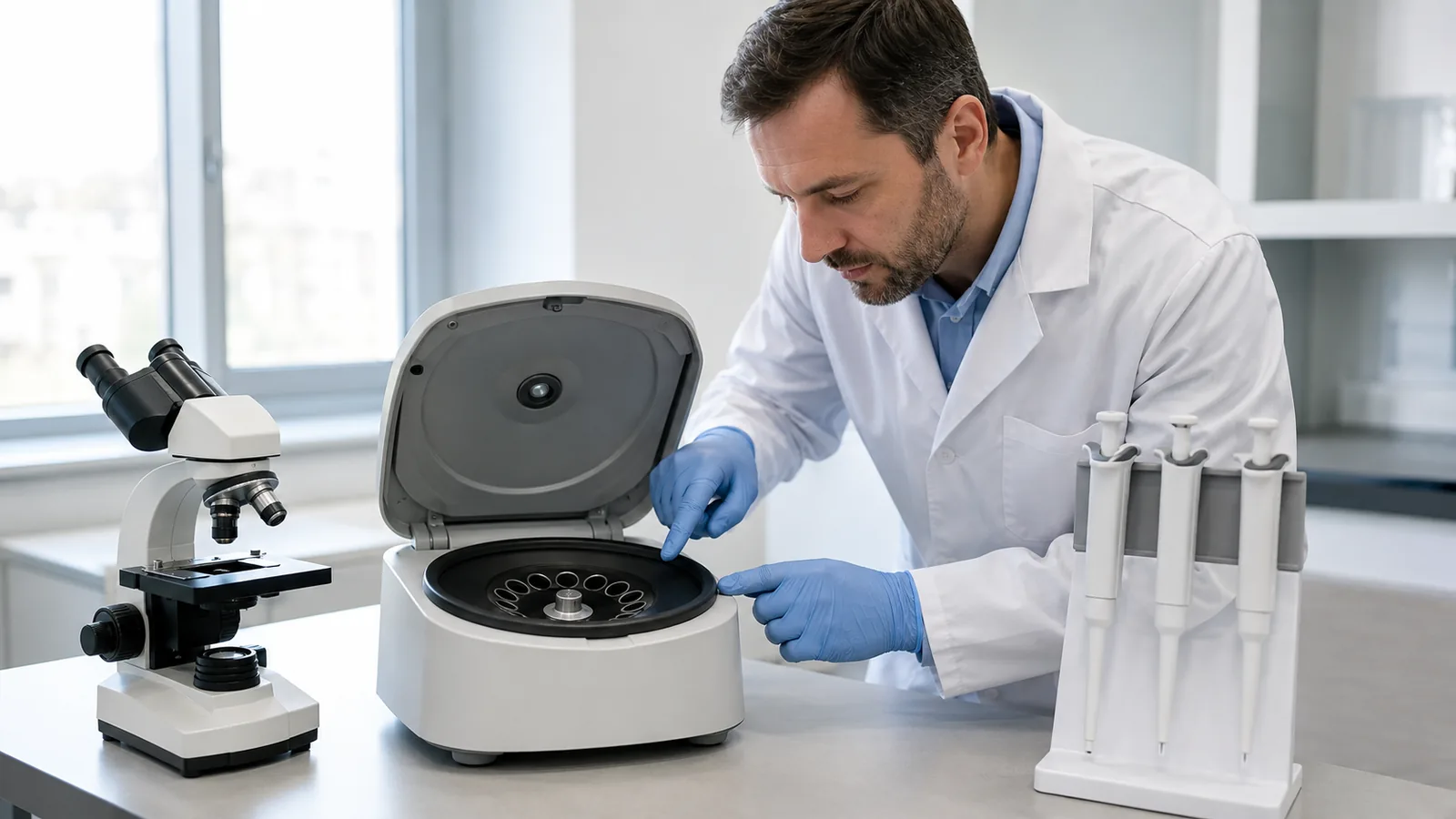
- Centrifuges: Separate solids from liquids by spinning at high speeds. Options include microcentrifuges, benchtop models and refrigerated or floor‑standing centrifuges. Evaluate maximum speed (RPM), relative centrifugal force (RCF), rotor types, sample capacity and temperature control.
- Microscopes: Essential for visualising cells and structures. Compound microscopes offer various objective lenses (4×, 10×, 40× and 100×) for brightfield or phase‑contrast imaging; digital microscopes integrate cameras for screen‑based viewing. For advanced imaging, consider confocal or fluorescence capabilities. (For more on microscope features, see our detailed guide on Essential Features of Medical Laboratory Microscopes.)
- Incubators and ovens: Provide controlled environments for cell culture or sample drying. Key features include temperature range, uniformity, CO₂ control (for cell culture incubators), humidity control and alarms.
Analytical Instruments
Analytical equipment often represents the lab’s largest capital investment. Examples include:
- Spectrophotometers: Measure light absorbance or emission at specific wavelengths. Choices include UV‑Vis, fluorescence and infrared instruments. Consider wavelength range, bandwidth, sensitivity, sample throughput and microvolume capabilities.
- Chromatography systems: Gas chromatography (GC) and high‑performance liquid chromatography (HPLC) separate compounds for analysis. Evaluate detectors, column compatibility, flow rates, pressure limits and software integration.
- Mass spectrometers: Provide highly sensitive analysis of molecular weights and structures. Consider mass range, resolution, ionization sources (electrospray, MALDI), vacuum requirements and software integration.
- PCR instruments: Thermocyclers for DNA amplification. Evaluate block format (96‑well vs. 384‑well), ramp speeds, temperature uniformity and automation compatibility.
Safety Equipment and Personal Protective Equipment (PPE)
Safety equipment protects staff from exposure to biological, chemical and physical hazards. A Lab Manager guide emphasizes the importance of masks, face shields, goggles, lab coats and gloveslabmanager.com. Additional equipment such as chemical storage cabinets, safety showers and eye‑wash stations is essential to ensure compliance. When selecting safety equipment, ask questions about required standards (e.g., OSHA, NFPA), how often items need replacement or servicing, appropriate PPE for specific hazards and inventory management strategieslabmanager.com.
Key Factors to Consider When Purchasing Lab Equipment
Purchasing laboratory equipment is not as simple as choosing the lowest price. A systematic evaluation ensures instruments meet current needs and remain valuable over time. Below are key factors to consider.
Fit for Purpose and Technical Specifications
Equipment must align with the lab’s scientific goals. The WHO guidelines emphasise defining the intended use of each instrument and matching technical specifications to requirementspmc.ncbi.nlm.nih.gov. For instance, if you plan to perform high‑throughput PCR, a thermocycler with a 384‑well block and rapid ramp rates may be necessary. If your research involves cell culture, incubators should provide stable temperature and CO₂ control with HEPA filtration.
Technical specifications encompass accuracy, precision, resolution, speed, temperature range and environmental controls. A Lab Manager article notes that equipment selection should focus on application suitability, ensuring the instrument can perform the intended procedures reliablylabmanager.com. For centrifuges, check maximum RCF, rotor compatibility and capacity. For spectrophotometers, assess wavelength range, path length and dynamic range.
Total Cost of Ownership (TCO)
Upfront price is only part of the cost equation. Lighthouse Lab Services advises looking beyond the sticker price; the total cost of ownership includes initial purchase, maintenance, calibration and consumableslighthouselabservices.com. In some cases, leasing may offer budget flexibility and access to newer models. Consider the ongoing expenses of reagents, replacement parts and energy consumption. For example, refrigerated centrifuges require regular replacement of seals and refrigeration components, while PCR machines need calibration and service contracts.
To avoid unexpected expenses, create a consumables plan. Estimate usage of tips, reagents and calibration standards; order supplies accordingly to prevent shortages or overstockinglighthouselabservices.com. Negotiating service contracts and training as part of the purchase can provide long‑term savings.
Compatibility, Space and Scalability
Equipment should integrate seamlessly with existing lab infrastructure. Remi, a parts‑source company, notes that successful purchases require evaluating compatibility with existing systems, space requirements and use in procedurestheremigroup.com. For example, large floor‑standing centrifuges demand adequate floor space and ventilation; HPLC systems need solvent waste management and stable temperature. Ensure electrical requirements (voltage, frequency) match your facility and consider future expansion—will you need additional modules or accessories as experiments evolve?
Scalability is another important factor: can the instrument adapt as your organization’s needs grow? The Remi article suggests investing in scalable solutions that avoid premature replacementtheremigroup.com. For instance, modular microscopes allow you to add fluorescence or confocal modules later, and multi‑channel pipettes can accommodate higher throughput.
Usability, Training and Vendor Support
Even the most advanced equipment is useless if staff cannot operate it effectively. Remi recommends assessing usability and training requirements before purchasetheremigroup.com. Some instruments have steep learning curves; ask vendors about training programs, user manuals and ongoing support. When evaluating microscopy platforms, for example, consider whether the software interface is intuitive and whether the vendor provides on‑site training or video tutorials.
Vendor reputation and support are crucial. Reliable customer service, quick response times and accessible warranty information can minimize downtime. Investigate whether the vendor offers service contracts or remote diagnostics for troubleshootingtheremigroup.com. For complex instruments like mass spectrometers or high‑content imagers, robust vendor support can prevent extended outages.
Regulatory Compliance and Validation
Laboratories must comply with standards such as CLIA, ISO 15189 or Good Laboratory Practice. Lighthouse Lab Services stresses that every instrument must meet regulatory and accreditation requirementslighthouselabservices.com. When evaluating equipment, verify that it includes documentation for validation and quality control, especially if you plan to perform laboratory‑developed tests (LDTs). Check whether the vendor provides guidelines for installation qualification (IQ), operational qualification (OQ) and performance qualification (PQ) as part of the purchase.
Data Integration and Software Compatibility
Modern labs increasingly rely on digital workflows and data analytics. Instruments should integrate with laboratory information management systems (LIMS) or electronic medical records (EMR) to streamline data capture and reduce transcription errors. Lighthouse Lab Services recommends selecting open systems that allow flexibility in reagents and test menuslighthouselabservices.com. Ensure that instrument software exports data in standard formats (CSV, XML) and offers secure connectivity, especially when handling patient data.
Safety and Environmental Considerations
Safety should never be an afterthought. Choose equipment with built‑in safety features such as over‑temperature protection, automatic rotor imbalance detection in centrifuges and UV sterilization in biosafety cabinets. Review chemical compatibility and proper ventilation for fume hoods or acid cabinets. The Lab Manager safety guide emphasises proper fit for PPE and the need for emergency equipment like showers and eye‑wash stationslabmanager.com. Additionally, evaluate energy efficiency to support sustainability and reduce operating costs. Some incubators offer energy‑saving modes or use ozone‑friendly refrigerants.
Second‑Hand Equipment and Donations
Purchasing used or donated equipment can be cost‑effective, but caution is warranted. The WHO guide highlights factors to consider when buying second‑hand equipment, such as verifying that the instrument meets safety and quality standards, ensuring availability of spare parts and understanding service historypmc.ncbi.nlm.nih.gov. Always obtain documentation for calibration and maintenance and verify that the equipment is compatible with your facility’s energy requirementspmc.ncbi.nlm.nih.gov. Consider having a qualified technician inspect and refurbish used equipment before use.
Step‑by‑Step Process for Selecting Laboratory Equipment
Below is a step‑by‑step approach to guide laboratory managers through the equipment selection process.
1. Define Your Needs
Begin by reviewing current and future experiments. Determine the types of analyses, sample volumes and throughput requirements. Consult with scientists and technicians to understand their workflows and challenges. A clear understanding of needs prevents over‑purchasing (buying expensive features you don’t need) and under‑purchasing (selecting equipment that becomes obsolete quickly).
2. Research Options and Compile Specifications
Gather technical specifications from multiple vendors. Create a comparison matrix listing key parameters (capacity, accuracy, speed, control range, software features, service requirements). For example, when comparing centrifuges, note maximum RPM/RCF, rotor compatibility, refrigeration capability and noise levels. For incubators, list temperature range, CO₂ control, humidity, HEPA filtration and alarms.
3. Evaluate Total Cost of Ownership
Use the TCO framework to account for the initial purchase, installation costs, training, consumables, maintenance and energy consumptionlighthouselabservices.com. Request quotes for service contracts, extended warranties and calibration services. Consider the potential resale value and expected lifespan to estimate depreciation. Create a budget that includes contingency funds for unforeseen expenses (e.g., repairs or upgrades).
4. Assess Compatibility and Infrastructure Needs
Verify that the equipment fits into your space. Check dimensions, power requirements (voltage, frequency, plug type) and ventilation needs. For networked instruments, ensure you have the necessary IT infrastructure (cables, network ports, firewall exceptions). Confirm compatibility with existing LIMS and data analysis tools to facilitate seamless workflow.
5. Consult Vendor References and Support Services
Contact other labs using the same equipment to gain insights into reliability and service quality. Evaluate the vendor’s track record for customer support, training and spare parts availability. Ask vendors about service response times, remote diagnostics and software updates. A good vendor should provide user training, validation documentation and ongoing technical supporttheremigroup.com. Be wary of vendors that cannot provide clear maintenance schedules or spare part availability.
6. Plan for Installation and Validation
Once you choose an instrument, coordinate with the vendor and facility engineers to schedule installation. Confirm that the instrument will fit through doorways and into designated spaces. Plan for installation qualification (IQ) and operational qualification (OQ) to verify that the equipment operates according to manufacturer specifications. For regulated labs, perform performance qualification (PQ) by running standardized tests and documenting results. Ensure that all validation protocols align with accreditation requirementslighthouselabservices.com.
7. Implement Training and Documentation
Develop comprehensive training for users and maintenance staff. Provide manuals, quick reference guides and hands‑on training sessions. Document standard operating procedures (SOPs) for operation, cleaning, calibration and troubleshooting. A robust training program reduces user errors and extends instrument life.
8. Establish a Maintenance and Calibration Plan
Develop maintenance schedules based on manufacturer recommendations, usage frequency and environmental conditions. Excedr explains that maintenance focuses on calibration, cleaning, lubrication and inspection to prevent contamination and equipment failureexcedr.com. Keep a maintenance log to record tasks, dates and responsible personnel. For critical instruments, schedule preventive maintenance (PM) and predictive maintenance (PdM) to minimize downtime. Run‑to‑failure strategies are only suitable for non‑critical instruments where replacement costs are lowexcedr.com.
9. Plan for Decommissioning and Upgrade
Document the procedures for decommissioning and disposing of equipment at the end of its life. Work with vendors to ensure safe removal and disposal of hazardous components (e.g., refrigerants, electronics). Plan for equipment upgrades that align with evolving scientific needs and technology advancements. Evaluate trade‑in programs or leasing options that allow regular upgrades without excessive upfront costs.
Maintenance and Calibration: Ensuring Long‑Term Performance
Proper maintenance extends equipment lifespan, ensures reliable data and protects staff safety. Excedr lists several reasons to prioritize maintenance:
- Extended Lifespan: Routine maintenance reduces wear and tear, prolonging the life of instrumentsexcedr.com. Preventive care—cleaning, lubrication and part replacement—keeps equipment running smoothly and reduces replacement costs.
- Reliable Data: Calibration and routine checks prevent drift, contamination and errors, ensuring accuracy. Accurate instruments are critical in areas like biotechnology, where precise measurements are essential for compliance and quality assurance.
- Enhanced Safety: Maintenance mitigates hazards. For example, poorly maintained centrifuges can vibrate or leak, posing risks to staff.
- Reduced Downtime: Preventive maintenance minimizes unexpected breakdowns, keeping critical equipment available when needed.
- Compliance: Regulatory standards often require documented maintenance and calibration. Proper care ensures compliance with GLP and other standardsexcedr.com.
Types of Maintenance
Excedr outlines several maintenance strategiesexcedr.com:
- Preventive Maintenance (PM): Scheduled calibration, cleaning, lubrication and inspections to prevent failures.
- Predictive Maintenance (PdM): Uses sensor data (temperature, vibration) to predict when servicing is needed. For example, monitoring the vibration of a centrifuge can indicate when bearings require replacement.
- Corrective Maintenance (CM): Addresses equipment issues after a malfunction; necessary but less cost‑effective than preventive maintenance.
- Condition‑Based Maintenance (CBM): Real‑time monitoring triggers maintenance based on equipment condition (e.g., increased vibration).
- Run‑to‑Failure (RTF): Equipment is used until it breaks, then repaired or replaced; appropriate only for non‑critical instruments.
Maintenance Procedures and Documentation
Effective maintenance requires standardized procedures and documentation. Excedr suggests the following tasksexcedr.com:
- Calibration: Regularly calibrate instruments like pipettes, balances and thermometers to ensure accuracy.
- Cleaning: Deep cleaning prevents contamination, especially for equipment exposed to reagents and solvents.
- Inspection: Visual inspections detect wear, corrosion or leaks before they cause failure.
- Lubrication: Mechanical components (e.g., centrifuge rotors) need lubrication to reduce wear.
Document each maintenance task in logs or digital systems. Include checklists, manuals and maintenance schedules. This record supports audits and warranty claims. Maintenance frequency depends on usage, equipment age and environmental conditionsexcedr.com; adjust schedules accordingly.
Market Overview: Laboratory Equipment Growth and Trends
The laboratory equipment industry is experiencing significant growth due to technological advancements and increased demand for diagnostics and research tools. Precedence Research reports that the global laboratory equipment market was valued at USD 33.36 billion in 2024 and is projected to reach USD 69.53 billion by 2034, growing at a compound annual growth rate (CAGR) of 7.62%precedenceresearch.com. The U.S. market alone was valued at USD 8.87 billion in 2024 and is expected to double by 2034. This growth is driven by increasing healthcare spending, expansion of research and development programs and the adoption of advanced technologies such as robotics, automation and digital diagnostics.
The market encompasses a wide range of equipment, including laminar flow hoods, centrifuges, incubators, microscopes, homogenizers, and autoclaves. Disposable lab supplies such as pipettes, tubes and cuvettes also contribute significantly to the market, ensuring safety and preventing cross‑contaminationprecedenceresearch.com. As labs adopt more sophisticated instruments, they must invest in training and maintenance to ensure reliability and compliance.
Emerging Trends
- Automation and Robotics: High‑throughput workflows are increasingly automated, reducing human error and increasing efficiency. Liquid handlers, automated sample processors and robotic arms are becoming common in molecular biology and clinical labs.
- Digital and Connected Instruments: Many instruments now offer IoT connectivity, allowing remote monitoring and predictive maintenance. LIMS integration ensures seamless data transfer and improved traceability.
- Point‑of‑Care and Portable Devices: Portable analyzers, handheld PCR devices and digital microscopes allow testing outside traditional labs, enhancing accessibility and speed.
- Sustainability: Manufacturers are developing energy‑efficient instruments and eco‑friendly materials. Labs are adopting green practices like recycling consumables and using renewable energy.
- AI and Data Analytics: Machine learning algorithms assist with image analysis (e.g., digital pathology) and predictive maintenance. For example, digital microscopes integrated with AI can automatically detect cell abnormalities. (See our article on Complete Guide to Digital Microscopy: Unleashing the Future of Imaging for more on AI in microscopy.)
Sustainability and Green Lab Practices
Sustainability is an emerging priority in laboratories, given the energy consumption and waste generated by equipment. Consider choosing equipment that adheres to energy efficiency standards (e.g., Energy Star certification) and uses environmentally friendly refrigerants. Refrigerated centrifuges with ECO modes or LED lighting in incubators reduce energy consumption. Evaluate the recyclability of consumables and packaging, and establish waste management protocols for hazardous materials. Additionally, implement shut‑down protocols for idle equipment and encourage a culture of sustainability among staff.
Conclusion
Selecting laboratory equipment is a complex process that directly impacts research quality, patient care and safety. By carefully defining your needs, evaluating technical specifications and total cost of ownership, assessing compatibility and scalability, ensuring vendor support and regulatory compliance, and planning for maintenance and training, you can make informed purchasing decisions that support long‑term success. Proper maintenance extends equipment lifespan, ensures accurate data and enhances safety. Market growth and emerging trends highlight the increasing importance of automation, connectivity and sustainability in laboratory environments. When combined with thoughtful planning and ongoing care, your investment in lab equipment will pay dividends for years to come.
Frequently Asked Questions (FAQs)
How do I decide whether to purchase or lease laboratory equipment?
Leasing may provide flexibility and lower upfront costs, while purchasing offers long‑term ownership. Evaluate total cost of ownership (including maintenance and consumables)lighthouselabservices.com, expected lifespan and whether technology upgrades are frequent. Leasing can be beneficial for rapidly evolving technologies or for short‑term projects, but may cost more over time..
What factors affect the total cost of ownership?
The total cost includes purchase price, installation, training, calibration, maintenance, consumables, energy consumption and disposallighthouselabservices.com. Consider service contracts, warranties, spare parts availability and vendor support. Estimating consumable usage and energy costs helps prevent budget surprises.
How often should laboratory instruments be calibrated?
Calibration frequency depends on the instrument type, usage and regulatory requirements. Excedr notes that preventive maintenance—including calibration—should follow manufacturer recommendations and usage patternsexcedr.com. Critical instruments like balances and pipettes may require calibration monthly or quarterly, while others may be calibrated annually. Always document calibration dates and results for complianceexcedr.com.
What should I consider when buying used lab equipment?
Verify that second‑hand equipment meets safety and performance standards. The WHO guide recommends checking for available spare parts, service history and compatibility with your facility’s power supplypmc.ncbi.nlm.nih.gov. Obtain calibration and maintenance records, and have a qualified technician inspect and refurbish the equipment before use.
How can I ensure staff are properly trained on new equipment?
Request training as part of the purchase agreement. Remi emphasizes that vendor training materials and ongoing support are crucial to maximize accuracy and workflow efficiencytheremigroup.com. Provide hands‑on training, standard operating procedures and continuous education to keep staff up to date.
Why is preventive maintenance more cost-effective than corrective maintenance?
Preventive maintenance reduces wear and tear, prolongs equipment lifespan and prevents failures, thereby minimizing downtime and repair costsexcedr.com. Corrective maintenance often involves emergency repairs after a breakdown, which can be more expensive and disruptiveexcedr.com.
How do I ensure regulatory compliance when purchasing equipment?
Select instruments that meet relevant standards (e.g., CLIA, ISO 15189) and request validation documentation from vendorslighthouselabservices.com. Ensure the equipment includes installation qualification (IQ), operational qualification (OQ) and performance qualification (PQ) procedures and that your lab’s quality system covers calibration and maintenance records.
What role does vendor support play in equipment selection?
Vendor support ensures timely repairs, access to spare parts and expert training. Evaluate service contracts, warranties and response times. Reliable vendors provide long‑term technical support and updates, which are essential for complex instruments and high‑throughput labstheremigroup.com.
How can I integrate new equipment into my lab’s data system?
Look for instruments with open system architectures and LIMS/EMR compatibilitylighthouselabservices.com. Ensure they export data in common formats and support secure connectivity. Collaborate with IT teams to set up network access and maintain data integrity.
About the Author
Wiredu Fred is a technology journalist and educator with over a decade of experience writing about scientific innovation, laboratory technology and educational tools. Fred founded FrediTech to translate complex scientific advancements into accessible resources for students, teachers and professionals. His articles emphasize evidence‑based research, practical applications and ethical considerations in technology adoption.