Google Pixel 8 Pro vs. iPhone 15 Pro: Which Phone Dominates in 2024
The Google Pixel 8 Pro and Apple iPhone 15 Pro are two of 2024’s top flagship phones, each representing the best of Android and iOS. Both launch at a similar $999 starting price and come packed with cutting-edge features and powerful hardware. But when it comes to which phone truly dominates in 2024, the answer isn’t straightforward. In this in-depth comparison, we’ll break down the Pixel 8 Pro vs. iPhone 15 Pro across all key categories – from design and display quality to performance, camera capabilities, battery endurance, and unique AI-driven features. By the end, you’ll have a clear picture of each phone’s strengths and weaknesses, backed by real-world examples, expert insights, and facts from reputable sources. Let’s dive into this flagship face-off and see how Google’s latest Pixel stacks up against Apple’s premium iPhone.
Before diving into the details, check out our in-depth smartphone reviews for additional insights and comparisons on other flagship devices in our archive.
{getToc} $title={Table of Contents} $count={Boolean} $expanded={Boolean}
Design & Build Quality
The iPhone 15 Pro (left, in white) and Google Pixel 8 Pro (right, in blue) showcase distinct design philosophies. The iPhone’s titanium frame and polished camera lenses contrast with the Pixel’s matte glass back and signature camera bar.
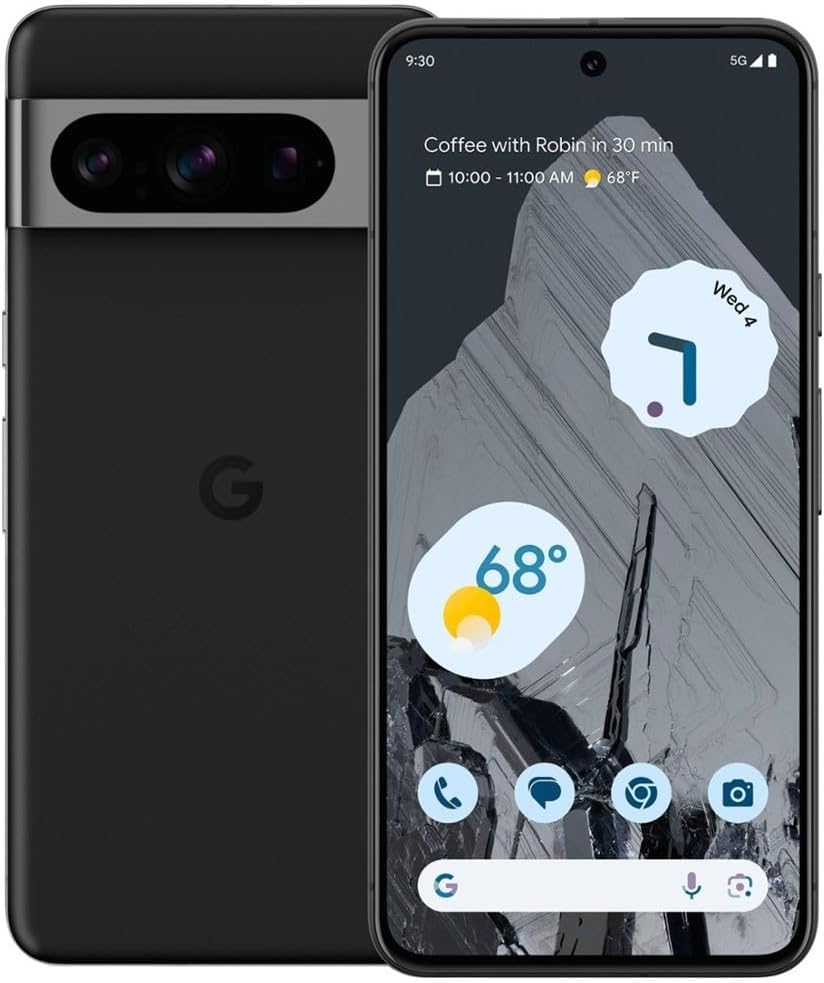
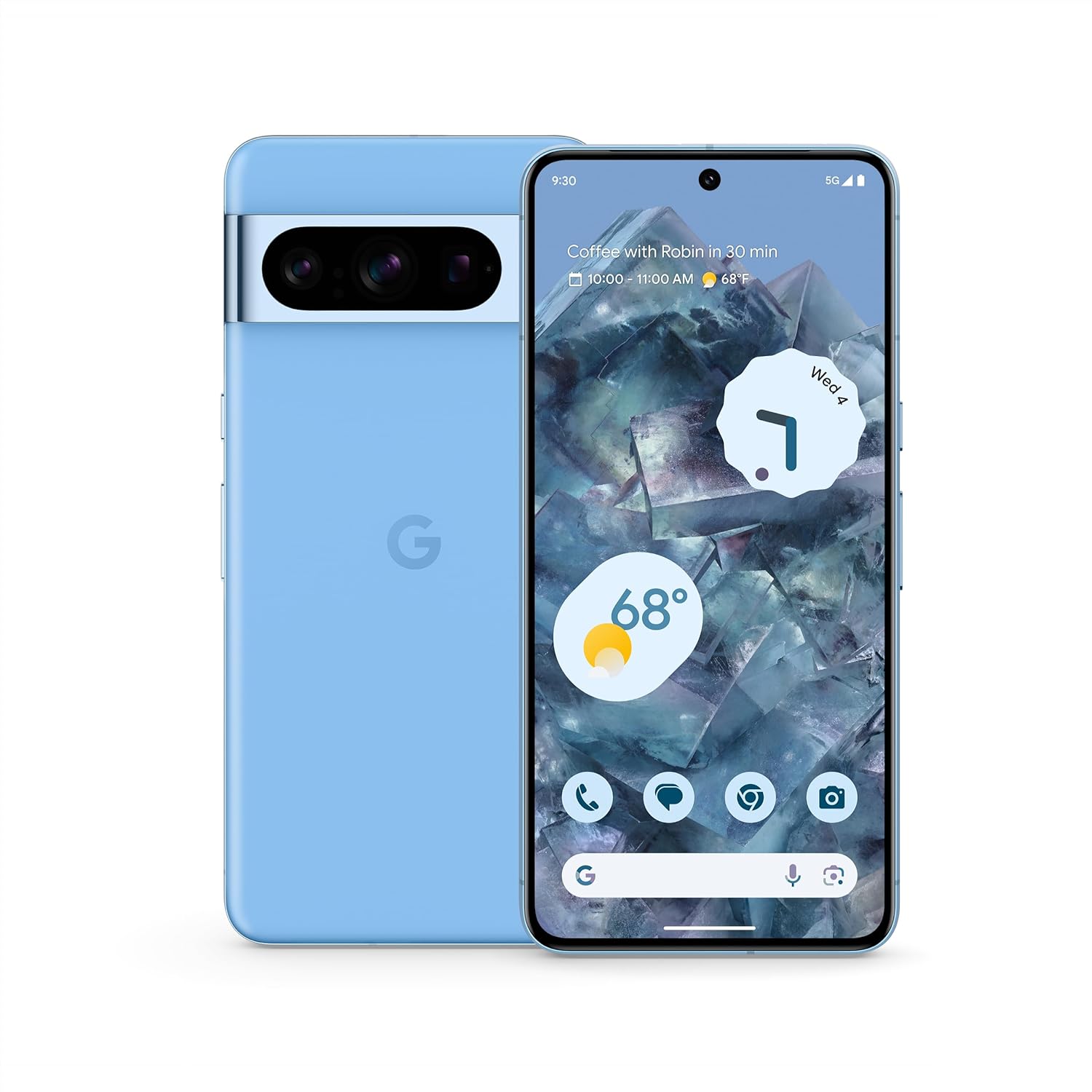
When it comes to design and build, these phones take different approaches while both exuding a premium feel. Google’s Pixel 8 Pro features a matte glass back and an aluminum frame, with the now-iconic horizontal camera visor stretching across the reartechradar.comtalkingtechandaudio.com. This visor isn’t just for looks – it helps the Pixel lie more evenly on a flat surface, avoiding the “wobble” you get with corner camera bumps. The Pixel 8 Pro also includes a quirky addition: a built-in temperature sensor on the back (next to the camera array) – a unique feature not found on any iPhone. In hand, the Pixel feels substantial; it’s physically larger and a bit heavier than the iPhone due to its bigger screen and battery. In fact, the Pixel 8 Pro measures 162.6 × 76.5 × 8.8 mm and weighs about 213 g, whereas the iPhone 15 Pro is a more compact 146.6 × 70.6 × 8.3 mm and only 187 gtechradar.com.
Apple’s iPhone 15 Pro has a more conventional design but with some premium twists. This year Apple introduced a titanium alloy frame on the iPhone 15 Pro, which makes it sturdier yet lighter than the previous stainless-steel modelstechradar.com. The titanium frame also gives the iPhone a refined, brushed-metal look and resists fingerprints – a nice perk for those who dislike smudges. Both phones use tough glass on the front and back (Gorilla Glass Victus 2 on the Pixel, and Apple’s Ceramic Shield on the iPhone) for durability, and both are IP68-rated for water and dust resistance, meaning they can handle accidental dunks and dusty environments with ease.
Aesthetically, the choice is subjective. The Pixel 8 Pro’s design is bold and utilitarian – especially the camera bar which Google has embraced as a design signature. The iPhone 15 Pro looks sleek and minimalistic with its rounded edges and the Dynamic Island cutout at the top of the display (housing Face ID sensors and the front camera). Apple’s new Action Button on the side (replacing the old mute switch) is another design change – a programmable button that can toggle silent mode or launch custom shortcuts with a pressimore.com. Meanwhile, the Pixel keeps it simple with a standard power button (that can double-tap for shortcuts) and volume rocker, plus an under-display fingerprint sensor for biometric unlock.
Color options vary too. Google offers the Pixel 8 Pro in eye-catching colors like Bay (a light blue), Obsidian (black), and Porcelain (white). Apple’s iPhone 15 Pro comes in more muted tones reflecting the titanium finish: Black, White, Blue, or Natural Titanium (which is a grayish metal look)techradar.com. Both devices feel extremely well-built, but the iPhone’s slightly smaller size and curved-edge design might make it more comfortable for one-handed use, whereas the Pixel’s larger footprint can feel more unwieldy but also offers a bigger canvas for content. In summary, build quality is top-notch on both – with the Pixel emphasizing a distinctive design and Google’s ecosystem touches, and the iPhone focusing on premium materials and ergonomic tweaks.
Display
The display is one area where the Pixel 8 Pro arguably takes the lead on specs. Google equipped the Pixel 8 Pro with a 6.7‑inch OLED screen that’s sharp, expansive, and incredibly bright. It’s a high-resolution panel at 2992 × 1344 pixels (~489 ppi) and uses LTPO technology to enable a smooth 120 Hz adaptive refresh ratetechradar.com. In practical terms, that means scrolling and animations on the Pixel look very fluid, and it can dial down to 1 Hz to save battery when an always-on clock is displayed. The Pixel’s screen also has excellent brightness – up to 2,400 nits peak brightness for HDR content or outdoor visibility. This is one of the brightest smartphone displays on the market. Reviewers noted that the Pixel 8 Pro’s display is so bright that using it under direct sunlight is no problem – it even outshines the iPhone’s rated 2,000-nit peak, making content easier to see on a sunny daytalkingtechandaudio.com. Colors on the Pixel screen are vibrant yet can be tuned to a more natural profile if you prefer.
On the other hand, the iPhone 15 Pro features a smaller 6.1‑inch OLED display (Apple calls it “Super Retina XDR”). It’s also sharp at 2556 × 1179 resolution (~461 ppi) and supports up to 120 Hz refresh with ProMotion technologytechradar.com. The iPhone’s screen has a peak brightness of 2,000 nits for outdoor use and 1,600 nits when viewing HDR photos or Dolby Vision video. While slightly less bright on paper than the Pixel, in real-world use the iPhone’s display is still excellent and plenty visible outside. Apple has been praised for its color accuracy and calibration – the iPhone’s panel delivers rich contrast, deep blacks, and very true-to-life colors out of the box. Both screens support HDR10 and have always-on display modes (the iPhone’s always-on display is particularly well-implemented, subtly dimming and toning down the wallpaper to save power while still showing glanceable info).
One noticeable difference is size and immersion: The Pixel 8 Pro’s larger 6.7″ screen is great for media consumption, gaming, and productivity, essentially matching the size of Apple’s Pro Max models. In fact, a reviewer commented that the Pixel’s screen is “bright and sharp… just as good as the iPhone 15 Pro Max, and maybe better”techradar.com. The iPhone 15 Pro’s 6.1″ display feels more compact but easier to manage with one hand. It’s worth noting the aspect ratio and bezels too: The Pixel has extremely slim, uniform bezels and a tiny punch-hole camera cutout, giving it a very edge-to-edge look. The iPhone’s display has the Dynamic Island – a pill-shaped cutout at the top center – which takes up a bit more screen real estate than a punch-hole. However, Apple uses this cutout as a functional area for alerts and multitasking (e.g., showing ongoing music or call status), turning a design quirk into a feature.
Overall, both displays are outstanding. The Pixel 8 Pro wins on sheer size, resolution, and peak brightness, making it a joy for watching HDR movies or using outdoorstechradar.com. The iPhone 15 Pro’s display is no slouch either – it’s color-accurate, smooth, and offers arguably the best always-on functionality in any phone. Unless you need the extra real estate of the Pixel, most users would be happy with either screen. It might simply come down to preference for a bigger vs. smaller device.
Google Pixel 8 Pro - Unlocked Android Smartphone with Telephoto Lens and Super Actua Display - 24-Hour Battery - Bay - 128 GB
Google Pixel 8 Pro - Unlocked Android Smartphone with Telephoto Lens and Super Actua Display - 24-Hour Battery - Mint - 128 GB
Performance and Software
Under the hood, Apple and Google take very different approaches. The iPhone 15 Pro is powered by Apple’s custom A17 Pro chip – a 3 nm, six-core processor (2 high-performance + 4 efficiency cores) paired with a 6-core GPU. This chip is a powerhouse and currently one of the fastest in any smartphone. In fact, benchmarks show the A17 Pro handily outperforms Google’s Tensor G3 chip (found in the Pixel 8 Pro) in raw CPU and graphics horsepowertechradar.com. Apple’s tight integration of hardware and iOS software means the iPhone runs buttery-smooth, and it’s capable of console-quality gaming with features like hardware-accelerated ray tracing. Intensive games like Resident Evil Village or Genshin Impact run at high settings with ease on the iPhone 15 Pro. Apple also equipped the Pro with 8 GB of high-speed LPDDR5 RAM, which might sound modest next to Android rivals, but iOS is highly memory-efficient. Everyday performance on the iPhone is snappy: apps launch quickly, multitasking is seamless, and complex tasks like 4K video editing in iMovie or running AR apps are handled gracefully.
The Google Pixel 8 Pro, meanwhile, uses Google’s own Tensor G3 chipset, built on a 4 nm process. It’s an octa-core design (actually reportedly 9 cores in a 1+4+4 arrangement) with a focus not just on speed but on machine learning and AI tasks. In terms of pure speed, the Tensor G3 isn’t as quick as Apple’s chip – in fact, Apple’s A17 Pro “absolutely smashes” the Tensor G3 in raw CPU/GPU output, according to TechRadar’s teststechradar.com. Benchmarks like AnTuTu show the iPhone scoring roughly 1.55 million vs around 1.15 million for the Pixel in overall performancenanoreview.net. However, for most typical uses, the difference may not be very noticeable. The Pixel 8 Pro feels fast and fluid in daily use, with 12 GB of RAM allowing lots of apps to stay open in the background. Swiping through Android 14 on the Pixel is smooth, and Google optimized animations and transitions nicely.
Where the Tensor G3 aims to shine is AI-driven features: it’s designed to accelerate on-device machine learning for things like voice recognition, image processing, and smart features (we’ll explore those unique AI features in a later section). That said, early reviews noted that the Pixel 8 Pro isn’t completely stutter-free – for instance, applying the new Magic Editor (an AI photo editing tool) or using certain AI wallpapers can cause occasional slowdownstechradar.com. These hiccups might be due to software that can be optimized in updates, but it shows that Google’s chip still can’t match Apple’s effortless performance in every scenario. The iPhone 15 Pro has a performance edge especially in graphics-intensive tasks and heavy apps – it’s essentially as powerful as some laptop CPUs, whereas the Pixel is closer to last-gen flagship Android performance.
On the software side, the experiences are very different by virtue of iOS vs. Android. The iPhone 15 Pro runs iOS 17 (Apple’s latest OS), offering a polished, secure ecosystem with features like FaceTime, iMessage, and a vast selection of optimized apps. Apple’s ecosystem integration is a selling point – if you have a Mac, iPad, or Apple Watch, the cross-device continuity (handoff, iCloud sync, etc.) is seamless. The Pixel 8 Pro runs Android 14 in its pure Google flavor. Pixel phones are known for a clean Android experience with no bloatware and first-in-line updates. Plus, Pixel adds exclusive perks like the Google Call Screen, Recorder with transcripts, and deeper Assistant integration.
One notable area both companies now excel in is software support longevity. Google has promised an unprecedented 7 years of OS updates and security patches for the Pixel 8 Pro – meaning it could receive Android version upgrades into 2030. This matches or possibly exceeds Apple’s track record; iPhones typically get around 5+ years of major updates, and Apple is likely to support the 15 Pro for at least 5–6 years (if not more). In fact, TechRadar notes that both phones are “two of the best-supported phones on the market” with around seven years of updates expectedtechradar.com. This is great news for longevity – you can invest in either device knowing it will stay updated with new features and security long term, outlasting most other Android phones in support.
Day-to-day performance on both phones is excellent for messaging, social media, web browsing, and multitasking. You likely won’t notice a difference in basic tasks – as one review put it, “both phones feel plenty fast doing what most of us do 95% of the time”techradar.com. Your choice here may hinge on platform preference: iOS vs. Android. iOS 17 is refined and user-friendly but more of a walled garden (limited customization, but very consistent). Android 14 on the Pixel is highly customizable and open, letting you tinker with icons, default apps, etc., and integrate tightly with Google’s services. Both OSes have copied and learned from each other so much that they are more alike than ever in core functionality – things like notifications, widgets, and multitasking feel broadly similar now. Ultimately, if you’re entrenched in one ecosystem (Apple or Google), that might dominate your decision more than a slight performance difference.
In summary, the iPhone 15 Pro has the raw performance edge – it’s arguably the more powerful device, with headroom for intensive tasks and graphically rich gamestechradar.com. The Pixel 8 Pro is powerful enough for virtually any everyday task, and it leverages its chip for smart features, but it isn’t trying to win benchmark wars. Both phones are smooth and fast in normal use, and each offers a different software experience tailored to its user base. If you demand the absolute highest frame rates and plan to push your phone to the limit, the iPhone might dominate that arena. If you care more about the AI smarts and customization of your phone, the Pixel’s platform could be more appealing.
Camera Capabilities
Both Google and Apple have built reputations on excellent smartphone cameras, and these two phones represent each company’s top camera system in 2024. On paper, the Google Pixel 8 Pro has an edge in camera hardware, but Apple’s iPhone 15 Pro counters with its own computational photography tricks. Let’s break down the camera specs and then the real-world performance:
- Pixel 8 Pro Camera System: Triple rear cameras – a 50 MP main wide camera (f/1.68 aperture, 1/1.31″ sensor), a 48 MP ultrawide (f/1.95, with a 125.5° field of view), and a 48 MP telephoto with 5× optical zoom (113 mm equivalent focal length)androidauthority.com. The Pixel’s telephoto uses a folded periscope lens to achieve 5× optical magnification, and all three rear cameras use Quad-Bayer sensors that normally output 12 MP images for better dynamic range via pixel binning. The Pixel also offers up to 30× digital “Super Res Zoom” leveraging those high megapixels. For the front, it has a 10.5 MP selfie camera.
- iPhone 15 Pro Camera System: Triple rear cameras – a 48 MP main wide camera (f/1.78 aperture, 1/1.28″ sensor), a 12 MP ultrawide (f/2.2, 120° field of view), and a 12 MP telephoto with 3× optical zoom (77 mm equivalent)androidauthority.com. Note that unlike the larger iPhone 15 Pro Max, the regular 15 Pro does not have Apple’s new 5× zoom lens – it sticks with 3× optical zoom. However, Apple’s 48 MP main sensor uses an intelligent approach: by combining the full 48 MP and binned 12 MP data, the default output is a detailed 24 MP photo. Apple also allows up to 15× digital zoom on the 15 Pro. The front camera is a 12 MP TrueDepth camera (which also facilitates Face ID).
On the hardware front, the Pixel’s advantage lies in its higher-resolution sensors for ultrawide and telephoto, and the longer 5× optical reach. Google’s 5× zoom lens and large sensor make it a “long-range winner” for zoom shots, easily beating the iPhone 15 Pro’s 3× zoom in detail. In fact, when you zoom in to 5× or beyond, the Pixel can capture far sharper images – the Pixel 8 Pro’s dedicated 5× telephoto (with 48 MP sensor) produces much more detail than the iPhone 15 Pro’s cropped digital zoom at 5×amateurphotographer.com. If telephoto photography (like wildlife, sports, or distant subjects) is important, the Pixel clearly dominates that area. For ultrawide, the Pixel’s lens fits slightly more in the frame (125° vs 120° on iPhone)androidauthority.com and has auto-focus which allows macro shots. The iPhone’s ultrawide is lower resolution but still performs well and doubles as its macro shooter via auto-focus too.
The main cameras on both are excellent and more similar than the specs suggest. The iPhone’s 48 MP sensor is marginally larger than the Pixel’s 50 MP (1/1.28″ vs 1/1.31″)techradar.com, which can help in low light. Apple defaults to 24 MP photos that have outstanding detail and dynamic range, whereas Google defaults to 12 MP for consistency and low file sizes. In practice, you get highly detailed, balanced shots from both in good lighting. The differences come in image processing style: Google’s Pixel tends to produce more contrasty photos with lifted shadows and controlled highlights, making every detail visible (great dynamic range). Colors on Pixel tend to be slightly more muted and true-to-life, avoiding oversaturation. The iPhone’s processing is a bit different – Apple often goes for a punchier look out of the camera, with slightly warmer tones and more vibrant colors, which can make shots “pop” more on the phone screenandroidauthority.com. Some reviews note the iPhone was prone to a slight yellow tint in certain lighting (a quirk that Apple has worked on reducing). Ultimately, these are subtle differences and a matter of taste; both cameras excel at capturing photos with excellent dynamic range and detail.
In challenging conditions like low-light or high-contrast scenes, both phones leverage strong computational photography. The Pixel’s famous Night Sight has been among the best for nighttime photos, and the Pixel 8 Pro continues that tradition, capturing bright, sharp low-light images with relatively little noise. The iPhone’s Night Mode is also superb, producing more natural darkness and color tones. Interestingly, in one camera comparison, the iPhone 15 Pro was noted to have an edge in some extreme low light scenes (perhaps aided by the LiDAR scanner for focus and a slightly larger sensor)digitaltrends.com, whereas the Pixel often pulls ahead in medium-to-low light. Both phones also have portrait modes with artificial bokeh. Apple made a neat addition: you can now capture a photo and decide after the fact to turn it into a portrait (the camera automatically captures depth info if it sees a person/pet). Pixel also takes nice portraits and even has an improved Best Take feature that lets you swap faces from a series of shots to ensure everyone in a group photo is smiling – a handy AI trick exclusive to Pixelwired.com.
Real-world results: According to Android Authority’s tests, “overall, the Google Pixel 8 Pro is the most consistent camera across a wider range of scenarios, but the Apple iPhone 15 Pro still takes scintillating pictures most of the time”androidauthority.com. That is to say, the Pixel might give you a reliably great shot in almost any situation (especially with its superior zoom and ultrawide detail), whereas the iPhone can produce some truly stunning shots as well, especially with its balanced main camera and Apple’s image tuning. Digital Trends performed a head-to-head camera comparison and declared the Pixel 8 Pro as the winner by a slight margin in overall camera performancedigitaltrends.com. In their breakdown, the Pixel won categories for main camera, ultrawide, and telephoto image quality, while the iPhone won in night mode, portraits, and selfies. This indicates how close it is – each phone has areas where it excels.
One area Apple historically dominates is video recording. The iPhone 15 Pro can shoot superb video up to 4K 60fps with some of the best stabilization and HDR processing (including Dolby Vision HDR) in any phone. Apple’s video is known for its realistic colors and smoothness, and the 15 Pro even supports ProRes video recording for professionals, as well as a new Log encoding for color grading. Google significantly improved the Pixel 8 Pro’s video capabilities (it can do 4K 60fps on all lenses, supports 10-bit HDR video, and even has an upcoming Video Boost feature that offloads processing to the cloud for enhanced quality). Reviewers have found the Pixel’s video quality to be much closer to iPhone now – one commentary mentioned that the Pixel 8 Pro is “every bit the match of the iPhone in video quality” with vibrant HDR clipstalkingtechandaudio.com. However, iPhone still has a slight edge in video for most users – especially in consistency of focus and exposure. If you shoot a lot of video, the iPhone’s track record is hard to beat (plus the iPhone can do things like Cinematic Mode for faux bokeh video, and Action Mode for super stabilization).
Selfie cameras on both are high quality: the iPhone’s 12 MP TrueDepth camera produces natural skin tones and can do 4K selfie video. The Pixel’s 10.5 MP front cam is wide and also supports face unlock. Some tests noted the iPhone’s front camera is more consistent in tricky lighting (like backlit conditions)androidauthority.com, while Pixel’s selfies are also excellent and benefit from Google’s software enhancements.
In summary, photography enthusiasts will find the Pixel 8 Pro slightly more versatile, thanks to that 5× zoom and Google’s computational wizardry (like Magic Editor, which can literally reshape and move objects in photos, and Magic Eraser to remove unwanted photobombers) – these AI tools can feel almost like cheating in photographywired.com. The iPhone 15 Pro’s camera is superb for most scenarios and especially reliable for portraits and video recording. It’s almost a draw, but if we’re to declare a victor in cameras: The Pixel 8 Pro edges ahead for still photography dominancedigitaltrends.com, whereas the iPhone 15 Pro remains slightly ahead for videography and has a more natural look that some prefer for life-like printstechradar.com. In any case, both devices rank among the best camera phones of 2024, and casual users will be thrilled with photos from either one.
Battery Life & Charging
Flagship phones demand big batteries to power their high-end chips and bright screens. Google and Apple took different approaches here due to device size. The Pixel 8 Pro carries a large 5,050 mAh battery, significantly bigger in capacity than the iPhone 15 Pro’s roughly 3,274 mAh batterytechradar.com. On paper that seems like an easy win for Pixel, but real-world battery life depends on efficiency and software optimizations too.
Apple’s iOS and the A17 Pro chip are highly power-efficient, so despite the smaller battery, the iPhone 15 Pro manages excellent battery endurance. Apple advertises about 23 hours of video playback on a charge for the 15 Pro, and users generally can get a full day (and then some) of typical use. Google claims “24+ hour battery life” on the Pixel 8 Pro under typical use, and with features like Extreme Battery Saver, it can stretch to multiple days in light use. In independent testing, both phones reliably last through a day of mixed usage – think 5–7 hours of screen-on time with social media, streaming, photography, etc., and still have some charge by night. One analysis noted that both will get you through a full day without much sweat, with the Pixel possibly having a slight edge in longevity under certain conditionstechradar.com. For example, the Pixel’s larger battery helps when doing something screen-intensive (the huge 6.7″ display can draw more power, but the capacity offsets it). On the other hand, if you push the Tensor G3 with heavy gaming, it may drain faster than the iPhone under similar load because the chip isn’t as power-frugal.
In essence, battery life is very good on both, and most users won’t have trouble lasting the day. If you’re a heavy user (hours of navigation, games, or 4K video recording), you might find the Pixel’s extra capacity beneficial, or you might carry a charger/bank for either. Standby drain is minimal on iPhone thanks to iOS optimizations, whereas Pixel’s standby is also improved and can even use AI to periodically hibernate apps.
Charging is another aspect to consider. Neither phone includes a charger in the box (a trend these days), but they support fast charging via USB-C. The Pixel 8 Pro supports up to 30 W wired charging (if you use Google’s 30 W PD charger, sold separately), and in testing it can charge 50% in around 30 minutes and about 100% in ~1 hourtechradar.com. The iPhone 15 Pro supports about 27 W peak wired charging, achieving roughly 50% in 30 minutes as well (with a 20 W or higher USB-C PD charger), but it takes longer to fill completely – about 1 hour 30+ minutes to reach 100%techradar.com. So, the Pixel does have an advantage that it fills up faster to full. Neither is breaking any records (some Android phones charge at 60–100 W+ these days), but they’re decent. Both also support wireless charging: the iPhone with MagSafe at 15 W and standard Qi at 7.5 W, and the Pixel with up to 23 W on a compatible Qi/PMA wireless charger (such as Google’s Pixel Stand). There’s also reverse charging capabilities – the Pixel 8 Pro can do Battery Share (wirelessly charge earbuds or a watch off its back), and the iPhone 15 Pro can even charge small devices via the USB-C port (for example, you can plug your AirPods or an Apple Watch charger into the iPhone, and it will share a bit of its battery).
A noteworthy change this year: the iPhone 15 Pro switched to USB-C for its port instead of Lightning. This means both Pixel and iPhone now use the same cable standard, which is super convenient if you’re switching or if you use multiple devices – you can charge your Pixel 8 Pro and iPhone 15 Pro with the same charger and cable. The iPhone 15 Pro’s USB-C port supports USB 3 speeds for data (up to 10 Gbps) with the proper cable, which is great for pro users transferring large ProRes video files (the Pixel’s port is USB 3.2 as well, useful for moving big photos or files). For everyday charging and data, there’s no huge difference, but it’s nice not to worry about two different cables anymore.
In terms of battery dominance, it’s a close call. The Pixel’s bigger battery and slightly faster charging give it a technical edge – for instance, tests found the Pixel 8 Pro could last about 25 hours in continuous use versus around 19.5 hours on the iPhone 15 Pro in one endurance testnanoreview.net. But Apple’s efficiencies narrow the gap such that both phones comfortably make it through the day for most users. If you need every last hour of use, Pixel might last a bit longer especially under lighter tasks. If you value charging speed to full, Pixel also wins there by reaching full charge significantly soonertechradar.com. Either way, neither phone “dominates” the other in battery by a wide margin – they both achieve solid all-day reliability, reflecting how far battery performance has come in modern flagships.
Special Features and AI Smarts
One of the most exciting aspects of this comparison is looking at special features, especially those driven by AI, where Google and Apple are charting different paths. The Pixel 8 Pro doubles down on Google’s AI prowess, packing in features that feel almost futuristic, while the iPhone 15 Pro introduces its own new tricks and leverages Apple’s powerful hardware for enhanced experiences.
Google’s AI-Powered Features on Pixel 8 Pro: This is where the Pixel tries to pull ahead. Google equipped the Pixel 8 series with a suite of AI-driven tools:
- Magic Editor: An evolution of Google’s photo editing magic, Magic Editor lets you dramatically manipulate photos with a few taps. You can move subjects around within the photo, change the background sky from midday to sunset, or remove and fill in objects with startling easewired.com. For example, Google demoed dragging a person in a photo to a new spot entirely – the software fills in the gaps behind them plausibly, as if that person had stood there originally. It can even relight a scene (turning a harsh midday shot into a golden-hour glow). These are tasks that would normally require pro software like Photoshop, but Pixel puts it in the palm of your hand. It’s incredibly impressive (albeit a bit scary in how it could alter reality – Google does tag images that used Magic Editor in metadata for transparency).
- Best Take: Ever take a group photo and one person is blinking or looking away? Best Take fixes that by combining frames. Essentially, when you snap a series of photos, Pixel can let you tap on each face and choose a better expression from a burst of shotswired.com. It then stitches the best faces together into one “perfect” group photo. No more “one more shot, everyone” – you can make one great shot out of several mediocre ones. This is done on-device and does not generate anything fake; it’s using real frames captured within moments of each other. Parents with squirmy kids or group selfie enthusiasts will love this.
- Audio Magic Eraser: Google didn’t just stop at photos. The Pixel 8 Pro can edit videos’ sound as well. Audio Magic Eraser will analyze a video clip for different audio layers (like voices, music, background noise) and allow you to reduce or mute the distracting onestomsguide.com. Have a video of you talking at the beach but there’s wind noise or a car horn? You can scrub those sounds down. This feature, as Wired notes, gives you “new powers over your videos” to eliminate unwanted noiseswired.com. It’s like having an audio engineer in your phone.
- Call Assist Features: Pixels have been known for their telephony AI. The Pixel 8 Pro continues to offer Call Screen, where Google Assistant can answer unknown calls and transcribe the caller’s message in real-time so you can decide to pick up or hang up on spam. It also has Hold for Me and Direct My Call, features where the Assistant will wait on hold for you with customer service and ping you when a human comes on, or show on-screen menu options when you dial a business (so you don’t have to listen to “press 1 for hours, press 2 for billing”)hooshmand.net. These remain Pixel-exclusive advantages that can genuinely save you time and frustration in daily life.
- On-Device AI & Assistant: The Tensor G3 is designed to run machine learning efficiently, so the Pixel can do things like voice typing with astonishing accuracy (Google’s Assistant voice typing can automatically add punctuation and even use context to correct words). There’s also an upcoming Assistant with Bard integration (Google’s AI chatbot) expected to come to Pixel, which will let the Assistant help with more complex tasks by tapping generative AI – like summarizing a webpage or drafting a message based on context. The Pixel’s Recorder app can transcribe voice memos with speaker labels using AI, a boon for students or journalists recording interviews.
On the Apple side, the iPhone 15 Pro’s special features are a mix of hardware and software:
- Action Button: As mentioned earlier, the iPhone 15 Pro replaced the mute switch with a programmable Action Buttonimore.com. By default it toggles silent mode, but you can set it to launch the camera, turn on the flashlight, record a voice memo, or run any custom Shortcut you’ve created. This gives advanced users a new way to quickly perform tasks – for example, you could configure a shortcut to open a specific note or start a voice recording and map that to the Action Button. It adds a layer of personalization previously unseen on iPhones, which historically had fixed functionality buttons.
- Dynamic Island & Live Activities: The Dynamic Island (the pill cutout) on the iPhone isn’t just a static space – it’s tied into iOS for showing live information. Incoming calls, music playing, timers, AirDrop progress, and more pop up in that area, which is interactive. It’s a clever use of what was dead space around the sensors. While not AI-driven per se, it enhances the user experience in a very Apple way, blending hardware design with software.
- Face ID and Face Unlock: The iPhone’s Face ID system is an infrared 3D facial recognition – extremely secure (it maps your face with a dot projector and works in the dark). The Pixel 8 Pro has an improved Face Unlock that now uses just the front camera but is smart enough to be used for payments and app sign-ins (earlier Pixels’ face unlock was less secure, but Pixel 8 Pro achieved a higher level of security)imore.com. Still, Apple’s Face ID with dedicated hardware might be considered more robust in varied conditions. On the flip side, Pixel offers a fingerprint reader under the display as an alternative biometric. iPhone has no fingerprint scanner (Apple expects you to use Face ID or a passcode). Some users prefer Pixel’s flexibility here – you can unlock via face or fingerprint on the Pixel, whereas iPhone is face-only (except the SE model).
- LiDAR and AR: The iPhone 15 Pro includes a LiDAR scanner on the back (the black circle near the cameras). This is used to sense depth for AR applications and to assist in low-light autofocus. For example, AR apps can place virtual objects more accurately in your space using LiDAR mapping, and the camera can focus faster in the dark by sensing subject distance. Pixel 8 Pro doesn’t have a LiDAR module; it relies on conventional autofocus methods and computational depth sensing.
- Ultrawideband & Ecosystem Gadgets: Both phones have the latest UWB (Ultra Wideband) chips (Pixel 8 Pro has UWB for the first time in a Pixel, and iPhone’s second-gen UWB can connect to Apple’s AirTag trackers more precisely and even point you toward a friend in Find My). Apple’s ecosystem advantage includes things like AirPods automatic switching, Apple Watch unlocking your phone if Face ID fails with a mask, etc. Google is building a similar ecosystem (Pixel Buds, Pixel Watch integration with Android), but Apple’s is more mature.
- Software perks: Apple’s iOS 17 introduced handy features like Live Voicemail (transcribing voicemails in real time, similar to Pixel’s Call Screen concept), improved autocorrect (finally!), and Personal Voice (an accessibility feature to clone your voice after 15 minutes of training). While not as flashy as Google’s AI edits, Apple focuses on continuity and reliability. For instance, the iPhone’s privacy-oriented approach means most AI processing (like Siri’s requests) now happens on-device too, and it leans on specialized engines in the A17 chip for things like voice isolation on calls or duplicate photo detection.
In comparing special features, the Pixel 8 Pro feels like the more “futuristic” device – it gives users AI capabilities that can genuinely transform how you use a smartphone (remixing photos, effortlessly handling calls, etc.). Google’s approach is to use AI to simplify or even wow the user: e.g., turning a mediocre photo into a perfect one or having your phone handle tedious tasks. The iPhone 15 Pro feels more like a refined toolkit – offering powerful hardware (fast chip, great cameras, LiDAR) and letting third-party apps or Apple’s own features gradually use that power in reliable ways. Apple doesn’t generally allow the kind of image manipulation Magic Editor does in the native Photos app, for example, likely out of a philosophy of authenticity and control. But third-party apps on iOS could be used for heavy editing if needed.
One area both are embracing is augmented reality and upcoming AI. Apple is positioning its ecosystem for the Vision Pro headset and AR experiences, and the iPhone 15 Pro with its strong GPU can handle augmented reality games and apps smoothly. Google is integrating AI (like Bard) into Android more deeply. So, moving forward, each will continue to leverage their strengths – Apple with its hardware and ecosystem, Google with its software AI genius.
Which has the advantage here? If you prize having the latest AI photo editing tricks and call handling convenience, the Pixel 8 Pro is unmatched right now – features like Magic Editor, Best Take, and Call Screen are game-changers in their usability and are cited as “blowing minds” of tech reviewerswired.com. For a user who wants a phone that actively helps fix or enhance content (photos/videos) and automate tasks, Pixel dominates. If you care more about a cohesive, privacy-conscious experience and tight integration with other devices (Mac, iPad, Apple Watch), the iPhone’s features will feel more valuable – the Action Button and Dynamic Island are nice touches that add to daily convenience, and Face ID remains a gold standard for security. It’s a matter of personal preference: Google is giving a vision of a smart assistant in your pocket that can do a bit of magic, while Apple gives you a robust all-rounder with a focus on human-centric design and steady improvements.
Price and Value
Both the Pixel 8 Pro and iPhone 15 Pro start at $999 in the U.S. for the base model, putting them in direct competition on pricedigitaltrends.com. That base gets you 128 GB of storage on either device (though in some regions Pixel’s base might be 128 GB while iPhone’s base is also 128 GB for the Pro). From there, pricing can diverge when opting for higher storage tiers:
- Google Pixel 8 Pro: $999 for 128 GB, $1,099 for 256 GB, $1,179 for 512 GB, and $1,399 for a 1 TB model (though 1 TB might not be available in all regions)techradar.com.
- Apple iPhone 15 Pro: $999 for 128 GB, $1,099 for 256 GB, $1,299 for 512 GB, and $1,499 for 1 TBtechradar.com.
As you can see, at equivalent storage, the prices are roughly on par until you get to the highest tiers – the iPhone’s 512 GB and 1 TB options are a bit pricier than the Pixel’s (for example, the 1 TB iPhone 15 Pro is about $100 more than the 1 TB Pixel 8 Pro in the US)techradar.com. In some regions (like the UK), Google actually raised the Pixel 8 Pro’s price over last year, whereas Apple slightly lowered the iPhone 15 Pro’s price due to currency changes. But generally, they target the same premium segment.
When considering value, one must factor in things like what’s included and long-term costs. Neither phone includes a charger, as noted, so you may need to spend $20–$30 on a fast charger if you don’t have one. Both offer things like 5G connectivity, and both can be found on carrier deals or installment plans. Google sometimes throws in perks (e.g., pre-ordering a Pixel might get you a Pixel Watch or earbuds bundle at a discount – promotions vary). Apple rarely discounts iPhones, especially early in the cycle, and they maintain value well over time. In fact, resale value is a consideration: iPhones tend to hold their value better on the second-hand market. As Amateur Photographer’s comparison pointed out, if you buy an iPhone and resell it a couple of years later, you’ll “likely get more back for it” than you would selling a Pixelamateurphotographer.com. That can offset the higher upfront cost if you upgrade frequently.
On the other hand, Pixel prices often drop faster after release. It’s not uncommon to see the Pixel 8 Pro on sale for $100 off or bundled with store gift cards within a few months of launch. Google also reduced prices during holidays. So the Pixel 8 Pro can be a better bargain if you catch a deal – it might undercut the iPhone’s price for similar storage a few months in. For example, some early buyers reported price drops or trade-in deals that effectively made the Pixel a fair bit cheaper. Google’s inclusion of a charger or case in some regions (or the aforementioned bundles) can add value too.
Another aspect: storage needs. Pixel offers Google Photos storage (though not unlimited full-res anymore) and has features to offload or optimize storage. Apple leans on iCloud (which costs extra if you need more than 5 GB). If you factor subscription services, it’s about equal since Google One or iCloud+ have similar pricing for extra cloud storage.
Value-added features like those AI capabilities on Pixel come “included” – no extra fee – and Apple’s ecosystem services (like iMessage/FaceTime) are also free but exclusive. It’s hard to put a dollar value on those, but as a consumer, consider which aligns with your usage. For instance, if you’d regularly use Pixel’s Magic Editor and Best Take to perfect your photos, that might save you time (and money on editing software subscriptions). If you’re deep into Apple’s ecosystem, the convenience of everything working together (AirDrop, continuity, etc.) might be invaluable to you.
In pure bang-for-buck, one could argue the Pixel 8 Pro offers slightly more hardware for the money – a larger display, more base RAM (12 GB vs 8 GB), and that periscope zoom – at the same starting price as the iPhone which has a smaller screen and no periscope lens. In fact, a value comparison by one source calculated that the Pixel 8 Pro offers a much better “value-for-money ratio” at current pricesnanoreview.net. However, value is also in the usage: an iPhone 15 Pro can be worth every penny for someone who utilizes the A17 Pro’s performance for productivity or enjoys Apple’s lengthy support and integration.
To sum up, both phones are expensive flagship investments – you’re paying ~$1000+ but you’re getting a top-tier experience. The Pixel might save you some money in the long run (especially if you find a sale or consider the slightly cheaper storage upgrades), and it delivers a lot of phone for the price. The iPhone might cost a bit more, but it holds value and offers intangible benefits like a robust ecosystem and likely higher resale. Neither is a clear winner in pricing, as they’re directly competitive. It really comes down to which phone’s features make that $1000 feel more worth it to you.
Conclusion: Which Phone Dominates in 2024?
Despite being similarly priced flagship phones, the Google Pixel 8 Pro and Apple iPhone 15 Pro diverge in philosophy and strengths, making it hard to declare an absolute “dominator.” Both are exceptional devices that push the envelope in 2024, but they excel in different areas:
Google Pixel 8 Pro shines in its display, camera versatility, and AI-driven features. It offers a bigger and brighter screen than the iPhonetechradar.com, a more capable zoom camera (5× optical) for long-range photographyandroidauthority.com, and innovative software tricks like Magic Editor, Best Take, and Call Screening that can genuinely change how you use your phone day-to-day. With its 7-year update promise and robust build, the Pixel 8 Pro is built to last. It’s the phone that tries to do more for the user: editing your photos, handling calls, and personalizing your experience with smarter Assistant integration. It also edges out in battery charging speed and has a slight edge in battery life under certain conditions. For an Android user or someone intrigued by Google’s rapid AI advancements, the Pixel 8 Pro is arguably the phone to beat in 2024, offering maximum features for the price.
Apple iPhone 15 Pro leads in raw performance, refined design, and ecosystem integration. It has a more compact, lightweight build that many will find more comfortable, thanks to the new titanium frametechradar.com. Its A17 Pro chip delivers class-leading speed that “smashes” the competition in benchmarks, ensuring the iPhone runs ultra-smoothly now and for years to come. Apple’s camera system, while lacking the Pixel’s long zoom, is extremely well-balanced – and the iPhone remains the gold standard for video recording quality among smartphones. The iPhone’s user experience is polished and cohesive, with features like the Action Button and Dynamic Island adding convenience, and Face ID providing fast, secure unlocks. Plus, if you own other Apple devices, the synergy (Continuity, AirDrop, iCloud, etc.) significantly boosts the iPhone’s value. It’s a phone that “just works” seamlessly, and now with USB-C and long support, it’s more flexible and future-proof than ever in Apple’s lineup. For someone embedded in Apple’s world or who values stability and top-tier app quality, the iPhone 15 Pro still arguably dominates in overall user satisfaction.
At the end of the day, the “dominance” depends on what you care about. If we consider pure technical advantages, the Pixel 8 Pro takes the crown in display and camera innovation (particularly photography)androidauthority.com, and it’s aggressively leveraging AI to stay ahead of the curve. The iPhone 15 Pro, however, dominates in performance and the intangible reliability and ecosystem strength that have long defined Apple’s iPhones. Most people will be thrilled with either device – and indeed, many reviewers conclude that you can’t go wrong with these choicesdigitaltrends.com.
For a balanced perspective: TechRadar’s experts ultimately gave a slight nod to the iPhone 15 Pro as the better phone overall for most users, citing its performance and polish (while noting lots of asterisks)techradar.com. Conversely, camera specialists at Amateur Photographer and Digital Trends leaned toward the Pixel 8 Pro as the more capable camera phone, giving it a slight edge in their verdictsamateurphotographer.com. This split decision illustrates that there is no outright winner – each “dominates” in different respects.
Choosing between them: If you love Android or want the latest bleeding-edge features (and don’t mind a larger device), the Pixel 8 Pro will feel like a powerhouse with a touch of Google magic. If you prefer iOS or want a more compact premium phone with unmatched performance and a deep ecosystem, the iPhone 15 Pro will likely serve you better. In 2024, the competition between Google and Apple is fiercer than ever, and ultimately the best phone is the one that fits your needs and lifestyle. Both the Pixel 8 Pro and iPhone 15 Pro are dominating in their own arenas – and consumers are the winners for having two such phenomenal phones to choose from.
FAQ (Frequently Asked Questions)
Q: Is the Google Pixel 8 Pro better than the iPhone 15 Pro?
It depends on what you mean by “better” – each excels in different areas. The Pixel 8 Pro has a larger, brighter display and more advanced AI features (like Magic Editor for photos and Call Screening) that many find extremely usefultechradar.comwired.com. It also offers a better telephoto camera for zoom shots and a slightly bigger battery. The iPhone 15 Pro, however, offers superior raw performance with the A17 Pro chiptechradar.com, a more compact and premium build (with a titanium frame), and an ecosystem that integrates seamlessly with other Apple products. In short, the Pixel is “better” for users who prioritize camera versatility, customization, and Google’s software smarts, while the iPhone is “better” for those who value top-tier performance, build quality, and the iOS ecosystem. Both are excellent flagship phones for 2024, so the best choice comes down to personal preference and which platform you prefer.
Q: Which phone has a better camera – the Pixel 8 Pro or the iPhone 15 Pro?
Both have outstanding cameras, but they have different strengths. The Pixel 8 Pro’s camera is arguably more versatile for photography: it has a stronger optical zoom (5× telephoto vs. 3× on the iPhone) and tends to produce very consistent still photos in all sorts of conditionsandroidauthority.comandroidauthority.com. Google’s computational photography delivers great dynamic range and sharp detail; the Pixel often excels in long-range zoom shots and low-light/night images. The iPhone 15 Pro’s camera produces slightly more natural colors and skin tones in many cases and has advantages in portraits and video recording. Apple’s 48 MP main sensor and image processing create beautiful, balanced photos (now at 24 MP by default), and the iPhone is still regarded by many as the gold standard for smartphone video (smooth 4K footage, great stabilization, and features like Cinematic mode). According to one detailed comparison, the Pixel 8 Pro slightly edged out the iPhone in overall photo qualitydigitaltrends.com, while the iPhone often leads in video and had some wins in portraits/selfiesdigitaltrends.comdigitaltrends.com. So, for pure photography, the Pixel 8 Pro might have a slight edge, especially if you love zoom or want to leverage its AI editing tools for the perfect shot. For video or a more neutral photo style, the iPhone 15 Pro still rules.
Q: Who has better battery life, the Pixel 8 Pro or iPhone 15 Pro?
Both phones can comfortably last a full day on a charge, but their approaches differ. The Pixel 8 Pro has a larger battery (about 5,050 mAh) versus the iPhone 15 Pro’s smaller pack (~3,274 mAh)techradar.com. In practice, battery life is quite similar for typical daily usage because the iPhone’s iOS and A17 Pro chip are very efficient. Google claims 24+ hours for the Pixel and Apple quotes up to 23 hours of video playback on the iPhone, and both generally achieve 6-7 hours of screen-on time in mixed usetechradar.comtechradar.com. The Pixel might last a bit longer under certain conditions (especially if you use the high refresh rate screen more sparingly or engage battery saver), and it definitely charges faster – ~100% in ~1 hour vs the iPhone’s ~1.5 hours to fulltechradar.comtechradar.com. However, the iPhone’s standby power management is superb, so it drains very little when idle. Bottom line: there’s no dramatic difference – both get through the day. Heavy users might see the Pixel hang on slightly longer by late night, but it’s pretty close. If battery life is a concern, you’ll be fine with either device for all-day use, and you can top up quickly (Pixel’s 30 W vs iPhone’s ~27 W charging are comparable, with Pixel being a touch quicker to 100%).
Q: Does the Pixel 8 Pro have Face ID or a similar face unlock feature?
The Pixel 8 Pro doesn’t have Apple’s Face ID, but it does offer face unlock using its front camera. Google improved the face unlock on the Pixel 8 Pro to be more secure than previous Pixels – it’s now considered secure enough to authenticate payments and banking apps, not just for unlocking the phoneimore.com. However, it’s still a 2D image-based system (using the RGB camera and advanced algorithms) rather than a 3D infrared scan like Face ID. Apple’s Face ID on the iPhone 15 Pro uses dedicated sensors (dot projector + IR camera) to map your face in 3D, which generally makes it more robust in varying lighting conditions and against spoofing. The Pixel 8 Pro compensates by also providing a fingerprint scanner under the display, so you have that alternative biometric method (something the iPhone lacks). In summary: Pixel 8 Pro’s face unlock is fast and now more secure than before, but Face ID is still considered the more advanced facial recognition system. If you want the convenience of face unlock, both phones have it – it’s just implemented differently. And Pixel offers the flexibility of fingerprint unlock as well, whereas iPhone relies solely on face recognition for biometric unlock.
Q: How do the Pixel 8 Pro and iPhone 15 Pro compare in price and value?
The prices are very similar. Both start around $999 (USD) for 128 GB base models, and higher storage configurations increase the cost similarly (e.g., ~$1,099 for 256 GB, and so on)techradar.com. Neither comes with a charger in the box, so you might need a separate purchase for that. In terms of value, each phone justifies its cost in different ways. The Pixel 8 Pro might give you slightly more bang for your buck on paper: it has a larger display, more RAM (12 GB vs 8 GB), and that expensive periscope zoom lens – all for the same starting price as the iPhone 15 Pro. Google also tends to offer promotions or price drops sooner; you might find the Pixel on sale or bundled with accessories, improving its value. The iPhone 15 Pro, while a bit more costly for the higher storage tiers, holds its resale value better over time – meaning if you plan to upgrade in a couple of years, the iPhone might fetch more of its original price than a used Pixel wouldamateurphotographer.com. Also, if you’re in Apple’s ecosystem, the value of features like iMessage, FaceTime, and seamless integration with Mac/Apple Watch can be significant (though hard to put a dollar figure on). Both phones will receive software updates for a long time (Pixel promises 7 years, iPhone typically gets ~5+ years of iOS updates), so you’re covered in longevity either waytechradar.com. In short, both are high-value flagship phones – the Pixel arguably gives you more cutting-edge features for the money (especially if you can snag a deal), while the iPhone gives you better long-term value retention and the intangible value of the Apple ecosystem. Your personal usage and ecosystem preference will determine which feels like the better value to you.
Q: Which phone is faster, the Pixel 8 Pro or the iPhone 15 Pro?
The iPhone 15 Pro is faster in raw performance. Apple’s A17 Pro chip is extremely powerful – in benchmarks and heavy tasks, it outpaces the Google Tensor G3 chip in the Pixel 8 Pro by a substantial margintechradar.comtechradar.com. This means for things like high-end gaming, complex productivity apps, or video editing on the phone, the iPhone will generally perform those tasks quicker or with higher frame rates. For example, the iPhone can run graphically intense games (like console-level titles) smoothly, whereas the Pixel 8 Pro’s GPU isn’t as strong for the latest 3D games (though it’s still capable for most mobile games). That said, in everyday usage (swiping around the interface, launching typical apps, multitasking, etc.), both phones feel very fast and responsive. The Pixel 8 Pro has a fluid 120 Hz interface and plenty of RAM, and Google optimized Android well, so you won’t notice lag in normal scenarios. In fact, outside of gaming or maybe exporting videos, you might not feel a difference at all – both are flagship-grade experiences. But if we’re being strict, the A17 Pro gives the iPhone the title of the faster device. Apple’s iOS is also very efficient with memory, so even with less RAM, it doesn’t slow down. In summary: iPhone 15 Pro wins on performance horsepower, which might matter to power users or those who want the longest-term speed future-proofing. The Pixel 8 Pro is plenty fast for virtually all everyday tasks, but it’s not trying to break speed records – it prioritizes AI and practical use over benchmark bragging rights.
Q: Are both the Pixel 8 Pro and iPhone 15 Pro 5G capable and do they have good connectivity?
Yes, both phones are fully 5G capable. The Pixel 8 Pro and iPhone 15 Pro support the latest 5G networks, including sub-6 GHz 5G used broadly worldwide. In the US, there are also models that support mmWave 5G (for super-fast speeds in select areas) – typically, iPhone 15 Pro has mmWave support on US models (hence the little antenna window on the frame), and Google’s Pixel 8 Pro also supports mmWave on the Verizon model or others where applicable. Beyond cellular, both have the latest Wi-Fi 6E (and iPhone even has Wi-Fi 6E, Pixel 8 Pro as well introduced Wi-Fi 7 ready hardware). They come with Bluetooth (Pixel has Bluetooth 5.3, iPhone has 5.3 as well), NFC for mobile payments (Google Pay, Apple Pay), and Ultra Wideband (UWB) for precise device-to-device location. They each have dual SIM capability (iPhone uses eSIM in many regions, Pixel has one physical SIM + eSIM). Overall connectivity is top-notch on both – you’ll get fast mobile data, reliable signal, and a wide range of network compatibility. There’s essentially no gap here; both phones are flagship devices with the latest radios, so you can expect excellent connectivity for calls, texts, internet, and accessory pairing. Just be sure to buy a model intended for your region/carrier to get full band support (especially for 5G bands).
Author: Wiredu Fred is a seasoned technology writer and smartphone enthusiast with years of experience reviewing consumer tech. He specializes in mobile technology and SEO-focused content, providing readers with in-depth analyses and trustworthy comparisons of the latest gadgets.