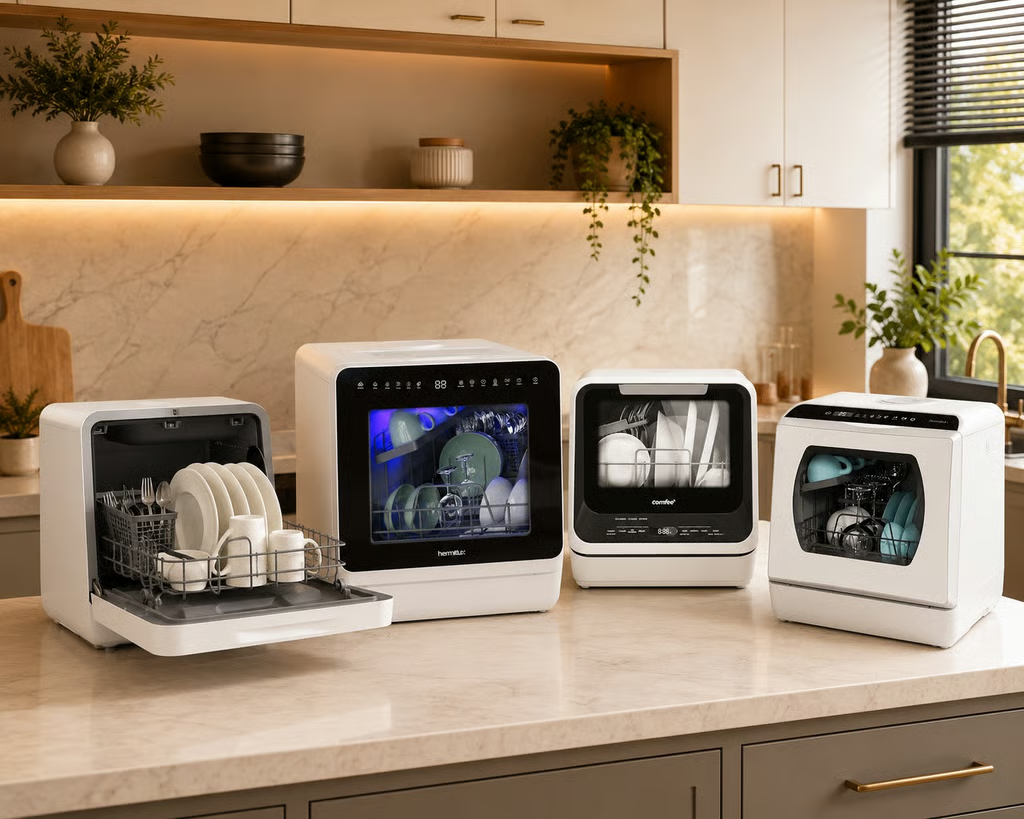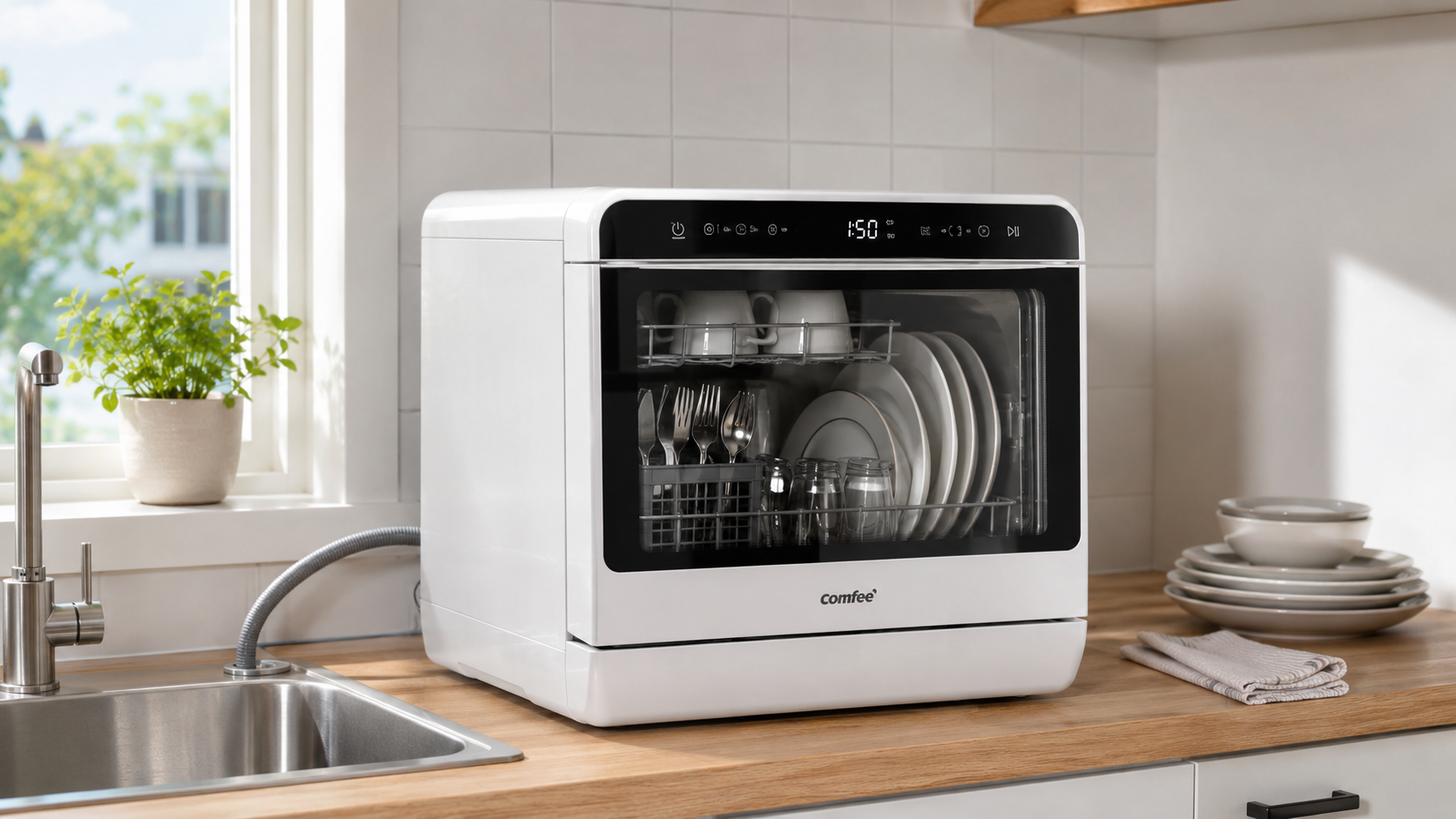


This COMFEE countertop dishwasher review examines the six-place CDC22P series for apartments, dorms, tiny homes and RVs. It offers eight wash programs, room for up to 70 pieces of tableware and no need for permanent plumbing—but it is a faucet-connected 46-pound appliance, not a lightweight dishwasher with a built-in water tank.
COMFEE’ countertop dishwasher review summary
The CDC22P’s appeal is straightforward: it delivers much of the day-to-day convenience of a dishwasher without a built-in installation. COMFEE’ says the rack can hold up to 70 pieces, including plates as large as 10 inches. The eight programs cover ordinary loads, heavier soil, glassware and quick refreshes, while a 24-hour delay and extra-drying option add useful flexibility.
The compromises are equally important. Its countertop footprint is substantial, the door needs room to open, and a specialty or pull-out faucet may not accept the supplied quick-connect adapter. The unit is also audible rather than whisper-quiet: COMFEE’s Canadian product-page title identifies this series at 61 dB. Buyers expecting a small built-in tank or an appliance that is easy to carry between campsites will be looking at the wrong model.
COMFEE’ CDC22P specifications
| Specification | COMFEE’ CDC22P detail | What it means |
|---|---|---|
| Capacity | 6 place settings; up to 70 tableware pieces; plates up to 10 inches | Suitable for daily dishes from roughly one to three people, depending on cooking habits. |
| Programs | Heavy, Normal, Baby-Care, ECO, Glass, Speed, Rinse and Mini-Party | More useful cycle choice than many basic countertop models. |
| Reference size | About 21.6 W × 20.6 D × 17.2 H inches | Measure the full counter depth, hose path and door-opening area before ordering. |
| Weight | About 46 lb | Portable in installation style, but not especially carry-friendly. |
| Power | 120 V | Use a properly grounded outlet and follow the manual’s electrical instructions. |
| Water supply | Faucet quick-connect or suitable plumbed connection; no built-in tank | Compatibility with your faucet is a purchase-critical check. |
| Normal-cycle water | About 10.8 L / 2.85 U.S. gal in the current white-model manual | Resource use varies by selected program and model revision. |
| Noise | 61 dB in COMFEE’s Canadian page metadata | Expect to hear washing and draining in a studio or open-plan room. |
| Warranty | 365 days on current U.S. listings, subject to official terms | Keep the receipt and check local service availability before purchase. |
COMFEE’ uses several CDC22P model codes. At the time of checking, the U.S. store listed the white CDC22P2AWW and black CDC22P1BBB, while the Canadian page referenced CDC22P1BWB. Published depth and width figures also vary slightly between listings, so use the exact retailer page and manual for the SKU you plan to buy—not a measurement copied from another color or market.
Design, countertop space and real capacity
The CDC22P has the familiar shape of a compact dishwasher, with a front door, upper control panel, dish rack, cutlery basket and cup shelves. White and black finishes make it easy to coordinate with common kitchen appliances. Its approximately 17.2-inch height can fit below many upper cabinets, but “fits” is not the same as “has safe operating clearance.” Allow room for ventilation, hose routing and the open door, and follow the clearance instructions for your exact manual.
Six place settings sounds generous for a countertop appliance, but standardized place-setting language does not mirror every real meal. Flat plates, bowls, cups and utensils pack efficiently; mixing bowls, skillets and deep cookware consume rack space quickly. A 10-inch plate may fit, while an oversized dinner plate or tall pan can interfere with the spray arm. For a couple who cooks moderately, one daily load may be realistic. A household of three that uses several pans may need two loads or continued hand-washing for cookware.
Loading it for better results
- Scrape off bones and large food scraps, but avoid wasting water on a full pre-rinse.
- Face dirty plate surfaces toward the spray and place cups or bowls opening-down.
- Confirm that nothing blocks the spray arm before starting the cycle.
- Keep small utensils secure in the basket and separate nested spoons.
- Use automatic-dishwasher detergent only; ordinary dish soap can create excessive foam.
- Run a full but not overloaded rack. Crowding prevents water from reaching every surface.
Installation: simple, but check the faucet first
No cabinet cutout or permanent plumbing is required for the usual countertop setup. However, the dishwasher still needs a pressurized water connection, safe drainage and electricity. The six-place unit cannot be filled by pouring water into an internal tank.
- Measure the location. Check width, depth and height, then leave space for the inlet hose, drain hose, power cord and open door.
- Choose a stable, level surface near the sink. The counter must safely support the roughly 46-pound appliance plus dishes and water.
- Check faucet compatibility. Remove the faucet aerator if instructed and attach the correct quick-connect adapter. Pull-down, pull-out, designer and sensor faucets often need a different solution or may be unsuitable.
- Secure the drain hose. Route it to the sink exactly as the manual shows so it cannot jump out, kink or siphon water incorrectly.
- Use a grounded 120-volt outlet. Keep the plug and connection dry. Do not improvise with an extension cord or adapter; follow the manual and local electrical requirements.
- Inspect for leaks. Turn on the water, check each connection and run the initial procedure in the model-specific manual before relying on the machine unattended.
Eight wash programs explained
| Cycle | Best use | Important expectation |
|---|---|---|
| Heavy | Heavily soiled dishes and compatible cookware | COMFEE’ describes 12 high-pressure nozzles, 360-degree spray and water up to 68°C / 154°F. |
| Normal | Typical daily plates, bowls, cups and utensils | The manual lists about 10.8 liters of water for the current white-model Normal program. |
| Baby-Care | Heat-tolerant feeding items and heavily soiled loads | Check that every component is dishwasher-safe; the cycle name alone is not proof of an independently certified sanitize cycle. |
| ECO | Normally soiled loads when efficiency matters more than speed | Eco programs often trade a longer routine for lower resource use. |
| Glass | Lightly soiled glassware and delicate dishwasher-safe items | Use rinse aid where recommended and confirm delicate pieces are machine-safe. |
| Speed | Fresh, lightly soiled dishes needed again soon | The current product listing describes a cycle of about 45 minutes. |
| Rinse | Holding dishes until a later full wash | Useful for preventing food from drying on; it is not a complete detergent wash. |
| Mini-Party | Small batches of recently used cups and plates | Designed for quick turnaround, not stubborn baked-on residue. |
The extra-drying option increases drying support on compatible cycles. It is useful, but it should not create an expectation that every plastic item will emerge bone-dry. Lightweight plastics cool quickly and often retain droplets; correct loading, rinse aid and opening the door after the program can improve results when the manual permits.
Cleaning and drying performance: what the design suggests
COMFEE’s official specifications are promising for ordinary small-household loads. A 360-degree spray arrangement and multiple high-pressure nozzles should give well-positioned dishes broad water coverage. The Heavy cycle raises the temperature and intensity for tougher soil, while Normal and ECO are the sensible starting points for daily loads. The short Speed and Mini-Party programs are better reserved for fresh, light residue.
Actual cleaning quality depends on more than the machine name. Hard water, detergent dose, blocked spray paths, nested utensils and dried starch can all change the outcome. Scrape large debris, load without overlap, choose Heavy for stubborn residue and occasionally clean the filter and spray components as the manual directs. Burned-on pans may still need soaking, and large cookware may not fit at all.
Because this article is not based on a controlled hands-on test, it does not claim that the CDC22P removed a particular food stain or outperformed a competitor. Instead, the verdict weighs verified hardware, cycle choices, capacity, setup demands and the practical constraints of a small kitchen. For a broader checklist, see FrediTech’s kitchen-appliance buying guide.
Baby bottles and feeding parts
Only load parts that their manufacturer labels dishwasher-safe, and place small components in a closed basket so they cannot fall into the filter. The CDC says a dishwasher using hot water and heated drying or a sanitizing setting can help with infant-feeding-item hygiene. However, COMFEE’s “Baby-Care” label should not be treated as independent sanitize certification. Follow the CDC’s current instructions and your child’s healthcare guidance, particularly for infants under two months, premature infants or those with weakened immune systems.
Water use, energy considerations and noise
Water and energy
The current CDC22P2AWW manual lists approximately 10.8 liters (2.85 U.S. gallons) for the Normal program. Other cycles use different amounts. That is more precise than applying one lower estimate to every program. Annual electricity cost will vary with cycle choice, heated drying, local rates and frequency, so a universal dollar estimate would be unreliable.
For lower resource use, scrape rather than pre-rinse, run a properly full load and select the least intensive cycle that can clean it. ENERGY STAR recommends checking the yellow EnergyGuide label to compare a specific model’s energy use and estimated operating cost. Certification applies to an exact model—not automatically to every product in a brand family—so verify the SKU in the official Product Finder or on its current label before purchase.
Noise
The Canadian COMFEE’ page title identifies this countertop model at 61 dB. That makes it an audible appliance in a studio, open-plan apartment or RV. Water spray, pump and drain sounds should be expected. If you take calls or sleep close to the kitchen, scheduling a cycle for a less sensitive time may matter more than the 24-hour delay’s off-peak-energy potential.
Is it best for apartments and RVs?
Apartment verdict: yes, with three checks
The CDC22P is well matched to many apartments because it needs no permanent built-in installation and has meaningfully more capacity than two-place tank models. Before ordering, confirm:
- the appliance, open door and hoses fit without blocking meal-preparation space;
- your faucet accepts the connection and the drain hose can be secured safely; and
- a grounded outlet is reachable without an extension cord.
It is most compelling for singles, couples and small households that cook often enough to justify the counter space. It is less attractive if you have minimal counter depth, a pull-out faucet, no nearby outlet or a family-size dish load.
RV verdict: possible, not universally best
The word “portable” can be misleading in an RV context. The six-place model weighs about 46 pounds before loading, has no built-in tank and requires both inlet and drain arrangements. A suitable campsite connection does not solve every issue: the RV must also provide adequate 120-volt power, water supply, gray-water capacity, stable counter support and secure storage for travel.
| RV question | Why it matters | Practical answer |
|---|---|---|
| Can your power system support it? | Heating water creates a meaningful electrical load. | Verify the appliance rating, circuit capacity and inverter/shore-power limits. |
| Do you have a compatible water connection? | The CDC22P has no fill-by-hand tank. | Confirm the faucet/adapter arrangement before the trip. |
| Can the sink and gray tank accept the discharge? | A Normal load uses about 2.85 gallons, and other cycles vary. | Include dishwasher water in fresh- and gray-water planning. |
| Can you secure 46 pounds safely? | A loose appliance can become dangerous in motion. | Operate only while parked and store or restrain it for travel. |
| Can you spare the counter volume? | The footprint and door swing are larger than mini tank models. | Make a cardboard template before buying. |
For a full-time RV with shore power, a compatible sink and generous counter space, the six-place capacity may be worth the tradeoff. For boondocking, frequent moves or a faucet that cannot accept an adapter, COMFEE’s smaller built-in-tank model is usually the more practical format.
COMFEE’ six-place dishwasher vs. built-in-tank mini
| Feature | CDC22P2AWW six-place | CDC17P2AWW 6 L tank mini |
|---|---|---|
| Place settings | 6 | 2 |
| Water input | Faucet quick-connect / suitable water line | Built-in 6 L tank or faucet connection |
| Dimensions | About 20.6 D × 21.6 W × 17.2 H in | About 17.24 D × 16.5 W × 18.43 H in |
| Weight | 46 lb | 41.3 lb |
| Official-store price when checked | $289.99 | $369.99 |
| Best reason to choose it | More dishes per load | Fill-by-hand flexibility |
| Main compromise | Needs a compatible water connection and more counter depth | Far smaller two-place capacity |
Prices are snapshots, not promises; retailer promotions, tax and stock change. The useful decision is capacity versus water-input flexibility. Choose the six-place unit when your sink connection works and you want fewer loads. Choose the mini tank when filling by hand matters more than rack capacity.
COMFEE’ countertop dishwasher pros and cons
Pros
- Six place settings and up to 70 pieces
- Eight programs for varied small loads
- 45-minute Speed option
- Extra-drying option and 24-hour delay
- No permanent built-in installation required
- White and black versions available
- One-year warranty on current U.S. listings
Cons
- No built-in water tank on the six-place model
- Faucet compatibility can be a deal-breaker
- Large footprint and 46-pound weight
- Oversized cookware may not fit
- 61 dB is audible in a small room
- Plastics may retain moisture
- Published dimensions vary slightly by SKU
Who should buy it?
Buy the CDC22P if you are a renter, student, couple or small household with a standard compatible faucet and enough counter space. It is particularly useful when you want more capacity than a tiny tank dishwasher but cannot install a full-size machine.
Who should skip it?
Skip it if you need hand-fill operation, regularly wash large pans, have a household of four or more, cannot spare the counter, or require a very quiet appliance. RV owners should also skip it unless they have verified power, water, drainage and safe travel storage.
Final verdict: best for apartments, conditional for RVs
The COMFEE’ CDC22P earns a recommendation for small apartments because it combines genuinely useful six-place capacity, eight cycles and temporary faucet installation at a competitive official-store price. Its limitations are knowable and easy to screen: measure carefully, confirm the faucet adapter and accept that 61 dB will be noticeable nearby.
For RVs, the answer is more selective. It can be an excellent campsite appliance in a roomy, well-powered rig, but its weight and lack of a built-in tank make it a poor universal pick. If you need to pour in water manually or conserve every inch, the two-place COMFEE’ tank model is the better format.
COMFEE’ countertop dishwasher buying options
Check the model number, dimensions, water-input method, included adapter and return policy on the final product page. Do not assume two listings with similar photos are the same machine.
Affiliate disclosure: As an Amazon Associate, I earn from qualifying purchases. If you buy through the links below, FrediTech may receive a commission at no extra cost to you.
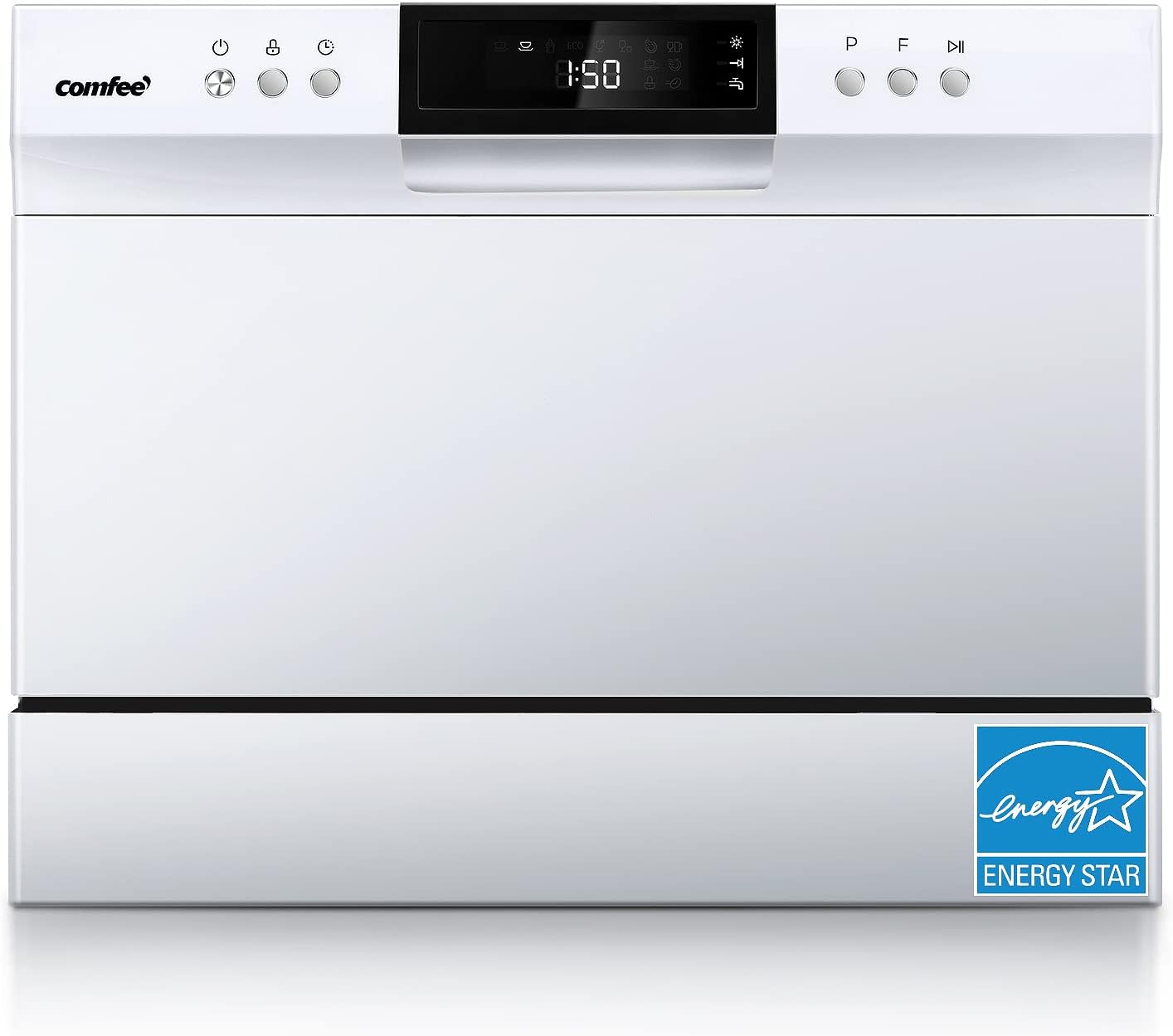
COMFEE’ six-place dishwasher — white
The full-capacity format reviewed here. Verify the exact CDC22P model code and faucet adapter before ordering.
Check price on Amazon
COMFEE’ six-place dishwasher — black
The black CDC22P variant has the same basic use case, but confirm listing-specific measurements and features.
Check price on Amazon
COMFEE’ mini tank dishwasher
A smaller alternative for buyers who prioritize fill-by-hand flexibility over six-place capacity.
Check price on AmazonFrequently asked questions
Is the COMFEE’ countertop dishwasher good for apartments?
Yes, especially for one to three people who cannot install a built-in dishwasher. Confirm that you have enough counter and door-opening space, a compatible faucet, safe drainage and a nearby grounded outlet.
Does the six-place COMFEE’ dishwasher have a built-in water tank?
No. The six-place CDC22P series needs a suitable faucet or water-line connection. COMFEE’s built-in-tank models are smaller, separate products with two-place capacity.
How much water does the COMFEE’ CDC22P use?
The current CDC22P2AWW manual lists about 10.8 liters, or 2.85 U.S. gallons, for the Normal program. Usage changes with the selected cycle and model revision.
How long is the COMFEE’ dishwasher Speed cycle?
COMFEE’s current U.S. listing describes the Speed wash as approximately 45 minutes. It is intended for lightly soiled dishes; tougher residue needs a more intensive program.
Will the COMFEE’ dishwasher fit 10-inch plates?
COMFEE’ says the six-place model accommodates plates up to 10 inches. Shape, rack position and neighboring items still matter, so measure unusually deep or wide dishes.
Is the COMFEE’ countertop dishwasher quiet?
The Canadian product-page title identifies the series at 61 dB. That is audible in a studio apartment or RV, so it should not be described as whisper-quiet.
Can I connect it to a pull-out kitchen faucet?
Many pull-out, pull-down, sensor and nonstandard faucets are not straightforward matches for countertop-dishwasher adapters. Compare your faucet threads with the manual and ask COMFEE’ support or a qualified plumber if uncertain.
Can the Baby-Care cycle sanitize bottles?
It is a high-temperature program, but the cycle name alone does not establish independent sanitize certification. Use only dishwasher-safe parts and follow current CDC hygiene guidance, the feeding-item manufacturer’s instructions and healthcare advice when relevant.
Is the COMFEE’ countertop dishwasher suitable for an RV?
It can be suitable when parked if the RV has sufficient 120-volt power, a compatible water connection, safe sink drainage, gray-water capacity, a stable counter and secure travel storage. Its 46-pound weight and lack of a tank make it less flexible than a mini tank model.
What warranty does COMFEE’ provide?
Current U.S. listings state a 365-day warranty. Coverage, exclusions and service options are governed by COMFEE’s official terms, so retain proof of purchase and check regional support before buying.
Sources and verification
- COMFEE’ Canada: six-place countertop dishwasher — programs, capacity, dimensions, weight, faucet connection and product-page noise reference.
- COMFEE’ U.S.: white CDC22P2AWW — current SKU, capacity, dimensions, power, price snapshot and warranty period.
- COMFEE’ U.S.: black CDC22P1BBB — color-specific model information and measurements.
- COMFEE’ U.S.: CDC17P2AWW 6-liter tank model — two-place capacity, dual-fill system, dimensions and weight.
- Official CDC22P2AWW user manual — installation, loading, cycle and resource-use guidance.
- COMFEE’ warranty terms — current coverage details and exclusions.
- ENERGY STAR dishwasher guidance — sizing, EnergyGuide labels, full loads and scrape-don’t-rinse advice.
- CDC infant-feeding-item hygiene guidance — dishwasher-safe parts, hot water, heated drying and sanitizing considerations.