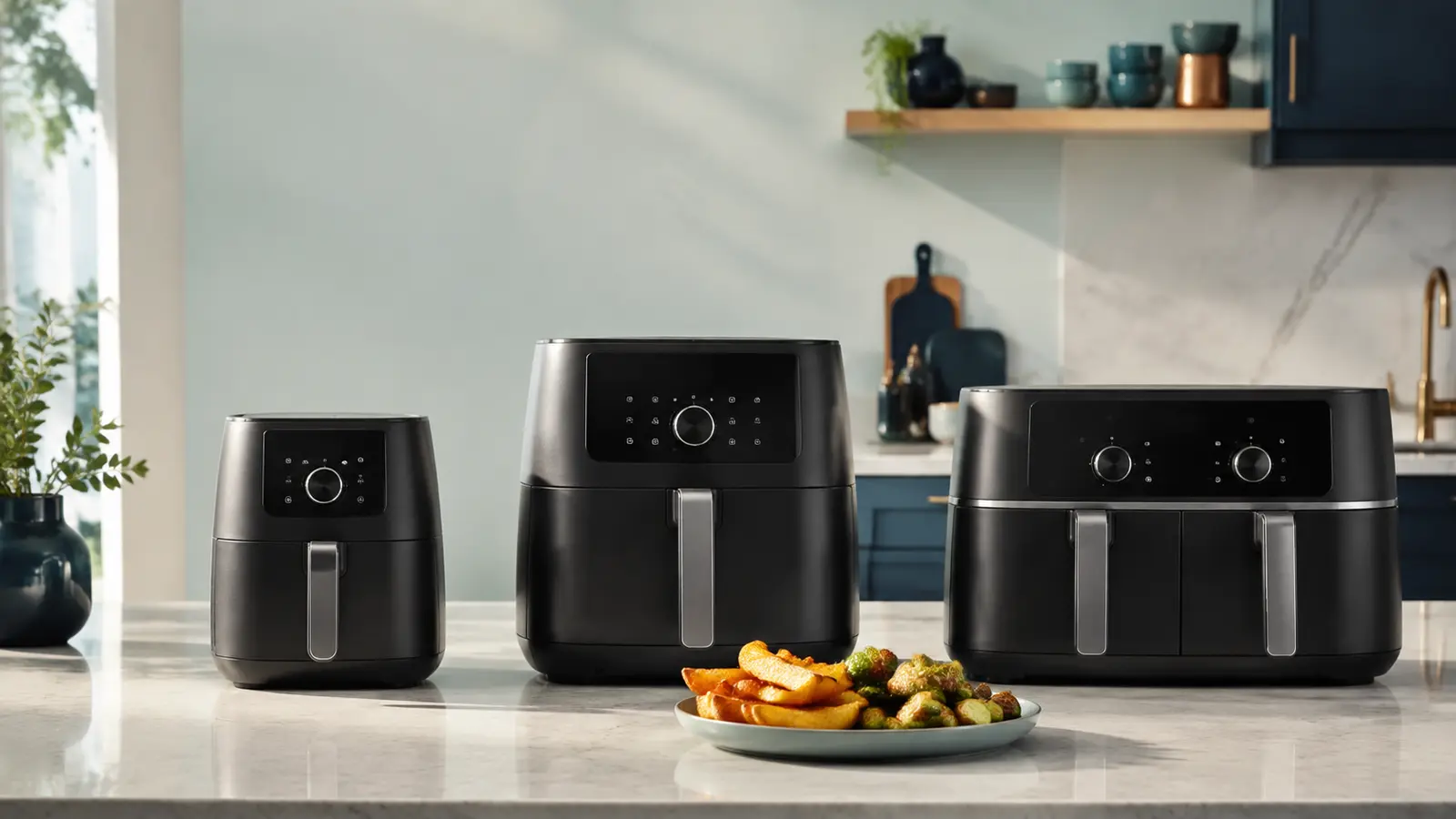

The best air fryer size and basket layout depend on what you cook and how much counter space you can spare. Capacity, usable cooking area, temperature consistency, cleanup, noise and whether a dual basket actually matches your meal routine matter more than headline wattage.
Quick Verdict
- Best for: buyers matching capacity and basket layout to household size and meal habits.
- Focus on: usable basket area, cooking consistency, controls, cleanup, counter footprint and replacement-part availability.
- Watch for: oversized capacity claims can be misleading if food must be stacked or the basket is awkward to clean.

Table of contents
Introduction
Air fryers are compact convection appliances, but capacity and basket layout matter more than marketing labels. For this August 2026 update, FrediTech checked current manufacturer information rather than relying on a future market-size forecast. Current lineups show the practical spread clearly: Philips sells compact 4.2 L and larger 6.2 L single-basket models, Ninja offers flexible dual-zone designs, and COSORI lists both single-basket and 9-quart dual-basket formats.
This guide compares small vs large and single vs dual‑basket air fryers. It blends independent product testing, energy‑use analysis and consumer advice to help you choose the right model. You’ll learn how size affects cooking results, when dual baskets make sense, and which models stand out in 2026. Throughout the article you’ll find links to FrediTech’s broader kitchen‑appliance guides and external resources for deeper exploration.
Air Fryer Market and Trends for 2026
Growth drivers and market breakdown
- Rising health and energy awareness – Consumers increasingly seek appliances that reduce oil consumption and energy bills. Mordor Intelligence notes that drawer/basket air fryers led the market with 51 % share and that households account for 79 % of purchasesmordorintelligence.com. The ability to crisp food without deep frying appeals to health‑conscious families.
- Shift to larger capacities – Units above 5 quarts are growing at 8.48 % CAGR, reflecting demand from families. Manufacturers have responded with dual‑basket and flexible‑drawer designs that cook multiple dishes simultaneously.
- Emergence of PFAS‑free materials – Awareness of non‑stick coatings containing per‑ and polyfluoroalkyl substances (PFAS) has spurred interest in ceramic and stainless‑steel baskets. Guides such as Zenda Guide emphasise choosing non‑toxic materials like ceramic or BPA‑free plasticszendaguide.com.
- Energy efficiency and smart features – Many new models offer app control, IoT connectivity and energy‑monitoring. Mordor Intelligence credits government rebates and regulations for encouraging adoption of energy‑efficient models and smart sensors.
Why air fryers are energy efficient
Air fryers use rapid convection to circulate hot air around food. The heating element and fan occupy a small chamber, so the appliance heats quickly and cooks food faster than an oven. FrediTech describes air fryers as “small convection ovens” and advises buyers to look for baskets large enough for family portions, adjustable temperature ranges (typically 170–400 °F) and dishwasher‑safe partsfreditech.com. According to energy‑use research summarised by Sense, a CNET analysis found that the cost per hour of cooking in an air fryer can be half that of an electric oven and about 38 % lower than a gas ovensense.com. Solartech’s energy‑cost guide adds that air fryers are most cost‑effective for small households; typical monthly usage costs US$2–8 for 1–4 servingssolartechonline.com.
Understanding Air Fryer Sizes: Small vs Large
How size is measured
Manufacturers measure basket capacity in quarts (US) or litres (UK/EU). The Air Fryer Kitchen advises that for most households, a 4–6 litre (≈4–6 quart) air fryer offers the best balance of capacity and footprinttheairfryerkitchen.com. Small (2–3 L) units suit singles or couples, while 6 L or larger models work better for families of four or more.
Capacity recommendations
Household size | Recommended capacity | Source |
1–2 people | Small air fryers (1–2 L) are ideal for singles or couples and save counter space. | The Air Fryer Kitchen |
3–4 people | Medium units (3–5 L) work well for families of three to four. | The Air Fryer Kitchen |
4–5 people | For a family of four, a 5–6 L air fryer balances capacity and counter space. Larger items like whole chickens may still require a bigger unit. | The Air Fryer Kitchen |
5+ people | Large models (≥6 L, up to 10 L) or dual‑basket systems allow cooking full meals for five or more. | The Air Fryer Kitchen |
Power consumption by size
Solartech’s 2026 energy guide notes that air fryers draw 800–2,000 watts depending on size, with small (1–2 quart) units consuming 800–1,300 W, medium (3–4 qt) models using 1,200–1,800 W and large (5+ qt) units requiring . Because larger models cook bigger batches, they may be more efficient per kilogram; for example, the 10.4 L Ninja FlexDrawer consumes 0.85 kWh to cook 1.2 kg of fries, comparable to smaller models making multiple batcheshomenura.com. Understanding wattage helps you estimate running costs:
- Find the rated wattage on the product label or manual.
- Convert to kilowatt‑hours (kWh): multiply wattage by cooking time (in hours) and divide by 1,000. A 1,500 W fryer used for 30 minutes consumes 0.75 kWh.
- Calculate cost by multiplying kWh by your electricity rate. For instance, in New York (US $0.17/kWh), a 30‑minute session with a 1,500 W air fryer costs about US$0.11.
Pros and cons of small vs large
- Large units provide greater capacity (6–10 L) for families or batch cooking. They often include multiple racks or dual‑zone designs that reduce total cooking time. The trade‑offs are higher upfront cost, larger counter footprint and higher wattage (1,600–2,600 W).
Single vs Dual Basket Air Fryers
Key differences
Home Nura’s 2026 comparison highlights the practical distinctions between single‑basket and dual‑basket models. A dual‑basket air fryer contains two independent compartments with separate temperature and timer settings. Some include Sync Finish or Smart Finish functions that coordinate completion times so both baskets finish simultaneously. A single‑basket fryer is more compact and straightforward; it cooks one dish at a time.
Feature | Single basket | Dual basket | Notes |
Total capacity | 3–7 L (average 4–5 L) | 7–10 L | Dual models offer greater total capacity but divide space into two baskets. |
Simultaneous cooking | No – dishes must be cooked sequentially | Yes – independent baskets allow different foods at different settings | Ideal for cooking protein and sides together. |
Footprint & weight | Compact (≈30×30×30 cm) and light (3–5 kg) | Large (≈40×30×35 cm) and heavier (6–9 kg) | Requires more counter space and storage. |
Price range | €60–150 | €130–280 | Dual models cost about €80–120 more. |
Power consumption | 1,200–1,800 W | 1,700–2,400 W | Dual models draw more power but reduce total cooking time. |
Ease of use | Simple operation with one program | Slight learning curve due to two sets of controls | Some include Smart Finish to simplify timing. |
Pros and cons
Single‑basket advantages
- Compact and affordable – Single baskets occupy less space and cost less; they are perfect for small kitchens and budgetshomenura.com.
- Easy to use and clean – One program controls all cooking, and there is only one basket to wash.
- Lower energy draw – Typically 1,200–1,800 W, resulting in lower running costs.
Single‑basket limitations
- Sequential cooking – You must cook side dishes and main courses one after the other, doubling total meal time.
- Limited capacity – A 4–5 L basket suits two or three people but can be tight for four.
Dual‑basket advantages
- Simultaneous meals – Cook fries and chicken separately but finish together thanks to Sync Finish. Home Nura estimates that for a family of four, the time saved amounts to roughly 78 hours per year when using a dual basket four times a week.
- Greater flexibility – Independent baskets allow different temperatures and times, enabling you to cook protein and vegetables simultaneously.
- Large capacity – Total volume of 7–10 L suits families of three or more. Some models merge both baskets into a single 10+ L zone.
Dual‑basket drawbacks
- Higher cost and power consumption – Expect to pay €130–280 and draw 1,700–2,400 W.
- Bigger footprint and weight – Dual models require more counter space and are heavier, making them harder to move.
- Slightly noisier – Fans run harder to circulate air, adding 2–4 dB compared with single models.
Step‑by‑Step: Should You Choose a Single or Dual Basket?
- Assess household size:
- 1–2 people – Choose a single basket (3–5 L) to save space and cost.
- 3–4 people – A dual basket or larger single (≥6 L) reduces cooking time.
- 5+ people – A dual basket with 8–10 L or a flexible drawer is essential.
- Consider cooking habits:
- If you often prepare one-dish meals or cook snacks, a single basket suffices.
- For complete meals (protein plus side) or varied diets (vegetarian vs meat) cooked at different temperatures, a dual basket is more efficient.
- Evaluate kitchen space:
- Measure available counter and cabinet space. Dual baskets can measure 40 × 30 × 35 cm and weigh 6–9 kg.
- Check power capacity:
- Older electrical circuits may struggle with 2,000+ W appliances. A single basket (1,200–1,800 W) fits more homes.
- Balance cost vs time savings:
- A dual basket costs €80–120 more but saves 20–30 minutes per meal, equating to about 100 hours per year for a family of four.
Best Air Fryers of 2026
The following models were chosen based on independent testing, energy‑use analysis and material safety. For more details on how these and other kitchen appliances are evaluated, read FrediTech’s Kitchen‑Appliance Reviews Guidefreditech.com.
Best Small & Single‑Basket Air Fryers
Philips 3000 Series XL (6.2 L)

- Capacity & size: 6.2 L basket; good for couples or small families.
- Power & presets: Around 1,600–1,800 W with multiple programs for fries, chicken, fish and vegetables. Adjustable temperature (40–200 °C) and timer.
- Pros: Compact footprint, easy to use and clean, dishwasher‑safe parts. Home Nura rates it 9/10 for value, citing its affordability (~€110) and performance.
- Cons: Single basket means sequential cooking; limited capacity for larger families.
- Ideal for: Couples or small families seeking a reliable, budget‑friendly model.
- Read more about choosing kitchen appliances in FrediTech’s Kitchen‑Appliance Reviews.
Xiaomi Smart Pro (4 L)
- Capacity & features: 4 L basket with Wi‑Fi connectivity and smartphone control.
- Power: About 1,500 W. Suitable for 1–2 people.
- Pros: Compact size, smart app for scheduling and remote control, good for tech‑savvy singles or couples.
- Cons: Limited capacity; not ideal for large meals.
- Ideal for: Singles or couples wanting smart features without a big footprint.
Aria 7‑Qt Ceramic Air Fryer Oven
- Capacity & materials: 7‑quart (≈6.6 L) oven‑style fryer with a PFAS‑free ceramic basket, one of the few large non‑toxic models.
- Power: About 1,700 W. Includes racks for multi‑level cooking.
- Pros: Non‑toxic ceramic coating; generous capacity; versatile oven‑style design; includes accessories.
- Cons: Bulkier footprint; some user reports of long‑term fit issues.
- Ideal for: Families of three to five seeking a PFAS‑free option.
Best Dual‑Basket & Large Air Fryers
Ninja Foodi FlexDrawer (10.4 L)

- Unique feature: A flexible drawer converts from a single 10.4 L “Mega Zone” to two independent 5.2 L baskets.
- Power & performance: 2,600 W; eight preset programs; temperature range 40–240 °C. In testing, it cooked 1.2 kg of fries evenly in 22 minutes, and a whole 1.8 kg chicken in 55 minutes.
- Pros: Exceptional flexibility (single or dual); large capacity; smart finish ensures simultaneous completion; premium build with ceramic coating.
- Cons: Large footprint (44.5×38×33.5 cm) and heavy (10.2 kg), high power draw and price (~€249.99).
- Ideal for: Large families (5+ people) or those who frequently cook whole chickens or large meals.
Ninja Foodi MAX Dual Zone (9.5 L)
- Capacity: Two 4.75 L baskets (total 9.5 L).
- Features: Sync Cook & Sync Finish functions for simultaneous cooking; multiple presets; approx. 2,400 W.
- Pros: Large enough for families of three to five; independent baskets allow different dishes; widely praised for reliability.
- Cons: Bulkier than single baskets; PTFE non‑stick coating (not ceramic).
- Ideal for: Families seeking dual‑basket flexibility without the size of the FlexDrawer.
COSORI 9-Quart Dual Basket Air Fryer
- Capacity: Two separate cooking drawers with 9 quarts of total capacity (about 8.5 L).
- Features: Independent zones let you use different time and temperature settings, while Sync Cook and Sync Finish coordinate the drawers.
- Pros: A genuine dual-basket layout for cooking a main and side together; useful viewing windows; dishwasher-safe removable components.
- Cons: Wider than a single-basket appliance and less suitable for one very large item than a removable-divider MegaZone design.
- Ideal for: Families that regularly prepare two foods with different settings.
Correction: COSORI Dual Blaze 6.8-Quart is a large single-basket smart air fryer, not a two-drawer model. The 9-quart product is COSORI’s current dual-basket comparison model.
Ninja Foodi Double Stack XL
- Overview: A vertical dual‑zone design with stacked drawers; reduces footprint but keeps dual functionality. Good for kitchens with limited counter width.
- Power & performance: ~2,400 W; dual baskets each ~4.75 L. Smart finish and match cook features.
- Pros: Space‑saving vertical orientation; integrated partition ensures two different foods finish together.
- Cons: Taller than other models; heavy; price around €229.99.
Honorable mentions
- Instant Vortex Plus 6‑Qt: A reliable mid‑priced single basket with presets and good crisping; ranked 7.5/10 by Zenda Guide.
- COSORI Lite 4 L: Compact and inexpensive for singles or couples; has a lower power draw and simple interface.
- Philips Premium XXL (7 L): For those wanting a single, large basket without dual zones; high capacity but sequential cooking.
Non‑Toxic and Safety Considerations
Air fryers often use non‑stick coatings to prevent food from adhering to baskets. However, some coatings contain PFAS chemicals associated with potential health risks. Zenda Guide recommends choosing ceramic, stainless steel or BPA‑free materials and avoiding cheap models with unclear coatings. The Aria 7‑Qt ceramic fryer (mentioned above) exemplifies a PFAS‑free option.
Other safety features to look for:
- Cool‑touch handles and auto‑shutoff: Prevent burns and provide peace of mind.
- Dishwasher‑safe components: Simplify cleaning and reduce bacterial build‑up.
- Non‑slip feet and sturdy construction: Prevent tipping during basket removal.
- Clear warranty and UL/CE certifications: Ensure compliance with electrical safety standards.
Energy Efficiency & Cost of Ownership
Typical wattage and power usage
The table below illustrates energy use for common cooking durations:
Cooking time | 1,200 W fryer | 1,500 W fryer | 1,800 W fryer | Source |
15 minutes | 0.25 kWh | 0.31 kWh | 0.38 kWh | Solartech |
30 minutes | 0.50 kWh | 0.63 kWh | 0.75 kWh | Solartech |
45 minutes | 0.75 kWh | 0.94 kWh | 1.13 kWh | Solartech |
Comparing with ovens, the Sense article notes that air fryers cost about half as much per hour to operate as an electric oven and 38 % less than a gas oven. This advantage is most pronounced for small to medium portions; for very large meals a conventional oven may be more efficient.
Practical tips to save energy
- Fill the basket properly – Avoid underfilling, which wastes energy heating empty space; 70–80 % basket fill optimises airflow and efficiency.
- Lower the temperature – Cooking at 300 °F uses baseline energy; raising the temperature to 450 °F increases consumption by 40–50 %. Try lowering oven recipes by 25 °F in the air fryer.
- Skip unnecessary preheating – Many foods don’t require preheating, saving 2–3 minutes of full‑power consumption.
- Use shorter cycles for reheating – Air fryers reheat leftovers quickly; shorter cycles reduce energy and prevent drying out food.
- Clean regularly – Buildup of grease can block airflow and reduce efficiency. Remove and wash baskets after each use, following manufacturer instructions.
Step‑by‑Step Buying Guide
Selecting an air fryer involves balancing capacity, features, materials, energy consumption and budget. Follow this process:
- Determine your needs
- Household size & portion sizes – Use the capacity chart above to choose 2–3 L for singles, 4–6 L for couples and small families, and 7–10 L (or dual baskets) for large families.
- Cooking habits – Are you preparing quick snacks, full meals, or batch cooking? Dual baskets suit complete meals, while single baskets suffice for simple dishes.
- Check power & voltage
- Verify that your kitchen wiring can handle a 1,500–2,600 W appliance; older homes may need single‑basket models.
- Evaluate features
- Temperature range & presets – Look for adjustable ranges (170–400 °F) and presets for common foods.
- Dual‑zone functions – Sync Finish and Match Cook simplify timing in dual baskets.
- Smart connectivity – Some models offer app control (e.g., Xiaomi Smart Pro, Cosori Dual Blaze). Decide whether you need remote scheduling or monitoring.
- Accessories & racks – Oven‑style models may include racks for multi‑level cooking; dual baskets offer more flexibility.
- Check materials
- PFAS‑free coatings – Prefer ceramic or stainless baskets.
- Dishwasher‑safe parts – Ease of cleaning encourages regular maintenance.
- Set a budget
- Single baskets range €60–150, dual baskets €130–280. Consider long‑term costs: energy savings and time saved with dual baskets can justify higher prices.
- Read reviews & warranties
- Consult independent reviews, such as Home Nura’s tests or FrediTech’s guides. Check warranty terms and after‑sales support.
Red flags to avoid
- Unknown coatings or cheap plastics – Zenda Guide warns against models without clear safety information.
- Inadequate capacity for your needs – Too small and you’ll cook in batches; too large and you’ll waste energy.
- Noisy operation beyond 70 dB – High noise can be disruptive; look for decibel ratings when available. Home Nura reports ~68 dB for the FlexDrawer at full power.
Tips for Using and Maintaining Your Air Fryer
- Preheat when needed – For breaded foods or meats requiring browning, a short preheat helps crispness; for many dishes, preheating isn’t necessary.
- Don’t overcrowd – Leave room for hot air to circulate. For large families, use both baskets or the mega‑zone to avoid stacking food.
- Shake or flip foods – Toss fries or vegetables halfway through to ensure even cooking; many models prompt you to shake.
- Use minimal oil – A light spray of oil enhances browning; avoid aerosol cans that can damage coatings.
- Clean after each use – Hand‑wash or use the dishwasher as recommended; wipe the heating element to remove splatters.
- Check for recalls – Some brands have had recalls for overheating or fire risks. Register your product to receive safety updates.
Conclusion
The air fryer market in 2026 offers something for everyone—from compact single‑basket units perfect for apartments to large, flexible dual‑basket models designed for busy families. Market data show that large‑capacity and dual‑basket models are growing fastest, but single baskets remain cost‑effective for small households. Understanding your household size, cooking habits, and available space is the first step toward choosing the right appliance. In summary:
- Single baskets are ideal for 1–3 people seeking simplicity and affordability.
- Dual baskets suit families of four or more, delivering time savings of up to 100 hours per year by cooking meals simultaneously.
- Large flexible models like the Ninja FlexDrawer offer both single and dual functionality for maximum versatility.
- PFAS‑free and energy‑efficient designs provide health and cost benefits.
Ultimately, the best air fryer for you balances capacity, features, materials and budget. By applying the step‑by‑step approach outlined here and consulting credible reviews, you can make an informed decision that enhances your kitchen efficiency and mealtime enjoyment. For more appliance reviews and smart home guides, explore FrediTech’s growing library of articles.
August 2026 verification
This buyer’s guide was structurally cleaned and its current product formats were rechecked on August 22, 2026. Capacity names vary by country, so confirm the model number on the final retailer page.
- Philips official Airfryer range — current compact, 6.2 L and dual-basket formats.
- Ninja Foodi FlexBasket official product page — 7-quart MegaZone and two 3.5-quart zones.
- COSORI official manuals — current 9-quart dual-basket documentation.
- COSORI Dual Blaze official page — 6.8-quart single-basket format.
FAQ
What size air fryer is best for a family of four?
A 5–6 L single-basket air fryer can serve a family of four, but a dual-basket model with two 4–5 L compartments (about 8–10 L total) often makes meal prep faster and easier—especially when cooking two foods at once.
Are dual-basket air fryers worth the extra cost?
For families of three or more, often yes. Dual baskets can reduce cooking time because you can cook two dishes simultaneously. Many shoppers find the extra cost (often around €80–120 more) worthwhile if it saves 20–30 minutes per meal and adds up to significant time saved over a year.
Do air fryers really save energy compared with ovens?
For small to medium portions, usually yes. Because air fryers heat a smaller space and cook faster, they can use less energy than a full-size oven. Some analyses suggest the cost per hour of air-fryer cooking can be roughly about half that of an electric oven and lower than gas ovens for similar small meals. For large roasts or multiple trays, an oven can be more efficient.
Is a single basket enough for a couple?
Yes. A 4–6 L single basket is usually more than enough for two people and is often simpler to clean and store than a dual-basket model.
What is Sync Finish or Match Cook?
These are features on many dual-basket air fryers that help two different foods finish at the same time. The air fryer stagger-starts one basket (or matches settings) so both baskets complete cooking together—so everything is hot and ready at once.
Are ceramic air fryers better than those with PTFE coatings?
Ceramic baskets are often chosen because they’re typically PFAS-free and more scratch-resistant. PTFE (Teflon) coatings are also effective and easy to clean, but they can degrade if overheated or scratched. To extend coating life, avoid extreme overheating and use non-metal utensils.
How much electricity does an air fryer use per month?
Monthly cost depends on your air fryer’s wattage, how long you cook, and your electricity rate. Some estimates suggest typical small-household use can cost around US$2–8 per month, but your real cost may be higher or lower based on your usage and local rates.
Bottom Line
Choose the smallest air fryer that comfortably handles your normal portions. A practical basket, consistent heat and easy cleanup will matter more over time than a long preset list.