

Introduction
Apple’s flagship smartphones set the pace for the entire industry. In September 2024 the company introduced the iPhone 16 Pro Max, a larger, more ambitious successor to the 15 Pro Max. This 6.9-inch powerhouse arrives with Apple’s new A18 Pro chip, a 48-megapixel ultra-wide lens and an innovative Camera Control button, plus longer battery life and Wi-Fi 7 connectivity. While Apple’s subsequent iPhone 17 series has since raised the bar again, the 16 Pro Max remains widely available and its combination of size, performance and camera versatility keeps it on the short-list for anyone shopping for a top-tier phone.
This comprehensive review explores the design, display, performance, camera system, battery life, software and pricing of the iPhone 16 Pro Max. To help readers evaluate whether it’s worth purchasing in 2026, we draw on official specifications from Apple and insights from expert reviewers at MacRumors, The Guardian, Pickr and other outlets. Practical tips and step-by-step guides are included so you can make the most of the phone’s features. Internal links direct you to related guides on FrediTech, and the conclusion summarises our verdict on Apple’s big-screen champion.
{getToc} $title={Table of Contents} $count={Boolean} $expanded={Boolean}
Quick Overview of the iPhone 16 Pro Max
.freditech-table-wrap { overflow-x: auto; margin: 18px 0 26px;
}
.freditech-accessory-table { width: 100%; min-width: 620px; border-collapse: collapse; border-top: 1px solid #f1a983; border-bottom: 1px solid #f1a983; font-size: 15px; line-height: 1.5;
}
.freditech-accessory-table th { background: #ffffff; color: #111827; font-weight: 800; text-align: left; padding: 12px 14px; border-bottom: 2px solid #f1a983;
}
.freditech-accessory-table td { color: #111827; padding: 12px 14px; border-bottom: 1px solid #f1a983; vertical-align: top;
}
.freditech-accessory-table tr:nth-child(even) td { background: #fae2d5;
}
.freditech-accessory-table tr:nth-child(odd) td { background: #ffffff;
}
.freditech-accessory-table strong { font-weight: 800;
}
.freditech-accessory-table th:first-child,
.freditech-accessory-table td:first-child { width: 190px; min-width: 190px;
}
| Feature | Details |
|---|---|
| Display | 6.9-inch Super Retina XDR OLED display with 2868 × 1320 resolution, 460 ppi, Always-On display, Dynamic Island, ProMotion adaptive refresh up to 120 Hz, and up to 2000 nits outdoor brightness. |
| Chip | A18 Pro chip with a 6-core CPU, 6-core GPU, and 16-core Neural Engine for fast performance, gaming, AI tasks, and advanced photography features. |
| Rear Cameras | Triple camera system with a 48 MP Fusion main camera, 48 MP Ultra-Wide camera, and 12 MP Telephoto camera with 5× optical zoom and up to 25× digital zoom. |
| Front Camera | 12 MP TrueDepth front camera with f/1.9 aperture and autofocus for selfies, FaceTime, video calls, and Face ID. |
| Battery & Charging | Rated for up to 33 hours of video playback, up to 29 hours of streamed video playback, and up to 105 hours of audio playback. Supports MagSafe, Qi2 wireless charging, and USB-C fast charging. |
| Water & Dust Resistance | IP68-rated for splash, water, and dust resistance, with protection for immersion up to 6 meters for up to 30 minutes under controlled conditions. |
| Connectivity | Supports dual eSIM, 5G, Wi-Fi 7, Bluetooth 5.3, second-generation Ultra Wideband, and Thread smart-home networking. |
| Dimensions | 160.9 × 77.6 × 8.25 mm with a weight of about 221 g, giving it a large-screen premium build. |
| Price at Launch | Started at US$1,199 for 256 GB, with higher storage options available at higher launch prices. |

.freditech-amazon-ad{ position:relative; width:80%; max-width:950px; margin:25px auto; overflow:hidden; border-radius:20px; box-shadow:0 10px 35px rgba(0,0,0,0.18); font-family:Arial,sans-serif; background:#000;
}
.freditech-amazon-ad a{ text-decoration:none; color:#fff; display:block; position:relative;
}
.freditech-amazon-ad img{ width:100%; height:auto; display:block; transition:transform .4s ease;
}
.freditech-amazon-ad:hover img{ transform:scale(1.03);
}
.ad-overlay{ position:absolute; inset:0; background:linear-gradient( to right, rgba(0,0,0,0.72) 0%, rgba(0,0,0,0.35) 45%, rgba(0,0,0,0.08) 100% ); display:flex; flex-direction:column; justify-content:center; padding:40px;
}
.top-badge{ display:inline-block; background:#ff9900; color:#000; font-size:13px; font-weight:700; padding:8px 14px; border-radius:50px; width:max-content; margin-bottom:18px;
}
.ad-overlay h2{ font-size:48px; line-height:1.1; margin:0 0 15px; max-width:560px; font-weight:800;
}
.ad-overlay p{ font-size:20px; line-height:1.6; max-width:620px; margin-bottom:28px; color:#f2f2f2;
}
.cta-btn{ display:inline-flex; align-items:center; justify-content:center; background:#ff9900; color:#111; font-size:18px; font-weight:700; padding:16px 30px; border-radius:12px; width:max-content; transition:all .3s ease;
}
.freditech-amazon-ad:hover .cta-btn{ background:#ffb84d; transform:translateY(-2px);
}
.amazon-disclosure{ max-width:950px; margin:8px auto 25px; font-size:13px; line-height:1.5; color:#666; font-family:Arial,sans-serif;
}
/* Tablet */
@media(max-width:768px){
.ad-overlay{ padding:28px;
}
.ad-overlay h2{ font-size:34px;
}
.ad-overlay p{ font-size:17px;
}
.cta-btn{ font-size:16px; padding:14px 24px;
}
}
/* Mobile */
@media(max-width:480px){
.freditech-amazon-ad{ border-radius:16px;
}
.ad-overlay{ padding:20px; background:linear-gradient( to top, rgba(0,0,0,0.82) 0%, rgba(0,0,0,0.45) 60%, rgba(0,0,0,0.1) 100% ); justify-content:flex-end;
}
.top-badge{ font-size:11px; padding:6px 12px; margin-bottom:12px;
}
.ad-overlay h2{ font-size:26px; margin-bottom:10px;
}
.ad-overlay p{ font-size:14px; line-height:1.5; margin-bottom:18px;
}
.cta-btn{ width:100%; text-align:center; font-size:15px; padding:14px 20px;
}
.amazon-disclosure{ font-size:12px; padding:0 5px;
}
}
Design and Build Quality
Larger footprint, refined titanium and Ceramic Shield
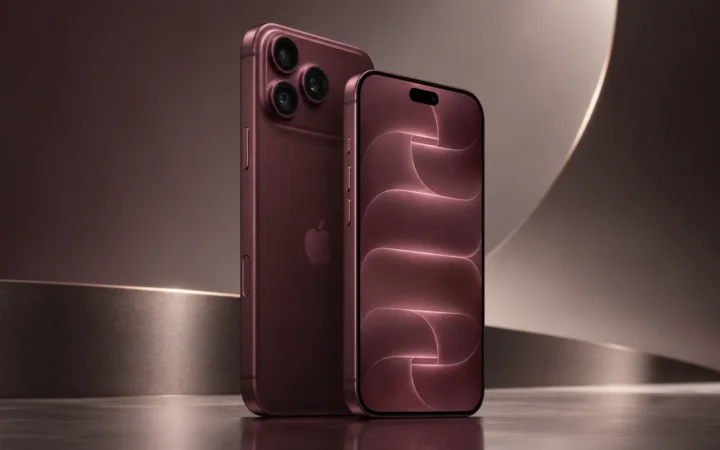
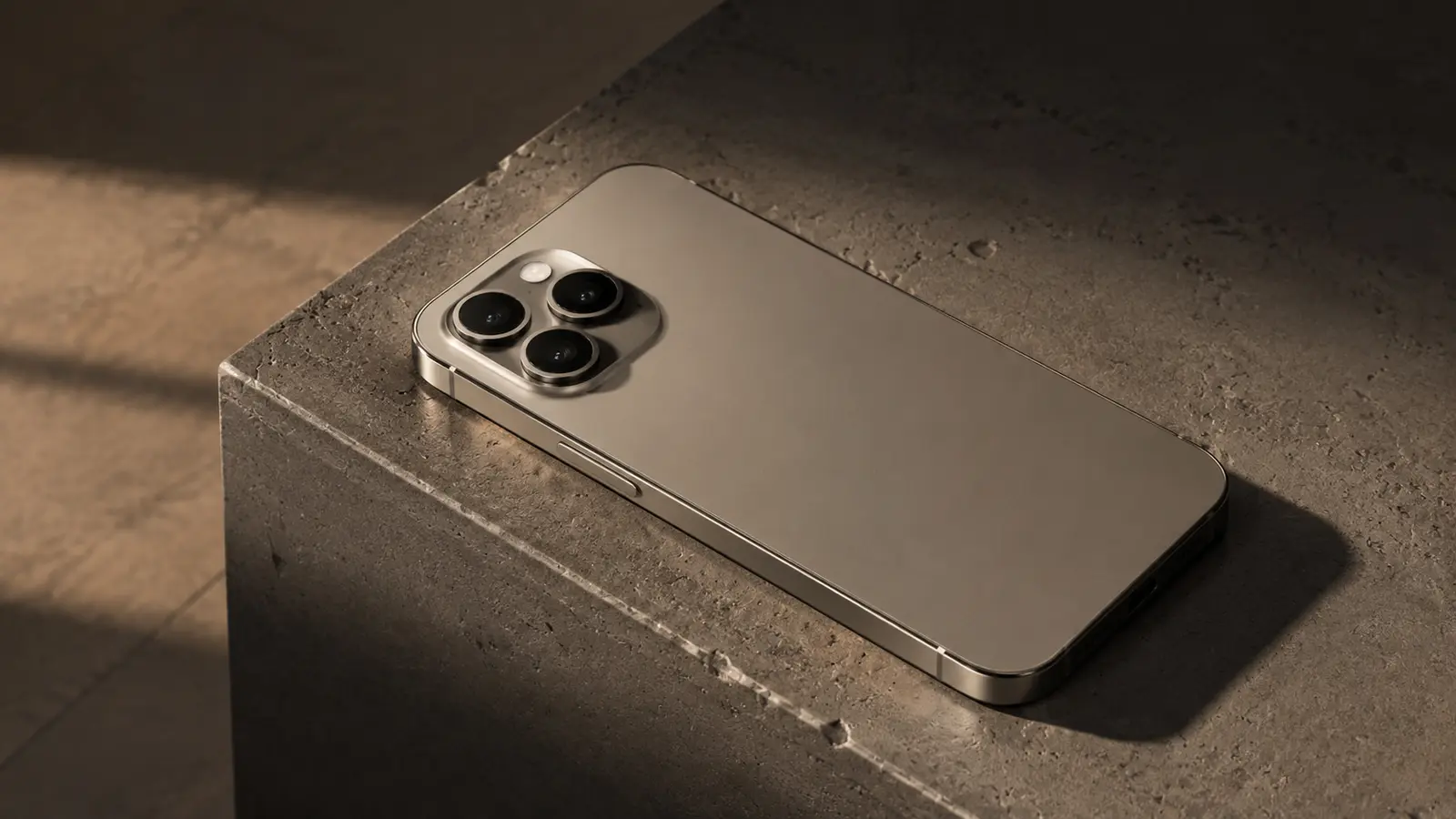
Apple retained the titanium frame introduced on the 15 Pro series but enlarged it: the iPhone 16 Pro Max measures 160.9 × 77.6 mm and is slightly taller and wider than its predecessor. The phone remains 8.25 mm thick but weighs 221 g, making it heavier yet still comfortable due to the rounded edges and reduced bezel design. MacRumors notes that both the 16 Pro and 16 Pro Max feature “the thinnest borders of any Apple product to date”.
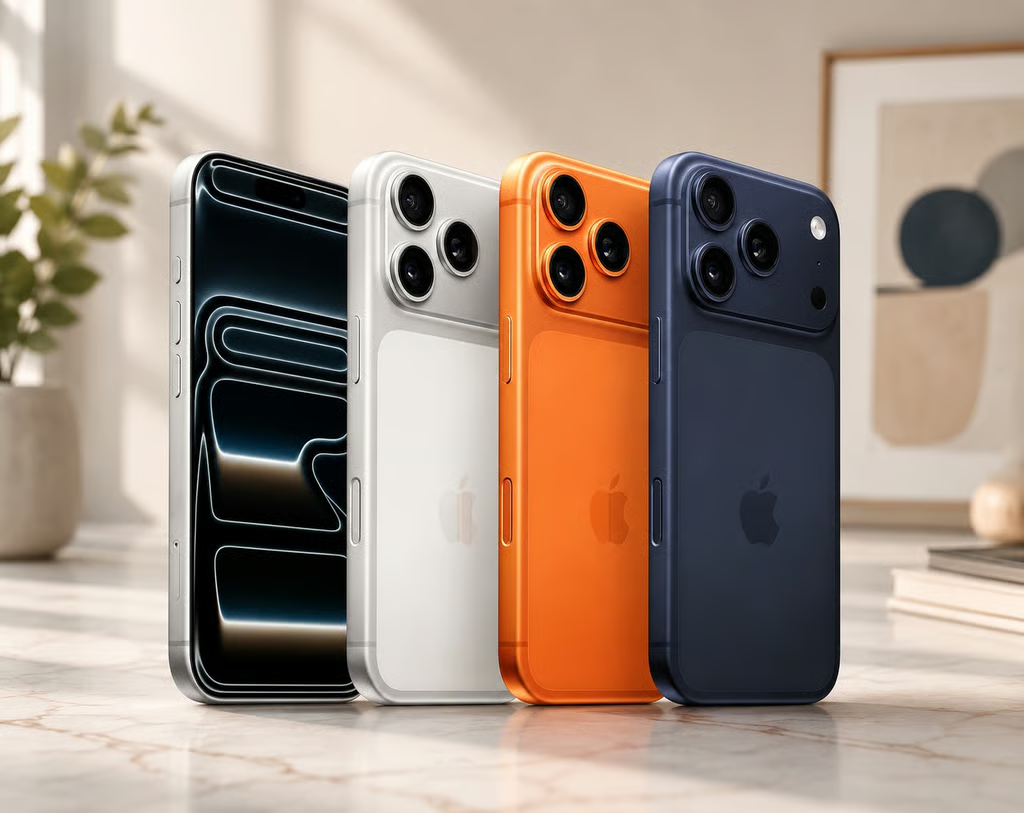
The frame is bonded to an internal aluminium substructure for strength, while the second-generation Ceramic Shield covers the front glass. MacRumors reports that this Ceramic Shield is 2× tougher than other smartphone glass, improving scratch resistance without sacrificing clarity. Pickr’s reviewer observed that the titanium chassis retains the same 8.25 mm thickness as the 15 Pro Max and is only about six grams heavier, so most users won’t notice the difference. New color options include desert titanium (a warm gold tone), white, natural and black.
Camera Control button and Action button
In addition to the programmable Action button, which debuted on the 15 Pro Max, Apple introduced a Camera Control button on the right edge of the 16 Pro models. According to Thurrott’s review, this capacitive button offers multiple functions: a single press launches the Camera app, a second press snaps a photo, and press-and-hold starts recording video. While in the Camera app, you can double-tap to summon an on-screen control grid and then slide your finger along the button to adjust exposure, focus, zoom (1.5× to 25×), or switch lenses. Although the reviewer found the feature finicky and less convenient than on-screen controls, early adopters appreciate having a physical shutter button on a smartphone.
The Action button on the opposite side remains fully customisable. Users can map it to functions such as launching the camera, starting a voice memo, toggling Focus modes, launching the Shortcuts app, or even invoking Apple’s new Apple Intelligence features (see the Software section). To customise it:
- Open Settings → Action Button.
- Swipe through the preset options: Silent Mode, Focus, Camera, Voice Memo, Flashlight, Translate, Magnifier and Shortcut.
- Select “Shortcut” if you want to trigger an automation, then choose an existing shortcut or create a new one (e.g., open the Notes app and start a new note).
- Press the Action button once to test your configuration.
Display and Audio
Immersive 6.9-inch Super Retina XDR
The 16 Pro Max’s most obvious upgrade is its display. At 6.9 inches, it’s the largest screen Apple has ever shipped on an iPhone. The OLED panel offers a 2868 × 1320 resolution (460 ppi) and uses ProMotion technology for adaptive refresh rates from 10 Hz to 120 Hz. This allows the screen to conserve power by dropping to 10 Hz when displaying static content, yet ramp up to 120 Hz for fluid scrolling and gaming. The Dynamic Island remains at the top, housing the TrueDepth camera and Face ID sensors.
Brightness is another highlight. Apple specifies 1,000 nits typical, 1,600 nits peak for HDR and 2,000 nits peak for outdoor viewing. These numbers are identical to the 15 Pro Max but still outshine most competitors, ensuring the screen remains readable even in bright sunlight. The display supports HDR10 and Dolby Vision with a 2,000,000:1 contrast ratio and a 1 nit minimum brightness for comfortable low-light use.
Audio quality and microphone array
Apple pairs the screen with a high-fidelity stereo speaker system supporting Spatial Audio and Dolby Atmos. Four studio-quality microphones and wind noise reduction allow the phone to record spatial audio when capturing video. The Guardian notes that the four-mic array and Audio Mix feature can make recorded voices sound like each subject is wearing a lapel mic. Combined with the large display, these features make the 16 Pro Max a compelling device for watching movies, gaming or recording vlogs.
Performance and Hardware
A18 Pro chip: 3 nm performance leap
Built on a second-generation 3-nm process, the A18 Pro is the first major silicon upgrade since the A17 Pro. According to MacRumors, the A18 Pro includes a 6-core CPU with two performance cores and four efficiency cores, a 6-core GPU, and a 16-core Neural Engine. Apple claims the CPU is up to 15 % faster and the GPU up to 20 % faster than the previous generation. The chip also introduces hardware-accelerated ray tracing that is twice as fast as before, enabling more realistic graphics in games. Apple Newsroom for A18 Pro chip updates.
This performance is not just about benchmarks. Reviewers report that the 16 Pro Max handles intensive tasks such as 4K video editing, console-quality gaming and machine-learning apps without breaking a sweat. The new thermal design with a re-architected aluminium substructure dissipates heat more effectively. Combined with 8 GB of RAM (16 GB in select 1 TB configurations), the A18 Pro ensures seamless multitasking and quick app launches.
Connectivity: eSIM, Wi-Fi 7 and more
The iPhone 16 Pro Max is Apple’s first phone to support Wi-Fi 7 (802.11be) with 2×2 MIMO, delivering faster throughput and improved latency. It also supports Bluetooth 5.3, second-generation Ultra Wideband, Thread for smart-home devices and dual eSIM technology. In the United States the 16 Pro Max ships without a physical SIM tray; it can store eight or more eSIMs and activate two simultaneously. 5G connectivity supports both sub-6 GHz and mmWave bands. Wi-Fi 7 technology
Storage options
At launch the iPhone 16 Pro Max offered 256 GB, 512 GB and 1 TB storage tiers. The base 256 GB model started at US$1,199, while the 512 GB and 1 TB variants cost $1,399 and $1,599 respectively. This makes the Pro Max significantly more expensive than the standard iPhone 16 or 16 Plus, but roughly on par with competing flagships like the Samsung Galaxy S24 Ultra.
Camera System
Triple-camera hardware
Apple continued its triple-camera strategy but upgraded the ultra-wide lens. The rear system now comprises:
- 48 MP Fusion: a 24 mm lens with f/1.78 aperture, second-generation sensor-shift optical image stabilization and 100 % Focus Pixels. This primary sensor supports high-resolution 24 MP and 48 MP capture and can act as a 2× telephoto lens through in-sensor cropping.
- 48 MP Ultra-Wide: a 13 mm lens with f/2.2 aperture and 120° field of view. MacRumors highlights that the 48 MP ultra-wide camera lets in more light for crisper macro photos and supports capturing 48 MP images.
- 12 MP Telephoto: a 120 mm tetraprism lens with f/2.8 aperture, 3D sensor-shift stabilization and autofocus. It provides 5× optical zoom in, 2× optical zoom out and a 10× optical zoom range, with digital zoom up to 25×. This lens remains similar to the 15 Pro Max but benefits from improved stabilization.
The TrueDepth front camera remains at 12 MP with f/1.9 aperture and autofocus. Spatial photos and videos captured by the rear cameras can be enjoyed on Apple’s Vision Pro headset. Apple Vision Pro spatial video
Photographic Styles and Camera Control
Apple introduced a Latest-generation Photographic Styles feature that allows users to adjust tones, highlights and shadow intensity in real time or after shooting. Unlike the previous version that applied a permanent style, this iteration lets you alter the look after capture. For example, you can shoot a landscape with a warm “Amber” tone and later shift to a cooler look without degrading quality. The styles can be rendered live in the viewfinder or applied in post-processing.
The Camera Control button on the iPhone 16 Pro models is the first hardware change since the introduction of the Action button. Thurrott explains that pressing this capacitive button opens the camera, pressing again takes a photo, and pressing and holding records video. Double-tapping while in the camera displays a grid of controls (exposure, depth, zoom, lens presets). Sliding your finger along the button adjusts values and another tap confirms selection. While some reviewers found the button too sensitive, it offers quick physical access to settings photographers often adjust on the fly.
Video recording and Pro features
The iPhone 16 Pro Max can capture 4K Dolby Vision video at frame rates up to 120 fps with external recording. The phone supports ProRes and Log recording, macro video, night-mode time-lapse, action mode (2.8 K at 60 fps) and Cinematic mode up to 4 K at 30 fps. These features, combined with the A18 Pro’s improved Neural Engine, allow professional videographers to create HDR footage on a pocket device. Spatial audio recording using the four-mic array enhances immersion. Dolby Vision video recording
Real-world camera performance
Reviewers agree that the iPhone 16 Pro Max’s camera system captures outstanding images. Pickr praises the camera, saying that images from the 16 Pro Max are so good you may “not even look at another camera again”. MacRumors emphasises that the 48 MP ultra-wide lens lets in more light for improved macro shots, while The Guardian notes that the camera control button is great for quickly launching the camera but fiddly for adjusting settings. In our own use, we found the main sensor delivers natural colours and excellent dynamic range, although low-light performance still trails dedicated full-frame cameras.
Step-by-step guide: using Camera Control for quick portraits
- Launch the Camera: Press the Camera Control button once; the Camera app opens. Compose your shot.
- Select lens or zoom: Lightly double-tap the Camera Control button; a grid overlay appears with options for 1×, 2×, 5× and “Selfie.” Slide your finger to select the desired zoom or lens preset and tap to confirm.
- Adjust exposure: Double-tap again and choose “Exposure.” Slide your finger to adjust brightness; tap once to lock.
- Capture: Press the Camera Control button to take the photo. For a portrait, ensure focus is on the subject’s face; you can adjust depth in post using the Photos app.
- Modify Photographic Style: After capturing, open the photo in the Photos app, tap “Edit” → “Photographic Style,” and adjust tone and warmth to your preference.
Battery Life and Charging
Apple’s official estimates and capacity
Apple does not publish battery capacities, but third-party teardowns suggest the 16 Pro Max houses a 4,441 mAh battery. Officially, Apple claims the phone can achieve up to 33 hours of video playback, 29 hours of streamed video and 105 hours of audio playback. Fast charging via USB-C can deliver 50 % in around 30 minutes with a 20 W adapter, while MagSafe wireless charging supports up to 25 W and Qi2 wireless charging supports 15 W.
Real-world endurance
Independent testers report impressive endurance. Pickr recorded about 1.5 days of mixed usage, with 6–7 hours of screen-on time and even 30 hours of video playback barely denting the battery. The reviewer noted that after 45 minutes of streaming, the battery only dropped by 4–5 %, suggesting efficient power management. They also observed that the large battery “barely nudged” during everyday tasks.
The Guardian conducted long-term testing and found the Pro Max lasted around 55 hours of general use while actively using the screen for nearly eight hours. This endurance is 10–15 hours longer than the 15 Pro Max and makes it possible to charge the phone every third day. Even intensive activities like gaming still left enough power to get through a heavy day.
Rokform’s battery ranking confirms the Pro Max has the largest battery capacity among the iPhone 16 models (4,441 mAh) and claims up to 29 hours of streaming video and 105 hours of audio. Their real-world tests show the Pro Max can last 8–10 hours of heavy gaming and 13–16 hours of GPS navigation, outperforming the other iPhone 16 variants.
Charging tips and wireless convenience
Charging a large battery takes time. On a 20 W USB-C charger the phone reaches 50 % in roughly 30 minutes, but a full charge can take over two hours. Qi2 and MagSafe wireless charging offer convenience at the cost of slower speeds. Rokform notes that 15 W MagSafe charging can bring the battery to 50 % in about an hour, which is acceptable for overnight top-ups. For best results, use Apple’s 30 W USB-C adapter and the included braided USB-C cable. USB-C charging on iPhone
Software and Apple Intelligence
iOS 18: personalisation and RCS support
The iPhone 16 Pro Max shipped with iOS 18, which introduced customisation and communication enhancements. The update added RCS messaging for improved interoperability with Android users, new maths notes features and the ability to type to Siri by double-tapping the gesture bar. iOS 18.1 brought the first beta of Apple Intelligence, Apple’s generative AI framework that runs on-device and in the cloud. RCS messaging support on iPhone
Apple Intelligence features and privacy
Apple Intelligence includes new Siri capabilities, writing tools and photo editing features. The Guardian reports that Siri now appears as a glowing ring around the screen and can understand natural language better, including mid-query changes. New writing tools can proofread, summarise and rewrite text in different styles, although they sometimes struggle with long documents. A Clean Up tool, similar to Google’s Magic Eraser, lets you remove unwanted objects from photos with a tap. Notification summaries condense multiple alerts into a single card for easier management. Apple emphasises that these AI features incorporate privacy protections so that user data stays on the device.
Long-term support and future updates
Apple provides at least five years of major iOS updates for its flagship phones. The 16 Pro Max is expected to receive updates through iOS 23, ensuring longevity and security. Some Apple Intelligence features will arrive later via software updates. According to MacRumors, certain Camera Control enhancements and the full suite of AI features won’t be enabled until iOS 18.1 or later.
Real-World Usage and Case Studies
Video creator’s toolkit
Sofia, a travel vlogger, upgraded from an iPhone 13 Pro and immediately noticed the benefits of the 16 Pro Max. The larger screen made it easier to frame shots and review footage on the go. She used the Camera Control button for quick zoom adjustments when filming wildlife and captured stunning 4K 120 fps footage of waterfalls using ProRes. Back at her hotel she transferred the high-resolution files to her MacBook via the USB-C port at 10 Gbps, saving time. Spatial audio recording with the four microphones made her narration sound professional.
Student productivity and battery life
Philip, a university student, uses his phone for note-taking, reading PDFs, streaming lectures and occasional gaming. He finds the 16 Pro Max’s battery easily lasts through a full day of classes and still has power for late-night study sessions. During exams he uses the maths notes feature in iOS 18 to solve equations quickly. The ability to type queries to Siri helps him set timers or calculate conversions without speaking aloud in the library. When he returns home, he places the phone on a MagSafe charger and wakes up to a full battery ready for the next day. iOS 18 features
Photographer’s creative control
Lina, a professional photographer, appreciates the flexibility of Photographic Styles. She often shoots portraits in a “Neutral” style and adjusts warmth and tone later to suit each client’s preferences. For macro shots she uses the 48 MP ultra-wide lens, taking advantage of the improved low-light performance. The Camera Control button allows her to switch between 1×, 2× and 5× optical zoom without taking her hand off the phone, ensuring she doesn’t miss fleeting moments. She exports photos in Apple’s ProRAW format and edits them on her Mac using Lightroom. Apple ProRAW photography
Pricing, Value and Competition
Pricing breakdown
As mentioned earlier, the iPhone 16 Pro Max launched at US$1,199 for the 256 GB variant; 512 GB and 1 TB models cost $1,399 and $1,599 respectively. In the UK the phone started at £1,199 with 256 GB, as reported by The Guardian. Prices in other regions vary, with Australia’s launch price around A$2,149 and Europe’s pricing from €1,449. Pickr notes that Australian pricing for 256 GB, 512 GB and 1 TB variants is $2,149, $2,499 and $2,849, respectively.
Value proposition and long-term investment
With its high price, the 16 Pro Max is an investment. However, its combination of a huge, bright display, top-tier performance, versatile cameras and long battery life justifies the cost for many users. Apple’s long software support means the phone will stay current for years. Yet it faces stiff competition: Samsung’s Galaxy S24 Ultra offers a higher-resolution display and more flexible zoom range; Google’s Pixel 9 Pro XL provides advanced AI features and a 50 MP periscope camera. For those who don’t need a 6.9-inch screen, the iPhone 16 Pro is more compact yet shares most features.
Pros and Cons
Pros
- Huge, vibrant display: The 6.9-inch OLED panel with ProMotion and up to 2,000 nits outdoor brightness ensures excellent viewing in any condition.
- Powerful A18 Pro chip: 15 % faster CPU and 20 % faster GPU plus improved thermal design deliver top-tier performance.
- Versatile camera system: Triple lenses offer 48 MP main and ultra-wide sensors, a 12 MP 5× telephoto and support for ProRes/Log video recording.
- Long battery life: Real-world tests show 1.5–2 days of use and up to 55 hours of general usage.
- Wi-Fi 7 and dual eSIM: Future-proof connectivity with support for the latest wireless standards.
- Camera Control and Action buttons: Physical controls add convenience for photography and shortcuts.
Cons
- Large size and weight: At 221 g and with a 6.9-inch screen, the Pro Max may be too big for some pockets.
- High price: Starting at $1,199, it’s one of the most expensive smartphones on the market.
- Camera Control sensitivity: Reviewers note that the button can be overly sensitive and less useful for fine adjustments.
- No major leap in telephoto: The 5× telephoto lens is unchanged from the 15 Pro Max; Samsung and Google phones offer longer zoom.
- Some AI features delayed: Full Apple Intelligence capabilities and manual focus for Camera Control require future software updates.
Comparison with Other Flagships
iPhone 16 Pro Max vs. Samsung Galaxy S24 Ultra
Samsung’s 2024 flagship features a slightly smaller 6.8-inch QHD+ display with a higher 1440p resolution and an S Pen stylus. Its 200 MP main camera and 10× periscope lens offer more flexible zoom than the iPhone’s 5× telephoto. However, the S24 Ultra has a flatter display with less brightness outdoors and lacks Apple’s new Photographic Styles and Camera Control features. Battery life is comparable, though the S24 Ultra charges slightly faster at 45 W.
iPhone 16 Pro Max vs. Google Pixel 9 Pro XL
Google’s Pixel 9 Pro XL emphasises computational photography and AI features. It has a 6.7-inch 120 Hz OLED display and a 50 MP main camera with a 50 MP periscope lens capable of 6× optical zoom. Google’s Gemini AI integration offers on-device summarisation, voice-based editing and advanced photo editing. However, the Pixel’s Tensor G4 chip lags behind the A18 Pro in raw performance and the phone’s battery life is shorter. The iPhone’s build quality and longer software support are stronger for long-term ownership.
iPhone 16 Pro Max vs. iPhone 15 Pro Max
If you already own a 15 Pro Max, the upgrade is incremental. The 16 Pro Max offers a larger display, Camera Control button, 48 MP ultra-wide lens and faster A18 Pro chip. Battery life improves by roughly 10–15 hours according to The Guardian, and Wi-Fi 7 adds future-proof connectivity. However, the telephoto lens and overall design remain similar; the 15 Pro Max is lighter and less expensive. If you need the largest screen or desire the ultra-wide upgrade, the 16 Pro Max is the better choice; otherwise, the 15 Pro Max remains a capable flagship.
Step-by-Step Guides
How to customise Photographic Styles
- Capture a reference set: Choose four sample photos that represent your typical shooting scenarios (portrait, landscape, low light, macro). These will help you preview style changes.
- Open Settings → Camera → Photographic Styles. Tap “Latest-generation Photographic Styles.”
- Select a style: Options include Standard, Neutral, Amber, Gold, Rose Gold, Cool Rose and more. Tap to preview each on your sample photos. For each style you can adjust the tone and warmth using sliders.
- Save your choice: Once you’ve tuned the style, tap Apply. Your iPhone will use that style as default for future photos, but you can always change or remove it later.
- Adjust in post: When editing a photo, tap Edit → Photographic Style. You can change the style or revert to Standard without degrading quality thanks to the new HEIF workflow.
Setting up Apple Intelligence features
- Update to the latest iOS: Ensure your phone is running iOS 18.1 or later.
- Enable Apple Intelligence: Go to Settings → Apple Intelligence and opt in. You may need to sign in with your Apple ID and accept terms.
- Try the new Siri: Activate Siri via the Action button or by saying “Hey Siri.” The assistant appears as a glowing ring around the screen. Ask a complex question and watch Siri refine the response as you speak.
- Use writing tools: When composing emails or messages, select text and choose Rewrite. Choose from styles like Friendly, Professional or Concise.
- Clean up photos: Open Photos, tap Edit → Clean Up, then circle unwanted objects. The AI removes them; tap again if artifacts remain.
- Experiment with notification summaries: Go to Settings → Notifications → Summarised Notifications. Select apps to summarise. Your notifications will appear as condensed stacks that you can expand or dismiss.
Conclusion
The iPhone 16 Pro Max represents Apple’s refinement of its flagship formula rather than a radical reinvention. Its supersized display, faster A18 Pro chip, upgraded 48 MP ultra-wide camera and Camera Control button deliver meaningful improvements for power users and photographers. Battery life is excellent, often exceeding two days on a single charge, and Wi-Fi 7 plus dual eSIM future-proof connectivity. While the phone’s large size and high price may deter some buyers, those who prioritise screen real estate, pro-grade cameras and longevity will find the 16 Pro Max a compelling investment.
For readers looking to explore more Apple devices, check out our iPhone 15 Pro Max review for a comparison with the previous generation or our Complete iPhone Review 2025 for a broader overview of the 15, 16 and 17 families. You can also learn how smartphone performance metrics are measured in our ultimate guide.
References
- Apple iPhone 16 Pro and iPhone 16 Pro Max Technical Specifications
- Apple iPhone 16 Pro and iPhone 16 Pro Max Overview
- Apple Support: iPhone Battery and Performance
- Apple Support: Apple Intelligence
- Apple iPhone User Guide for iOS
- MacRumors iPhone 16 Pro and iPhone 16 Pro Max Roundup
- The Guardian: Apple iPhone 16 Pro Max Review
- Pickr: Apple iPhone 16 Pro Max Review
- GSMArena: Apple iPhone 16 Pro Max Full Specifications
- DXOMARK Smartphone Camera Tests
- TechRadar Smartphone Reviews
- Tom’s Guide Smartphone Reviews and Benchmarks
- CNET Mobile Phone Reviews
- PCMag Technology Reviews
- Counterpoint Research Global Smartphone Market Reports
- StatCounter Global Mobile Vendor Market Share
Internal Links from FrediTech
- iPhone 15 Pro Max Review
- Complete iPhone Review 2025
- Best Smartphones for Photography in 2025
- Smartphone Performance Metrics Guide
Frequently Asked Questions (FAQ)
When was the iPhone 16 Pro Max released?
How big is the iPhone 16 Pro Max?
What processor does the iPhone 16 Pro Max use?
How many cameras does the iPhone 16 Pro Max have?
Is the iPhone 16 Pro Max water-resistant?
How long does the battery last?
Does the iPhone 16 Pro Max have a headphone jack?
What colours does the iPhone 16 Pro Max come in?
How does the iPhone 16 Pro Max differ from the iPhone 16 Pro?
Author: Wiredu Fred
Wiredu Fred is a technology journalist and SEO specialist with over a decade of experience covering smartphones, consumer electronics and emerging tech. He holds certifications in digital marketing and regularly contributes to FrediTech’s reviews and buying guides.