
Introduction
Wearable technology has become indispensable for athletes and outdoor enthusiasts, but balancing performance, battery life and durability remains a challenge. Garmin’s Instinct 2 Solar aims to solve this problem by combining a rugged, shock‑resistant case, extensive fitness sensors and a unique solar‑charging system that promises nearly unlimited battery life. Released in 2022, the Instinct 2 series builds on Garmin’s original Instinct by offering a higher‑resolution display, more advanced sports profiles, contactless payments and optional smaller 2S size. It competes with premium adventure watches like the Fēnix 7, Suunto 9 Peak Pro and Coros Apex Pro 2 yet costs less and has simpler controls. This review dives deep into the Instinct 2 Solar’s design, features, battery performance and real‑world usability to help you decide whether its promise of “forever power” justifies the price.

{getToc} $title={Table of Contents} $count={Boolean} $expanded={Boolean}
Key specifications
Spec | Garmin Instinct 2 Solar (45 mm) | Notes |
Case size & weight | 45 × 45 × 14.5 mm, 53 g | Fiber‑reinforced polymer case with metal screws for durability; QuickFit 22 mm silicone straps |
Display | 0.9 × 0.9 in (23 × 23 mm) monochrome transflective memory‑in‑pixel (MIP) with 176 × 176 px resolution | Always‑on display with a separate circular sub‑window; non‑touch, uses five buttons |
Battery life | Smartwatch mode: up to 28 days/unlimited with solar; Battery saver mode: 65 days/unlimited; GPS: 30 hours/48 hours with solar; Max Battery GPS: 70 hours/370 hours with solar | Battery life depends on sufficient sunlight (~50 k lux for 3 hrs/day) |
Water rating | 10 ATM (100 m) | Suitable for swimming, snorkeling and water sports; not for diving |
Sensors | Multi‑GNSS (GPS/GLONASS/Galileo), barometric altimeter, compass, accelerometer, thermometer, Garmin Elevate Gen 4 heart‑rate and Pulse Ox | Offers VO₂ Max, Body Battery, stress and respiration metrics |
Connectivity | Bluetooth & ANT+ sensors, smartphone notifications, Garmin Connect app, Connect IQ apps, Garmin Pay (Solar models) | Garmin Pay uses NFC; Solar & Dēzl models only |
Price (2025) | ~US$449 for Solar versions; US$349 for non‑solar; special editions (Surf, Camo, Tactical, Dēzl) from US$399 | Prices vary by region and retailer |
Design and build quality
Garmin designed the Instinct 2 Solar for extreme environments. The fiber‑reinforced polymer case withstands knocks and drops, while the lens uses Garmin’s proprietary Power Glass, a toughened glass with an embedded photovoltaic layer. Combined with a silicone strap and stainless‑steel screws, the watch meets U.S. military MIL‑STD‑810 environmental standards (thermal, shock and water tests). The watch is water‑resistant to 10 ATM (100 m)www8.garmin.com, meaning it can handle swimming and snorkeling but not scuba diving.
The 45 mm case looks similar to a digital G‑Shock: angular with protective bezel guards. Those with smaller wrists can choose the Instinct 2S (40 mm) that weighs 42 gdcrainmaker.com. Garmin offers dozens of colorways and special editions (Camo, Surf, Tactical, Dēzl) to suit different activities. The straps use Garmin’s QuickFit system, so you can swap them without tools.
Display and user interface
The Instinct 2 Solar uses a monochrome transflective memory‑in‑pixel (MIP) display that remains always on, conserving power and staying visible in direct sunlight. The screen resolution has increased to 176 × 176 pixels, making text and icons crisper than the previous Instinct’s 128 × 128 screen. A small circular sub‑display sits within the main rectangle; Garmin uses this second window to show key metrics (e.g., steps, altitude, solar intensity) or to overlay call notifications without hiding your current screen.
Unlike touchscreen smartwatches, the Instinct uses five physical buttons around the bezel. This rugged control scheme means you can operate the watch with gloves or wet hands, and the button layout becomes intuitive after a short learning period. Reviewers note that while the MIP screen is crisp, its black‑and‑white color scheme lacks vibrancy compared with color AMOLED watchescleverhiker.com. The display size (0.9 inch) feels small relative to the 45 mm case, so you may need to enlarge data fields or scroll through more pages to read metrics quickly.
Sensors and health tracking
Garmin upgraded the Instinct 2 series with its Elevate Gen 4 heart‑rate sensor, which offers 24/7 heart‑rate monitoring, all‑day stress tracking and Pulse Ox saturation measurement. The watch computes VO₂ Max, body battery (an energy score), respiration rate, sleep stages and fitness age. A built‑in thermometer, barometric altimeter and 3‑axis compass provide ABC (altimeter, barometer and compass) sensors for hiking and climbingboundlessmag.com. Multi‑GNSS support means the watch can connect to GPS, GLONASS and Galileo satellites for improved positioning accuracy.
In addition to heart‑rate and GPS data, the Instinct 2 offers menstrual cycle and pregnancy tracking, hydration logging, stress alerts, incident detection and safety assistance, features previously reserved for more expensive Garmin watcheslaptopmag.com. The watch can broadcast heart‑rate data to other devices via Bluetooth or ANT+, making it useful as a chest‑strap alternative for cycling or training apps.
Activity tracking and sports profiles
The Instinct 2 series transforms the Instinct line from a hiking‑centric device into a multisport and triathlon watch. Garmin added numerous sport profiles such as triathlon, HIIT, yoga, pilates, indoor climbing, bouldering, backcountry skiing, windsurfing and kiteboarding. It also introduced advanced metrics like MTB Grit & Flow for mountain biking, daily suggested workouts, recovery time, VO₂‑Max predictions and PacePro for race pacing. This broadens the watch’s appeal beyond hikers to cyclists, runners and swimmers. The Surf edition even includes surf conditions from Surfline and new wave‑count algorithmsdcrainmaker.com.
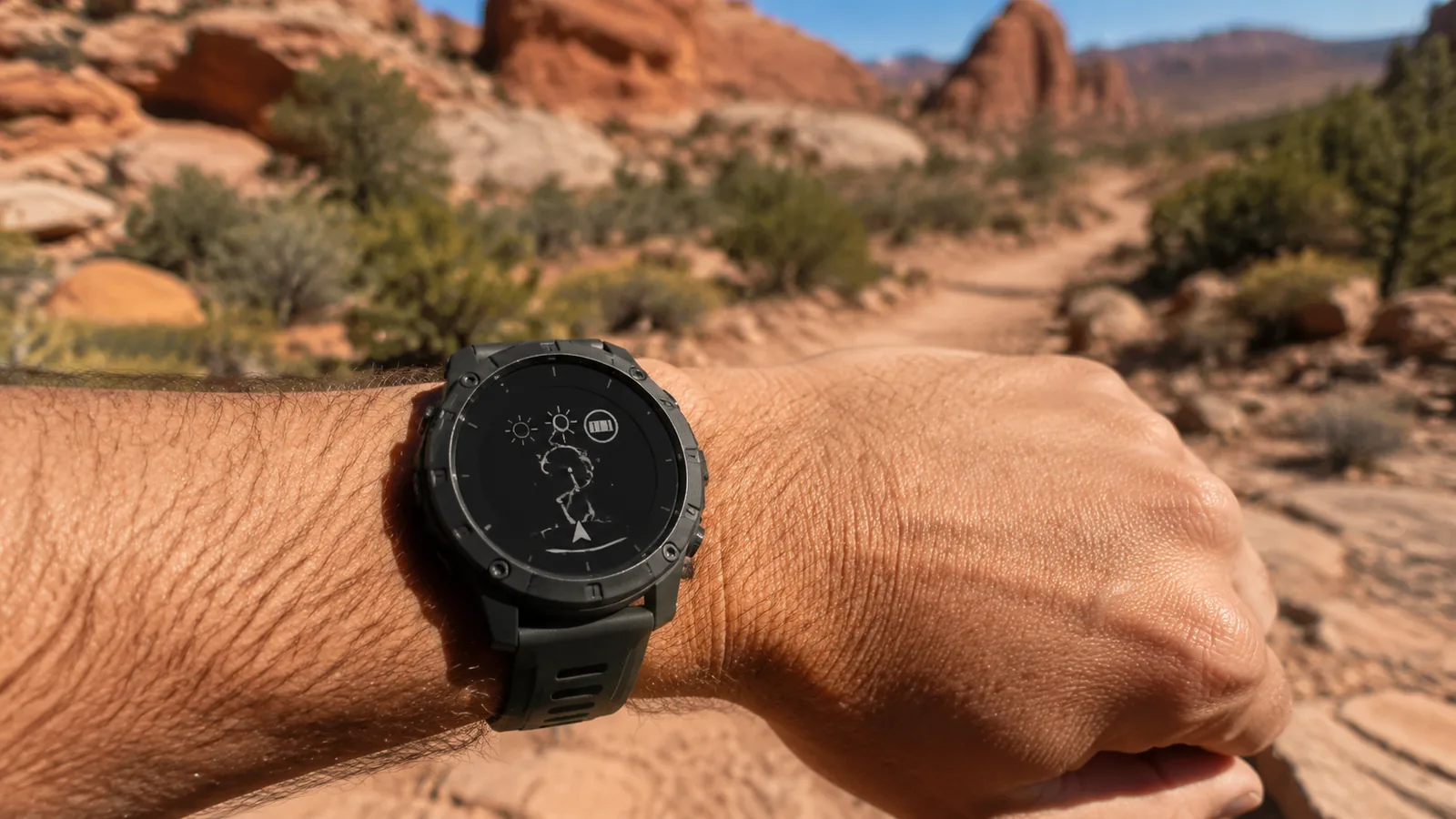
Navigation relies on breadcrumb routes rather than full topographic maps. You can follow a GPX course, mark waypoints and use the TracBack feature to retrace your path when lost. The watch lacks built‑in topo maps or turn‑by‑turn road navigation found on the Fēnix series; however, for many hikers and trail runners the breadcrumb line is sufficient and saves battery. CleverHiker notes that the Instinct 2 can upload routes but cannot download detailed maps; navigation is mainly a simple line with directional promptscleverhiker.com.
An intriguing addition is Garmin’s polygon area calculator—a tool that calculates the area of irregular shapes by walking their perimeter, useful for measuring farmland or campsites. Mountain bikers will appreciate that Grit & Flow scores measure how hard they ride (grit) and how smoothly they descend (flow), features previously exclusive to Garmin’s top modelsboundlessmag.com.
Connectivity and smart features
While the Instinct 2 remains a fitness watch first, Garmin added several smartwatch conveniences. Smart notifications mirror calls, texts and app alerts from Android and iOS, though you cannot reply directly from the watch. The Solar and Dēzl models include Garmin Pay for contactless payments using the near‑field communication (NFC) chip. Users can customise the watch face, download data fields, and install third‑party apps via Garmin’s Connect IQ storedcrainmaker.com. The watch pairs with cycling power meters, smart trainers and Bluetooth sensors and can broadcast its heart rate to gym equipment. Garmin also introduced phone configuration so you can adjust data screens and sports settings from your smartphone rather than navigating menus on the watch itself.
Battery life and solar performance
Battery life is the headline feature of the Instinct 2 Solar. Garmin’s official specifications promise an astonishing 28 days of smartwatch use — or unlimited power when exposed to at least 3 hours of 50 k lux sunlight per daydcrainmaker.com. In battery saver mode, which disables sensors and reduces update frequency, the watch can last 65 days or unlimited with solar. GPS modes vary: 30 hours (48 hours with solar) in standard GPS recording, 70 hours (370 hours with solar) in Max Battery GPS, and 32 days/unlimited in Expedition GPS. These numbers are unmatched by most competitors and highlight the efficiency of the MIP display and solar technology.
Garmin’s solar cells are integrated into the Power Glass lens and the bezel. The watch features a solar intensity widget showing the current energy harvesting level, allowing you to optimise strap orientation. According to DC Rainmaker, three hours of 50 k lux sunlight provide enough energy to offset a day of smartwatch use, or to gain about one hour of GPS recording. However, real‑world conditions rarely deliver consistent high‑lux light, so unlimited battery life is aspirational for most users.
Real‑world battery experiences
In practice, testers report impressive but not infinite runtimes. Laptop Mag wore the Instinct 2 Solar from May 17 to early June (about three weeks) with minimal solar exposure, yet the watch still had seven days of battery leftlaptopmag.com. The reviewer emphasised that achieving unlimited battery requires three hours of bright sunlight daily; city dwellers may rarely hit this target, but the watch still lasts weeks between charges. The Guardian found the watch lasted around 15 days under typical indoor use with occasional sunlighttheguardian.com. CleverHiker noted that GPS battery life is about 30 hours, extended to 48 hours with solar when conditions are goodcleverhiker.com. These experiences show that while solar charging significantly reduces the need to plug in, it is not truly unlimited under average conditions.
Durability and ruggedness
The Instinct 2 Solar’s durability sets it apart from typical smartwatches. The fiber‑reinforced polymer case resists scratches and impacts, and the watch’s bezel guards and raised edges protect the lens. The watch passes MIL‑STD‑810 environmental tests and is rated for -20 °C to +45 °C operating temperature. The 10 ATM water rating allows swimming and shallow divingwww8.garmin.com. This rugged build makes the Instinct 2 ideal for climbing, military training, kayaking and construction work. The Garmin tactix 7 review on FrediTech highlights similar resilience and notes that MIL‑STD‑810 compliance and 10 ATM water‑resistance enable watches to survive 31‑day mission‑ready battery livesfreditech.com, emphasising Garmin’s commitment to durability across its outdoor range.
Comparing the Instinct 2 Solar to other watches
Garmin offers several rugged watches at different price points. Compared to the Fēnix 7/7X Solar (US$699 and up), the Instinct 2 Solar is more affordable (around US$449), lighter (53 g vs roughly 73 g) and offers longer battery life thanks to its low‑power MIP screen. However, the Fēnix series includes colour mapping, music storage and a richer feature set. The Suunto 9 Peak Pro offers a stylish titanium design and colour display with similar GPS battery life, but it cannot match the Instinct’s solar longevity and costs more. Coros Apex Pro 2 is a strong competitor, offering a 47 mm case with dual‑frequency GPS and 75‑hour GPS battery life at a comparable price; yet it lacks Garmin Pay and has fewer third‑party apps. For users who prioritise solar charging and military‑grade ruggedness, the Instinct 2 Solar remains unique.
Pricing and variants
The Instinct 2 series comes in numerous versions: the standard Instinct 2 (45 mm), the compact Instinct 2S (40 mm), Solar and non‑Solar models, and themed editions such as Surf (with surfline tide data), Camo, Tactical (night‑vision compatibility and stealth mode) and Dēzl (trucker‑focused). Base non‑solar models start around US$349, while Solar models cost around US$449dcrainmaker.com. Surf, Tactical and Camo editions add US$50, and the Dēzl variant is priced similarly to the solar versions. Garmin occasionally discounts the watch, and retailers like REI and Amazon often offer special pricing. If you do not need solar charging, the standard Instinct 2 still boasts excellent battery life (up to 28 days) at a lower cost.
Step‑by‑step setup and first use
- Unboxing and charging – Open the box and remove the watch, charging cable and manuals. Attach the proprietary USB charger to the four gold contact points on the back; charge until the battery indicator is full (about 2 hours). It’s best to perform the initial charge outdoors to allow the solar cell to start generating power.
- Install Garmin Connect – Download the Garmin Connect app (iOS/Android), create or sign into your Garmin account, and enable Bluetooth.
- Pair the watch – Power on the watch by pressing the Light button. Open Garmin Connect, choose Add Device, and select Instinct 2 Solar. Follow on‑screen prompts to complete pairing.
- Update firmware – Garmin frequently releases firmware updates that improve battery life and add features. During setup, accept any updates offered.
- Select watch face and widgets – Use the Up/Down buttons to scroll through watch faces. Hold Menu, choose Watch Face, and customise colours and data fields. Install additional watch faces and data fields through the Connect IQ app.
- Configure activities – Press GPS to access activity profiles (e.g., run, bike, hike). Hold Menu within an activity to customise data screens, lap settings and alerts. On your phone, you can reconfigure data pages via the phone configuration featuredcrainmaker.com.
- Enable Garmin Pay (Solar models only) – In Garmin Connect, tap Garmin Pay, select your bank, and add your card details. On the watch, hold Menu and access the Wallet widget to pay at contactless terminals.
- Set up safety features – In the app, enable Incident Detection and LiveTrack so your emergency contacts receive alerts if the watch detects a crash or falllaptopmag.com.
- Optimise solar charging – Open the Solar Intensity widget on the watch to see how much sunlight the watch receives. The graph displays the last 6 hours of solar exposure. Align the watch strap to maximise sunlight on the bezel during outdoor activities. Remember that 3 hours of 50 k lux sunlight per day is required to achieve unlimited battery lifedcrainmaker.com.
Real‑world use cases
Long‑distance backpacking
Imagine you’re hiking a section of the Appalachian Trail for ten days. You need reliable navigation, weather data and health monitoring, but you’re carrying limited power banks. The Instinct 2 Solar’s Expedition GPS mode reduces update frequency and disables Pulse Ox to achieve up to 32 days of GPS tracking or unlimited with solar. Set the watch to battery saver for downtime at camp; use the barometer to track weather changes; and rely on the compass and breadcrumb route to stay on the trail. With good sunlight, you can finish your trek without recharging.
Mountain biking with grit and flow
For mountain bikers, Garmin’s Grit & Flow metrics score the difficulty of your ride and how smoothly you handle descents. During a downhill run, the watch calculates grit based on elevation and speed changes and flow from your smoothness and braking. Post‑ride, you can analyse your performance in Garmin Connect to see where you lost momentum or improved your techniqueboundlessmag.com. Combined with the MTB Dynamics sensor and Garmin’s Edge head unit, the Instinct 2 Solar becomes a comprehensive training tool.
Marathon training and triathlons
Runners and triathletes will appreciate daily suggested workouts, VO₂ Max estimates, PacePro pacing strategies and recovery time recommendations. For marathon training, set a race distance and target finish time in Garmin Connect; the watch creates a PacePro plan that guides you on each segment. Triathletes can enable the Multisport profile to seamlessly switch between swim, bike and run, capturing splits automatically. Because the Instinct 2 supports heart‑rate broadcasting, you can pair it with a chest strap for more accurate heart‑rate data during races. When training in remote areas, use the TracBack feature to return to your starting point.
Everyday health monitoring
Beyond adventures, the Instinct 2 Solar functions as a daily health tracker. It continuously measures heart rate, stress and respiration; logs sleep stages; and provides a Body Battery score. You can log hydration, track menstrual cycles and monitor pregnancy status. The watch delivers smartphone notifications and weather updates, and you can pay at coffee shops using Garmin Pay. Office workers will appreciate a device that requires charging only every few weeks, not daily.
Pros and cons
Pros | Cons |
Extremely long battery life with solar; potentially unlimited with sufficient sunlight | Solar unlimited claim depends on 3 hours of strong sunlight daily |
Rugged MIL‑STD‑810 construction & 10 ATM water ratingwww8.garmin.com | Monochrome display and small screen may feel dated compared to AMOLED rivals |
Wide range of sports profiles with advanced metrics (Grit & Flow, VO₂ Max, Daily Suggested Workouts) | No full colour maps or offline music storage (breadcrumb navigation only) |
Comfortable, lightweight design with QuickFit straps and multiple sizesdcrainmaker.com | Requires Garmin Pay–supported bank; cannot reply to smartphone notifications |
Comprehensive health tracking including heart rate, Pulse Ox, sleep, stress and Body Batteryboundlessmag.com | Price may approach higher‑end watches when adding special editions |
Who should buy the Instinct 2 Solar?
- Backpackers and adventurers who prioritise battery life and ruggedness over premium displays. The Instinct 2 Solar’s long battery life and robust construction make it ideal for long expeditions, mountaineering, hunting or military use.
- Athletes and multisport enthusiasts who want an affordable training watch with advanced metrics like VO₂ Max, Grit & Flow and PacePro but don’t need colour maps or music.
- Outdoor workers such as field researchers, park rangers and construction workers who need reliable ABC sensors, weather tracking and long battery life.
- Everyday users seeking a durable smartwatch that offers notifications, heart‑rate monitoring and contactless payments without frequent charging.
You might prefer a different watch if you prioritise a high‑resolution colour display, full mapping, offline music or a more elegant design. In those cases the Garmin Fēnix 7/8 or the Suunto 9 Peak Pro may be better choices, albeit at higher prices.
Frequently asked questions
What does “unlimited” battery life really mean?
Garmin claims the Instinct 2 Solar can deliver unlimited battery life in certain modes because the solar panels continuously charge the battery. In reality, unlimited life requires three hours of 50 k lux sunlight dailydcrainmaker.com. Under typical indoor conditions, the watch still lasts several weeks (about 15–21 days) between chargestheguardian.comlaptopmag.com.
Can you use the Garmin Instinct 2 for navigation without maps?
Yes. The Instinct 2 supports breadcrumb navigation: you can load GPX routes, follow a line on the screen and mark waypoints. The TracBack feature can guide you back to your starting point. However, the watch does not display full maps, so you’ll need to rely on the breadcrumb line or pair with a smartphone for detailed mapscleverhiker.com.
Does the watch support music or offline podcasts?
No. The Instinct 2 series does not have onboard music storage or offline streaming. You can control music playing on your phone via Bluetooth, but you must carry your smartphone. For offline music, consider models like the Garmin Fēnix 7 or Forerunner 955.
How accurate is the heart-rate and GPS tracking?
The Instinct 2 Solar uses Garmin’s Elevate Gen 4 sensor and multi‑GNSS tracking. Tests show heart‑rate readings are within ±0.39 beats per minute and GPS deviation is about ±0.11 miles over 2.8 milesoutdoorgearlab.com. While it lacks multiband GPS, the accuracy is sufficient for most recreational activities.
Is the Instinct 2 Solar suitable for swimming and diving?
Yes. The watch has a 10 ATM water rating (up to 100 m)www8.garmin.com, making it suitable for pool swims, open‑water swimming and shallow snorkeling. It supports swim metrics like stroke count and SWOLF but is not recommended for scuba diving.
Does the Instinct 2 Solar include Garmin Pay?
Yes. Garmin Pay is available on Solar and Dēzl models. Add your credit or debit card via Garmin Connect and pay at contactless terminals by holding the CTRL or Menu button to access the walletdcrainmaker.com.
How does the Instinct 2 Solar compare to the Instinct 2 (non-solar)?
Both watches share most features, but the non-solar Instinct 2 has shorter battery life—about 28 days in smartwatch mode and 30 hours of GPS. The Solar version’s Power Glass lens extends battery life and adds Garmin Pay. If you rarely spend time outdoors, the standard Instinct 2 can save about US$100.
Can you replace the battery or service the watch?
No. The battery is not user-replaceable. Garmin offers official service options if battery capacity degrades over time. Because the watch uses a sealed, water-resistant design, opening it yourself will void the water rating.
Conclusion
Garmin’s Instinct 2 Solar is a compelling choice for adventurers who value battery life and ruggedness over flashy displays and multimedia features. The combination of a tough polymer case, solar‑charging Power Glass lens and transflective display yields weeks of battery life and potentially unlimited runtime with ample sunlight. Garmin enhanced the original Instinct by adding a higher‑resolution display, contactless payments, advanced sport profiles and comprehensive health tracking. Although the watch lacks full mapping and music storage, its breadth of sensors, multisport capabilities and affordable pricing make it a versatile companion for hikers, cyclists, triathletes, outdoor workers and everyday users.
If you can overlook the monochrome display and are willing to spend time outdoors to harness its solar capabilities, the Garmin Instinct 2 Solar delivers a durable and reliable smartwatch that may never need to see a charging cable again.
Author
Wiredu Fred – Senior Technology Journalist & Reviewer
Wiredu Fred is a veteran technology journalist and hardware reviewer with more than a decade of experience testing laptops, wearables and consumer electronics. He contributes to multiple independent tech magazines and follows emerging trends so he can demystify complex products for readers. His hands‑on experience building PCs and reviewing smartwatches gives him authority to evaluate rugged outdoor devices like the Garmin Instinct 2 Solar.